
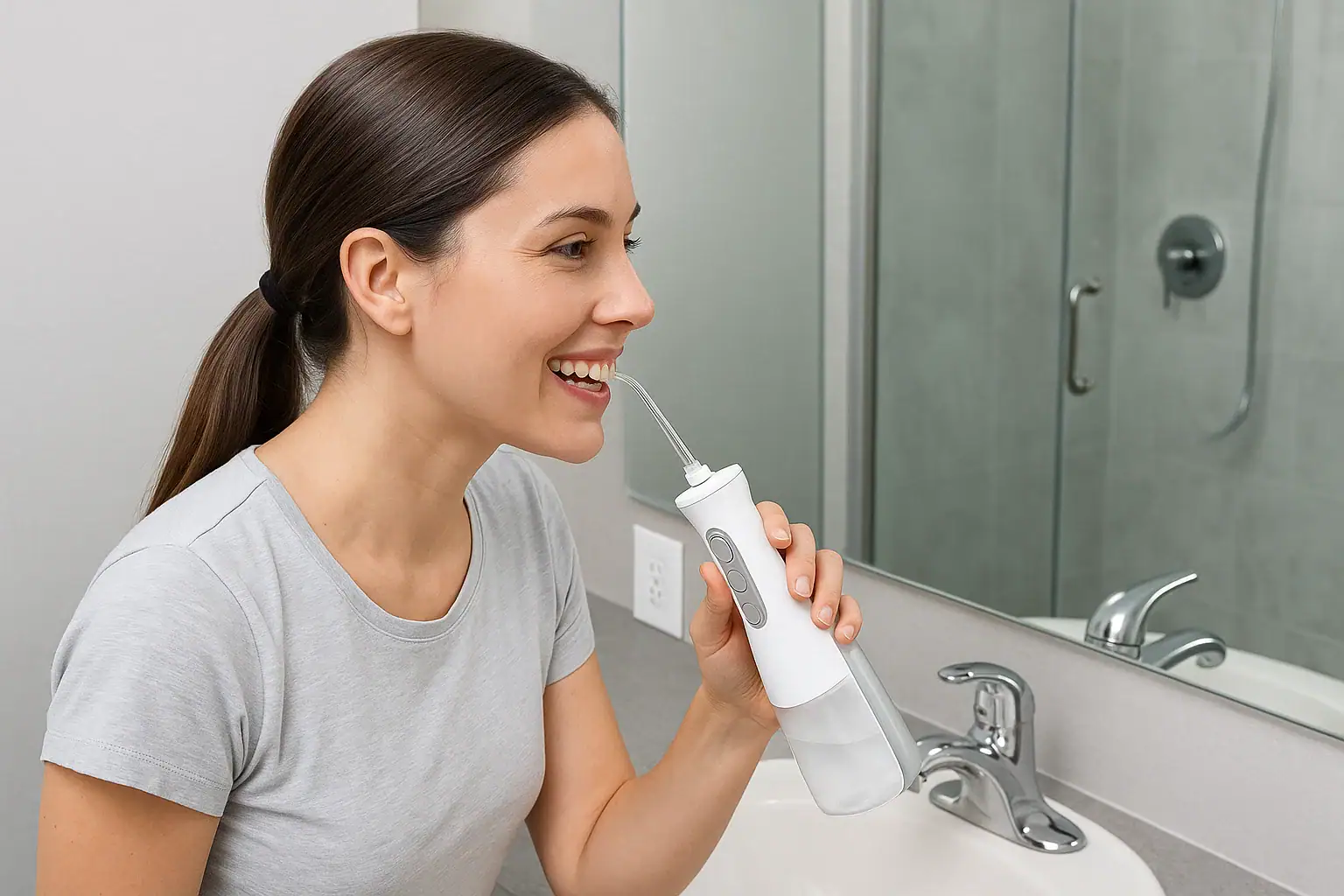
A Waterpik is a water flosser, and the technique is fixed: fill the reservoir with warm water, set the pressure low, put the tip in your mouth before switching the unit on, then trace the gumline at about 90 degrees, pausing between teeth. A full session empties the reservoir in roughly one to two minutes, once a day. In a 28-day randomised trial of 105 subjects, daily irrigation added to manual or sonic brushing reduced the bleeding index significantly more than brushing plus string floss at both day 14 and day 28 (PubMed 16305005). Tips are replaced every three to six months.
- 01Sequence matters more than pressure: tip in the mouth first, then power on, leaning over the sink and working back to front for one to two minutes.
- 02Bleeding is the outcome with the clearest data. Across 105 randomised subjects over 28 days, both irrigation groups beat brushing plus floss on the bleeding index at day 14 and day 28, while plaque differences were smaller and inconsistent (PubMed 16305005).
- 03In orthodontic patients the two methods land close together: in a 30-patient randomised trial over 14 days, water jet flossing held a non-significant 6.79% median advantage in plaque removal over interdental floss (PubMed 38678246).
- 04Maintenance runs on a schedule: replace tips every three to six months, clean the reservoir weekly, and clear mineral build-up with diluted white vinegar about once a month.
- 05Children from age six can use one under supervision, on a low pressure setting and with a child-sized or orthodontic tip.
/ Introduction: The Power of Water Flossing and Waterpik Basics
Brushing your teeth twice a day is essential but it’s not enough. Traditional flossing can be tedious or difficult for many, leading to incomplete oral hygiene. That’s where Waterpik water flossers come in.
Water flossers use a stream of pulsating water to remove food debris and plaque between teeth and along the gumline. They are especially helpful for people with braces, implants, crowns, or sensitive gums.
What Is a Waterpik and Why Use One?
A Waterpik is a brand of water flosser, a device designed to replace or supplement traditional string floss. It delivers a pressurized stream of water that gently removes plaque and food particles from hard to reach areas.
Benefits of Using a Waterpik
- Easy to use for people with limited dexterity
- Reaches deep into periodontal pockets
- Reduces gingivitis and bleeding gums
- More effective around braces and dental implants
- Fast, with little to no discomfort
Did You Know? The American Dental Association (ADA) has given its Seal of Acceptance to several Waterpik models.
Understanding the Parts of a Waterpik
- Reservoir – Holds the water or mouthwash
- Flosser Tip – The nozzle from which water is emitted
- Pressure Control – Adjusts water pressure
- On/Off Switch – Controls flow
- Tip Eject Button – For replacing tips
/ How to Use a Waterpik Properly, Time It, and Avoid Mistakes
How to Properly Use a Waterpik: Step-by-Step
- Fill the Reservoir with warm water or an ADA-approved mouthwash
- Choose a Tip that matches your dental needs (classic, orthodontic, plaque seeker, etc.)
- Adjust Pressure Settings – start low, increase gradually
- Lean Over the Sink – prevents splashing
- Place Tip in Mouth Before Powering On
- Floss Along the Gumline at a 90° angle, pausing between teeth
- Turn Off and Clean the unit after use
How to Use a Waterpik Without Making a Mess
- Always lean over the sink
- Keep your lips slightly closed
- Use warm water
- Turn it on only after the tip is inside your mouth
- Consider using it in the shower if splashing is a concern
How Often Should You Use a Waterpik?
Once per day is ideal. For people with braces or periodontal disease, twice daily use may be recommended.
Is It Better to Use a Waterpik Before or After Brushing?
Waterpik should be used before brushing. It loosens debris and allows fluoride toothpaste to work more effectively afterward.
How Long Should You Use a Waterpik?
A complete session usually lasts 1 to 2 minutes. Most Waterpiks are designed to empty the reservoir in this timeframe.
Common Mistakes to Avoid
- Turning on the device before placing it in your mouth
- Holding the tip too far from the gumline
- Forgetting to clean the tip or reservoir
- Using cold water (can trigger sensitivity)
- Not adjusting the pressure
/ Waterpik Use Beyond the Basics
Waterpik vs. Traditional Floss
| Feature | Waterpik | Traditional Floss |
|---|---|---|
| Ease of Use | High | Moderate |
| Comfort | Gentle on gums | May cause bleeding |
| Reach | Deeper gum cleaning | Better for tight spaces |
| Best For | Braces, implants, gum disease | General plaque removal |
Using a Waterpik with Mouthwash: Is It Safe?
Yes, you can safely add alcohol-free mouthwash to the reservoir.
- Recommended ratio: 50% water, 50% mouthwash
- Helps with bad breath, bacteria control, and gum inflammation
- Avoid strong essential oil-based rinses without professional advice
Can Children Use a Waterpik?
Children age 6 and up can use a Waterpik with supervision.
- Choose low-pressure settings
- Select child-friendly or orthodontic tips
- Especially helpful for kids with braces or retainers
Waterpik for Special Conditions: Gum Disease, Implants & Crowns
Waterpik is ideal for users with:
- Gum disease : Use the Pik Pocket Tip to reach deep periodontal pockets
- Dental implants or crowns: Use the Plaque Seeker Tip to clean around restorations
- Bridges and braces: Orthodontic tip removes food particles efficiently
Travel-Friendly Options: Portable Waterpiks
If you're traveling, opt for a cordless Waterpik.
- Rechargeable with USB
- Compact and spill-proof
- Maintains oral hygiene routine on the go
Models like the Waterpik Cordless Advanced are TSA-compliant and easy to carry.
How to Replace and Maintain Waterpik Tips
- Replace tips every 3 to 6 months depending on use
- Clean weekly with warm soapy water or vinegar solution
- Remove mineral buildup with diluted white vinegar once a month
- Store in a dry place to avoid bacterial contamination
Waterpik vs. Other Water Flossers: Which One Should You Choose?
| Feature | Waterpik | Sonicare AirFloss |
|---|---|---|
| Pressure Range | Adjustable | Fixed |
| Tip Options | Multiple | Limited |
| Portability | Both portable & countertop | Mostly portable |
| Effectiveness | High for deep pockets | Moderate for daily use |
| ADA Seal | ✅ | ❌ |
What Dentists Say About Waterpik Use
Many dentists recommend Waterpik as a supplement to string floss, especially for:
- Orthodontic patients
- Patients with implants or those undergoing periodontal therapy
- Those who struggle with manual dexterity
/ FAQ: How to Use a Waterpik
Q: How to use a Waterpik flosser for the first time?
A: Use warm water, start at a low setting, lean over the sink, and work from back to front teeth.
Q: Can you use a Waterpik without making a mess?
A: Yes. Lean forward, close lips loosely, and turn it on after placing the tip in your mouth.
Q: Can I use a Waterpik if I have braces?
A: Absolutely. The orthodontic tip is designed to clean around brackets and wires.
Q: Is it safe for people with sensitive gums?
A: Yes. In fact, it’s gentler than floss and helps reduce inflammation with regular use.
Q: How often should the tips be changed?
A: Every 3 to 6 months, or sooner if frayed, clogged, or discolored.
Conclusion: Make Water Flossing a Lifelong Habit
By learning how to properly use a Waterpik, you’re taking an important step toward healthier gums and a brighter smile. Whether you’re looking to reduce gum inflammation, protect your dental implants, or just want an easier flossing alternative, Waterpik is a reliable and effective tool.
And now that you know how to use a Waterpik flosser, how to use it without making a mess, and how to maintain it, it’s time to make water flossing a daily habit. Your gums will thank you.
Let’s plan the right treatment together.
Free Assessment→- 1.Barnes CM, Russell CM, Reinhardt RA, Payne JB, Lyle DM. Comparison of irrigation to floss as an adjunct to tooth brushing: effect on bleeding, gingivitis, and supragingival plaque. J Clin Dent 2005;16:71-7. PubMed 16305005
- 2.AlMoharib HS, Alqasem A, Almusfer G, Aldosari MA, Almadhoon HW. The effectiveness of water jet flossing and interdental flossing for oral hygiene in orthodontic patients with fixed appliances: a randomized clinical trial. BMC Oral Health 2024;24:498. PubMed 38678246