
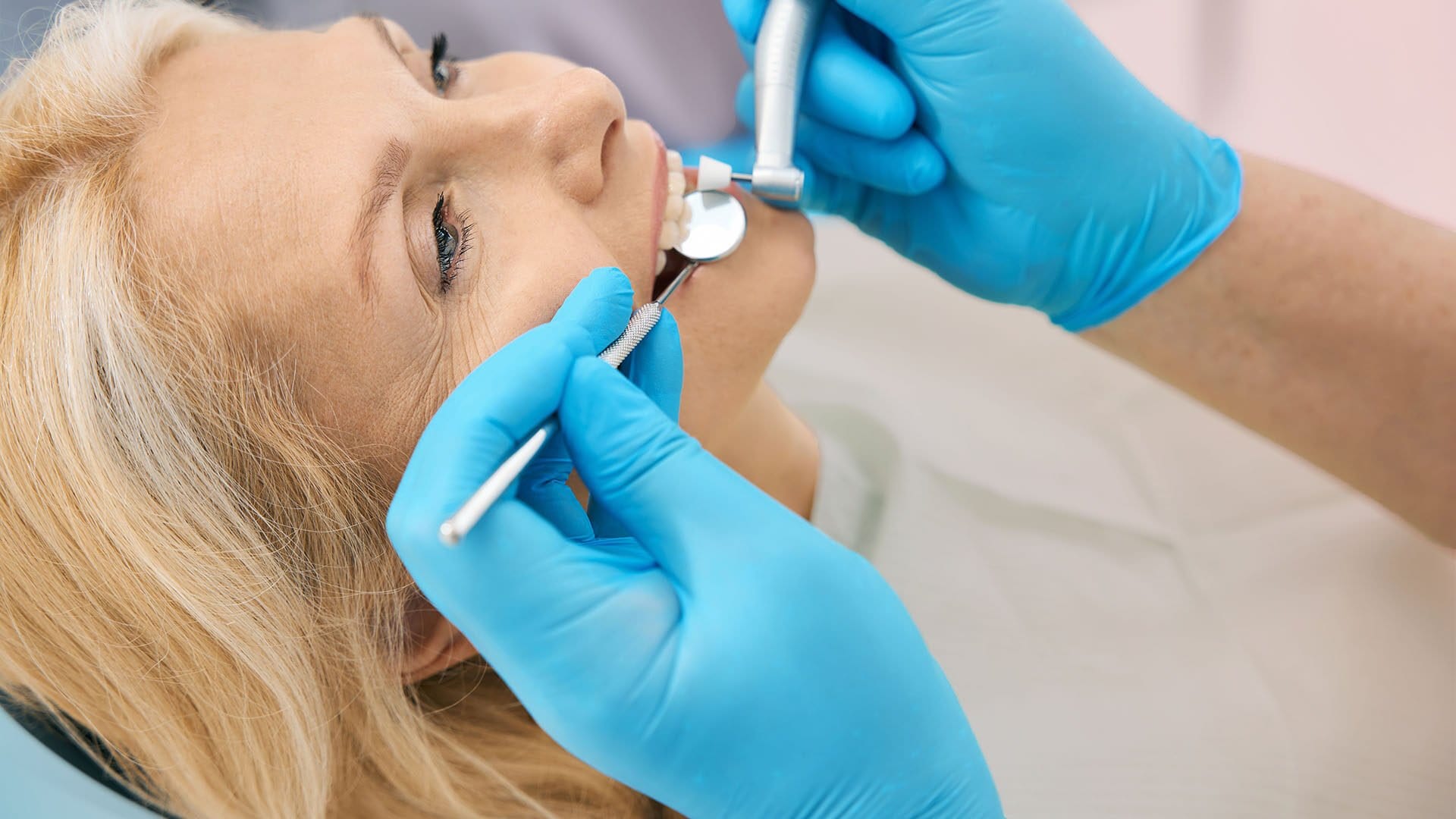
Dental scaling is the professional removal of mineralised plaque, meaning calculus, from crown and root surfaces using ultrasonic and hand instruments, usually followed by polishing; the combined procedure is called a scale and polish. It is neither a whitening treatment nor a replacement for daily cleaning. In Cochrane's pooled data from 1,711 regularly attending adults without severe periodontitis, six-monthly scale and polish reduced calculus against no scheduled treatment (standardised mean difference -0.32, 95% CI -0.44 to -0.20) while gingivitis and probing depths changed little or not at all over two to three years (PubMed 30590875).
- 01The procedure has a fixed sequence: examination, ultrasonic instrumentation to break up deposits, hand instruments for what remains, polishing to smooth the surface, and fluoride application where indicated.
- 02Measured effect on calculus, against no scheduled treatment: standardised mean difference -0.32 (95% CI -0.44 to -0.20) at six-monthly intervals and -0.19 (95% CI -0.31 to -0.07) at twelve-monthly, high-certainty evidence from 1,711 participants (PubMed 30590875).
- 03Neither of the two trials in that review measured adverse effects, attachment level change, tooth loss or halitosis, so claims about scaling harming teeth have no trial data behind them in either direction (PubMed 30590875).
- 04Interdental cleaning is the half you control: flossing added to brushing may reduce gingivitis at one month (standardised mean difference -0.58, 95% CI -1.12 to -0.04; 8 trials, 585 participants), at low certainty (PubMed 30968949).
- 05Interdental brushes showed the largest plaque effect in the same Cochrane review (standardised mean difference -1.07, 95% CI -1.51 to -0.63; 2 trials, 93 participants), while oral irrigators did not reduce plaque more than brushing alone (PubMed 30968949).
Dental health is an important part of our overall health. Dental tartar cleaning is of great importance for a healthy and aesthetic smile . Dental cleaning that is not done regularly can lead to tartar formation and long-term serious gum problems. In this article, we will discuss all the necessary details about dental tartar cleaning.
What is Tartar?
Tartar is plaque that accumulates on the surface of the teeth and at the gum line and hardens over time. Plaque is formed by the combination of food residue and bacteria. If plaque is not cleaned regularly, it hardens with the minerals in the saliva and becomes tartar.
Tartar not only causes an aesthetically bad appearance, but can also cause serious problems that can lead to gum disease and tooth loss. Therefore, tartar cleaning is of great importance for the protection of oral and dental health.
/ Tartar Formation, Dental Scaling and Cleaning Process
How Does Tartar Form?
Tartar formation occurs in several stages:
- Plaque Formation: Bacteria that accumulate on the surface of the teeth after eating cause the formation of dental plaque. If regular brushing is not done, plaque accumulates quickly.
- Plaque Hardening: Plaques harden by combining with minerals in saliva and turn into tartar over time.
- More Accumulation: Uncleaned tartar causes more plaque accumulation, negatively affecting oral health.
Factors that accelerate tartar formation include smoking, excessive tea and coffee consumption, inadequate oral hygiene and excessive consumption of sugary foods.
What is Dental Scaling?
Dental scaling is the professional cleaning of hardened plaque and tartar that accumulates on the surface of the teeth and at the gum line . This process is performed by dentists and helps protect oral health.
If dental scaling is not done regularly, it can lead to inflammation of the gums, gum recession and serious periodontal diseases. Therefore, it is recommended to have dental scaling done at least once a year.
How is tartar cleaning done?
Tartar cleaning is done by dentists using professional equipment. The process consists of the following stages:
- Examination: First, the dentist checks your gum health and tartar formation.
- Use of Ultrasonic Devices: Ultrasonic vibration devices are used to clean tartar. These devices break down the tartar and remove it from the tooth surface.
- Use of Hand Tools: Remaining small tartar is scraped off with special hand tools.
- Polishing: Tooth surfaces are smoothed and polished with a special paste. This process delays the formation of new plaque and tartar.
- Fluoride Application: Fluoride can be applied to strengthen tooth enamel. This helps prevent cavities.
- Oral Hygiene Recommendations: The dentist helps prevent tartar formation by providing regular care recommendations to the patient.
/ Maintaining Results After Dental Tartar Cleaning
Things to Consider After Tartar Cleaning
Some sensitivity may be experienced after tartar cleaning. However, this is temporary. Things to consider after the procedure are as follows:
- Avoid extremely hot and cold foods for the first 24 hours.
- Limit smoking, alcohol and caffeine consumption.
- Brush your teeth regularly and floss.
- Maintain oral hygiene by using mouthwash.
- There may be slight bleeding from the gums after the procedure, but this will pass in a short time.
Advantages of Dental Scaling
There are many advantages to having regular dental scaling:
- Healthier Gums: Helps prevent gum disease.
- Whiter Teeth: Cleans stains on the surface of your teeth, providing a brighter smile.
- Fresher Breath: Prevents bad breath.
- Longer-Lasting Teeth: Prevents tooth loss and maintains a healthy oral structure.
- Protecting General Health: Oral health is directly related to general body health.
How Often Should You Clean Your Teeth?
The rate at which tartar forms can vary from person to person. In general, dentists recommend professional dental cleanings once or twice a year. However, more frequent cleanings may be necessary in the following cases:
- People who smoke and consume a lot of coffee
- People with a history of gum disease
- People who frequently consume sugary and acidic foods
- Individuals who use braces
How to Prevent Tartar Formation?
You can take the following precautions to prevent tartar formation:
- Regular Teeth Brushing: Brushing should be done at least twice a day with fluoride toothpaste.
- Using Dental Floss: Flossing prevents tartar formation by cleaning plaque that accumulates between teeth.
- Using Mouthwash: Antiseptic mouthwashes protect gum health by preventing the growth of bacteria.
- Healthy Diet: Tartar formation can be minimized by avoiding sugary and acidic foods.
- Regular Dentist Checkups: You should visit your dentist every 6 months to have your oral health checked.
/ Frequently Asked Questions
- Is tartar removal painful?
No. Tartar removal generally causes little to no discomfort. There may be slight sensitivity, but this is temporary.
- Does tartar removal damage tooth enamel?
No, professionally performed tartar removal does not damage tooth enamel. On the contrary, it makes teeth healthier.
- What should be considered after tartar removal?
Extremely hot and cold foods should be avoided for the first 24 hours, and smoking and caffeine consumption should be limited.
- Can tartar be removed at home?
Plaque formation can be prevented by brushing and flossing at home, but professional help is necessary to remove hardened tartar.
Let’s plan the right treatment together.
Free Assessment→- 1.Lamont T, Worthington HV, Clarkson JE, Beirne PV. Routine scale and polish for periodontal health in adults. Cochrane Database Syst Rev 2018;12:CD004625. PubMed 30590875
- 2.Worthington HV, MacDonald L, Poklepovic Pericic T, Sambunjak D, Johnson TM, Imai P, et al. Home use of interdental cleaning devices, in addition to toothbrushing, for preventing and controlling periodontal diseases and dental caries. Cochrane Database Syst Rev 2019;4:CD012018. PubMed 30968949