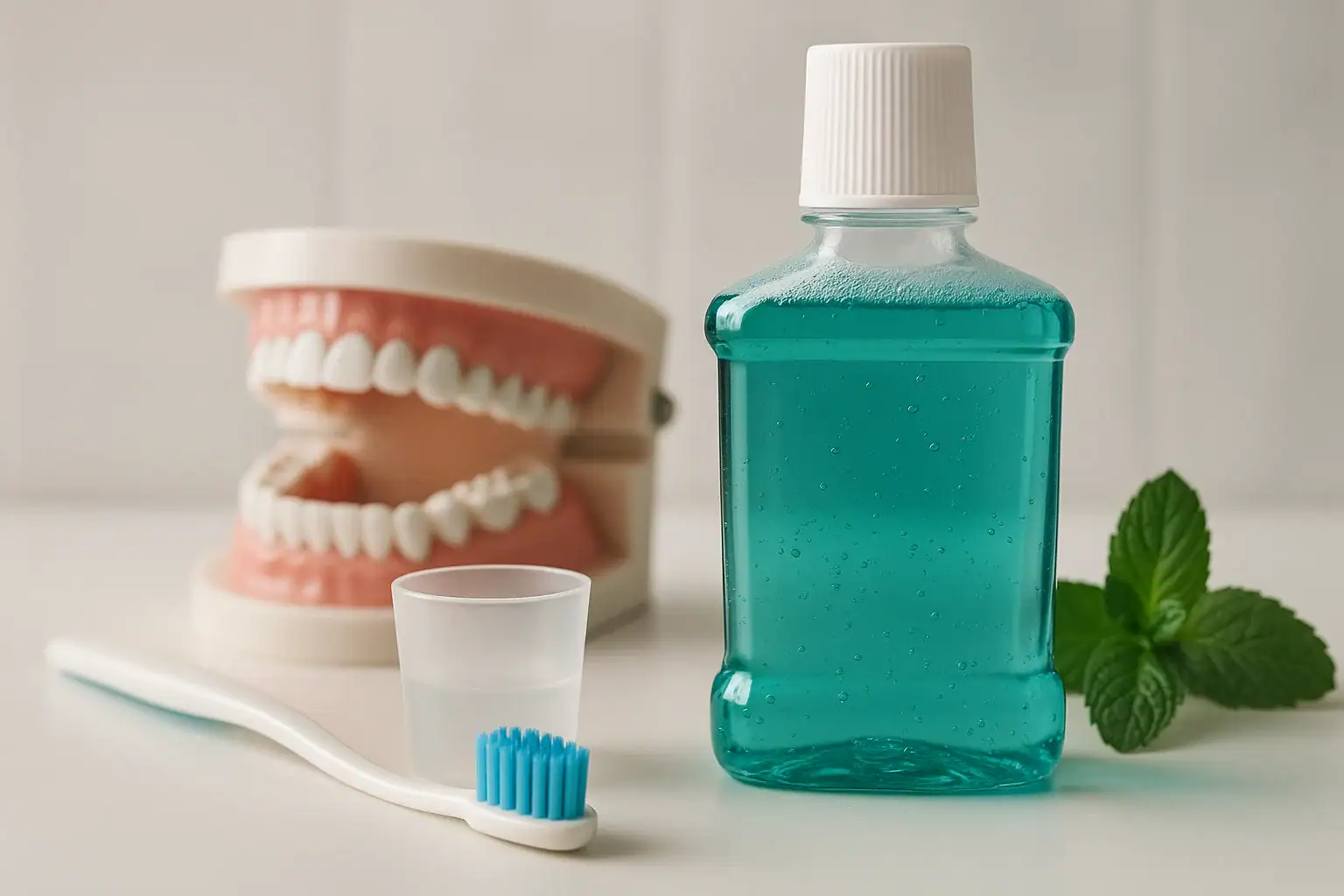
Antibacterial mouthwash is a rinse carrying an agent that kills or suppresses oral bacteria, usually chlorhexidine, cetylpyridinium chloride or essential oils, used after brushing and swished for 30 to 60 seconds. It is an adjunct to mechanical cleaning, never a replacement for it. Chlorhexidine has the strongest data and the clearest cost: across 12 trials with 950 participants analysed, plaque fell by a standardised mean difference of 1.45, while eight trials with 415 participants showed a large increase in extrinsic tooth staining after four to six weeks (PubMed 28362061). That trade-off is why long chlorhexidine courses stay under dental supervision.
- 01Chlorhexidine is an adjunct with a measured ceiling: high-quality evidence shows a large plaque reduction (SMD 1.45, 12 trials, 950 participants analysed) but a gingivitis reduction judged not clinically relevant in people with mild inflammation (PubMed 28362061).
- 02The staining is not anecdotal: extrinsic tooth staining rose by SMD 1.07 at four to six weeks across eight trials with 415 participants, and stayed raised at six months (PubMed 28362061).
- 03Concentration is not the lever. The same review found no evidence that one chlorhexidine concentration outperforms another, and insufficient data to separate once-daily from twice-daily rinsing (PubMed 28362061).
- 04Essential oil rinses carry strong supporting evidence for plaque and gingivitis control, while cetylpyridinium chloride evidence is weaker and less consistent across formulations (PubMed 20621242).
- 05Antiseptic is the wider term: antibacterial agents target bacteria, antiseptics also act on fungi and viruses, and a moisturising rinse for dry mouth is neither.
Maintaining oral hygiene involves more than just brushing and flossing. Antibacterial mouthwash is a powerful tool in the fight against plaque, gum disease, and bad breath. But what exactly is it, and how does it differ from other types of mouthwash?
/ Antibacterial Mouthwash Basics and Product Comparisons
What Is Antibacterial Mouthwash?
Antibacterial mouthwash is a liquid oral hygiene product formulated to kill or inhibit the growth of bacteria in the mouth. It's often recommended for individuals dealing with:
- Gingivitis
- Periodontal disease
- Bad breath (halitosis)
- Post-surgical oral care
Common active ingredients include chlorhexidine, cetylpyridinium chloride, and essential oils.
FAQ: What is antibacterial mouthwash? Answer: It’s a mouth rinse designed to reduce or eliminate bacteria that contribute to oral health issues.
How Does Antibacterial Mouthwash Work?
Antibacterial mouthwashes work by disrupting the bacterial cell membranes, thereby preventing their growth or killing them outright. Depending on the formulation, it may also reduce inflammation and help the healing of gum tissue.
Antibacterial vs. Antiseptic Mouthwash: What’s the Difference?
While often used interchangeably, these two types of mouthwash are not the same:
- Antibacterial: Targets bacteria specifically
- Antiseptic: Broader action, kills fungi and viruses too
Understanding this difference can help users choose the right product for their needs. Chlorhexidine and similar antiseptic rinses also appear among the topical treatments assessed in a BMJ Clinical Evidence systematic review of recurrent aphthous ulcers, alongside local painkillers, topical corticosteroids and a tetracycline mouthwash. Chlorhexidine and similar antiseptic rinses also appear among the topical treatments assessed in a BMJ Clinical Evidence systematic review of recurrent aphthous ulcers, alongside local painkillers, topical corticosteroids and a tetracycline mouthwash.
Common Uses of Antibacterial Mouthwash
- Daily oral hygiene support
- Managing gingivitis and periodontitis
- Reducing plaque and tartar buildup
- Aiding in post-surgical oral recovery
Best Antibacterial Mouthwash for Specific Needs
| Brand | Active Ingredient | Best For | Alcohol-Free |
|---|---|---|---|
| Listerine Total Care | Essential oils | General antibacterial use | No |
| Corsodyl | Chlorhexidine gluconate | Gum disease, gingivitis | Yes |
| Colgate Peroxyl | Hydrogen peroxide | Infections, minor irritation | Yes |
FAQ: What is the best antibacterial mouthwash? Answer: It depends on your needs. Listerine is good for general use, while Corsodyl is ideal for gum disease.
/ Safe Use of Antibacterial Mouthwash
Is Antibacterial Mouthwash Safe for Children?
Children aged 6 and above can use antibacterial mouthwash under adult supervision. Pediatric-specific versions are formulated with milder ingredients and less intense flavors.
Potential Side Effects and Considerations
- Altered taste sensation
- Staining of teeth (especially with chlorhexidine)
- Irritation of oral tissues
Avoid overuse and consult a dentist for long-term application.
When and How to Use Antibacterial Mouthwash
- After brushing and flossing
- Preferably before bed for overnight protection
- Swish for 30–60 seconds
- Avoid rinsing with water immediately after
Can You Build Resistance to Antibacterial Mouthwash?
While bacteria can adapt, true resistance is rare with mouthwash. Still, prolonged use of chlorhexidine is generally recommended only under dental supervision.
Should You Use Antibacterial Mouthwash Before or After Brushing?
Many people wonder when to use mouthwash in their routine. While practices may vary:
- Using it after brushing helps remove residual bacteria and debris.
- Avoid rinsing with water right after mouthwash to preserve its active effects.
- For chlorhexidine-based rinses, wait at least 30 minutes after brushing to avoid fluoride interaction.
Can Antibacterial Mouthwash Help with Bad Breath?
Yes, antibacterial mouthwash can significantly reduce halitosis by targeting odor-causing bacteria, especially those found on the back of the tongue and between teeth.
/ Long-Term Use of Antibacterial Mouthwash
Best Practices for Long-Term Use
- Cycle usage : Alternate with fluoride or moisturizing rinses if needed
- Check alcohol content : Alcohol-free versions are gentler for dry or sensitive mouths
- Monitor side effects : Such as staining or altered taste
- See your dentist regularly to adjust mouthwash use based on oral health status
Natural Alternatives with Antibacterial Properties
- Saltwater rinses : Simple and effective
- Tea tree oil : Antibacterial and anti-inflammatory
- Aloe vera rinses
- Coconut oil pulling
Additional FAQs
Is Biotene mouthwash antibacterial? Answer: No, it is primarily a moisturizing rinse for dry mouth and does not have antibacterial agents.
Is Listerine an antibacterial mouthwash? Answer: Yes, it contains essential oils with proven antibacterial properties.
Can I use antibacterial mouthwash every day? Answer: Most are safe for daily use, but consult your dentist for strong formulations like chlorhexidine.
Can mouthwash replace brushing? Answer: No. Brushing and flossing are irreplaceable parts of oral hygiene.
Antibacterial mouthwash is an excellent addition to a complete oral hygiene routine. By reducing harmful bacteria, it supports gum health, freshens breath, and helps prevent infections. However, it should be used as a complement not a substitute for brushing and flossing.
Consult your dental professional to choose the best mouthwash for your specific needs and enjoy a healthier, fresher smile every day.
Let’s plan the right treatment together.
Free Assessment→- 1.James P, Worthington HV, Parnell C, Harding M, Lamont T, Cheung A, et al. Chlorhexidine mouthrinse as an adjunctive treatment for gingival health. Cochrane Database Syst Rev 2017;3:CD008676. PubMed 28362061
- 2.Gunsolley JC. Clinical efficacy of antimicrobial mouthrinses. J Dent 2010;38 Suppl 1:S6-10. PubMed 20621242
- 3.Staines K, Greenwood M. Aphthous ulcers (recurrent). BMJ Clin Evid. 2015;2015:1303.