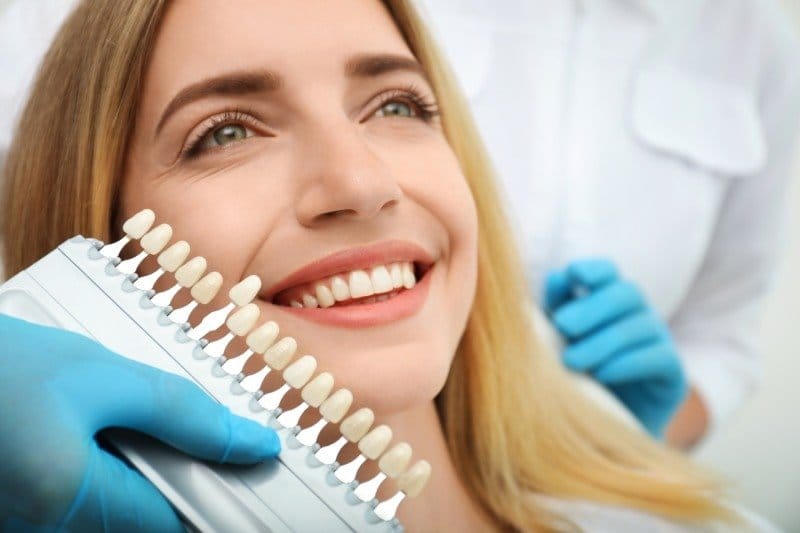
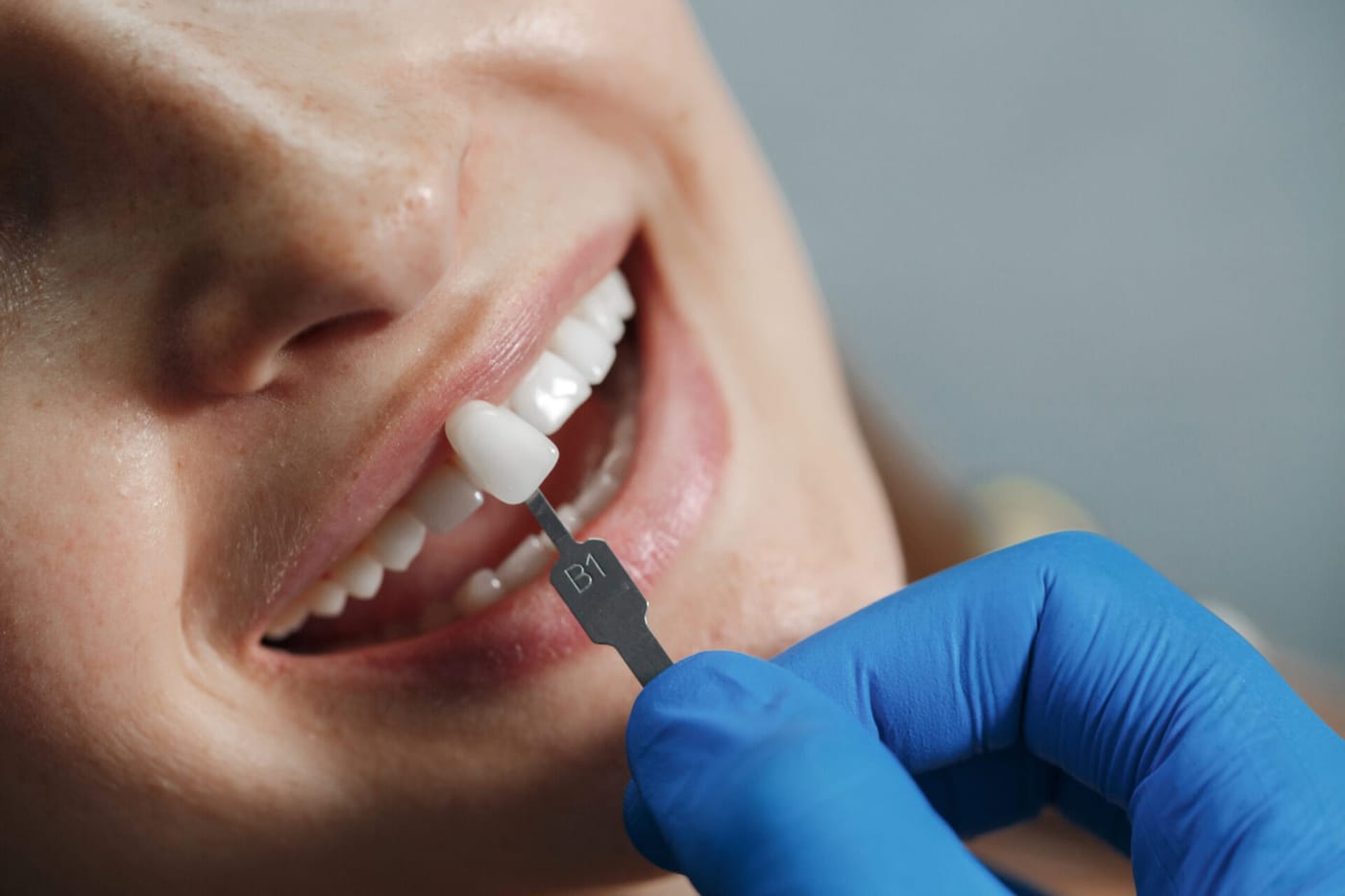
PFM stands for porcelain fused to metal, and in the clinical literature the same restoration is called a metal-ceramic crown. It is built in two layers: a cast or milled metal alloy coping that carries the chewing load, and dental porcelain fired over that coping in successive layers to give the tooth its colour. As a tooth-supported single crown, its five-year survival has been reported at 95.6% (PubMed 17594372), 94.7% (PubMed 25842099) and 97.1% (PubMed 41489982) across three independent systematic reviews spanning roughly twenty years, which makes it the crown type with the longest published track record. Its measured weaknesses are specific rather than general: it produces the highest antagonist enamel wear of the common ceramic systems (PubMed 38211687), and the metal coping is the source of the dark line that can appear at the gum margin over time. PFM is neither obsolete nor the answer to every case; it has defined indications.
- 01PFM means porcelain fused to metal, also written as a metal-ceramic crown. Three systematic reviews place its five-year tooth-supported single-crown survival between 94.7% and 97.1% (PubMed 17594372, 25842099, 41489982).
- 02"Porcelain crown" is not one product. On a quote it can mean PFM, feldspathic all-ceramic, lithium disilicate glass-ceramic or porcelain layered over zirconia, and the five-year survival of those options spans more than eight percentage points, from 90.4% to 98.5% (PubMed 41489982).
- 03For implant-supported multiple-unit fixed prostheses, metal-ceramic reached 98.7% five-year survival against 93.0% for veneered zirconia, with ceramic fracture and chipping at 11.6% versus 50% (PubMed 30328185). This is where PFM's case is strongest.
- 04Against opposing natural enamel over 24 months, metal-ceramic produced 82.5 µm more vertical loss than a natural-tooth antagonist, roughly double monolithic zirconia at 40.1 µm and far above lithium disilicate at 5.0 µm (PubMed 38211687).
- 05The alloy inside the coping is a real variable and is usually missing from quotes. Comparing gold-platinum against nickel-chromium porcelain crowns over 36 months in 131 teeth, the two groups differed significantly in shade, marginal adaptation, gingival discolouration and gingival status (PubMed 23062639).
/ What PFM stands for and what is actually inside the crown
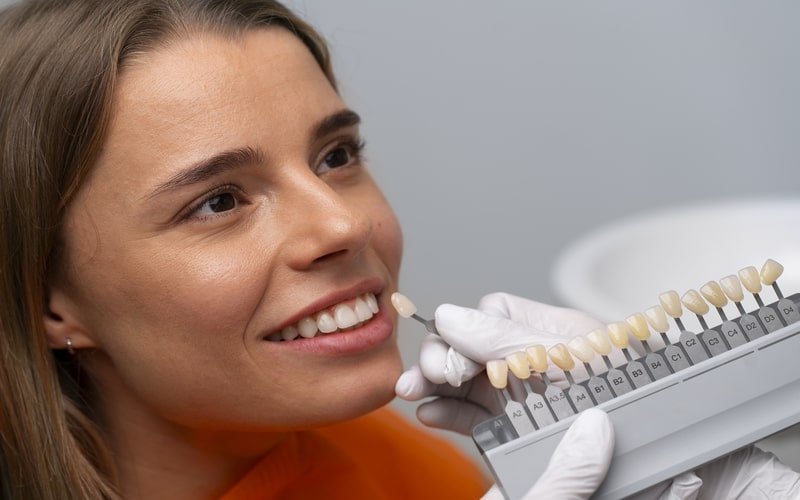
PFM is short for porcelain fused to metal. Prosthodontic literature calls the same restoration a metal-ceramic crown, and patients also meet it as a metal porcelain crown or simply a porcelain crown. All four names describe one construction: a metal alloy coping shaped to fit the prepared tooth, with dental porcelain fired onto it in layers.
The build order explains most of the crown's behaviour. The coping is produced by casting, milling or laser sintering from one of three alloy families: nickel-chromium, cobalt-chromium, or a gold-based noble alloy. An opaque ceramic layer is fired over the coping first, because the grey of the metal would otherwise read through the porcelain. Dentine and enamel porcelains are then built over the opaquer and the crown is glazed. The load is carried by the metal; the appearance is produced by the ceramic and by the technician's hand.
That two-layer design has a measured consequence. A systematic review pooling 35 clinical studies reported five-year chipping of the veneering ceramic at 2.9% for metal-ceramic and 2.8% for zirconia-ceramic, effectively the same. Fracture of the framework itself was 0.2% for metal-ceramic against 2.1% for zirconia, a statistically significant difference (PubMed 30328190). A metal coping is very unlikely to break; it does not, however, protect the porcelain sitting on top of it. Our zirconia crown profile covers the metal-free alternative in the same format, and the prosthodontics section lists what we provide.
/ Four different restorations answer to the word "porcelain"
The single most useful thing to know before comparing two quotes is that "porcelain crown" does not identify a material. It can mean at least four restorations with different clinical records. It can mean a PFM crown with a metal coping. It can mean a feldspathic or leucite-reinforced all-ceramic crown with no metal at all. It can mean a lithium disilicate glass-ceramic crown, sold under the e.max name. It can mean porcelain hand-layered over a zirconia coping, which patients hear as porcelain but which is structurally a zirconia restoration.
The 64-study meta-analysis that separates these options puts five-year tooth-supported single crown survival at 98.5% for monolithic lithium disilicate, 97.3% for veneered densely sintered zirconia, 97.1% for metal-ceramic, 96.8% for monolithic zirconia, 95.7% for veneered leucite or lithium disilicate, 94.5% for densely sintered alumina, 94.3% for glass-infiltrated alumina and 90.4% for feldspathic or silica-based ceramic (PubMed 41489982). More than eight percentage points separate the top of that list from the bottom, and every one of them can be, and is, called porcelain in conversation.
For anyone comparing clinics across countries this matters more than the price line. Two quotes that both say "porcelain crown" may describe the cheapest and the most expensive ceramic in that table. Ask which ceramic, ask whether there is a metal coping, and ask for the answer in writing. Our dental crowns guide for Istanbul walks through reading a treatment plan, and our porcelain crown article covers the family from the patient's side.
/ What the single-crown survival data reports
The auditable longevity data for PFM crowns comes from three systematic reviews published across roughly two decades, and the three agree closely with each other.
| Tooth-supported single crown, 5-year survival | Metal-ceramic | Comparison group |
|---|---|---|
| Pjetursson 2007 (PubMed 17594372) | 95.6% | All-ceramic 93.3% |
| Sailer 2015 (PubMed 25842099) | 94.7% | Zirconia 92.1%, leucite/Li₂Si₂O₅ 96.6% |
| Pjetursson 2026 (PubMed 41489982) | 97.1% | Monolithic zirconia 96.8% |
Metal-ceramic lands between 94.7% and 97.1% in every one of them. The same group’s 2018 review measures implant-supported single crowns instead, where metal-ceramic reached 98.3% and zirconia 97.6% (PubMed 30328190); those figures belong in a different column. No other crown type has evidence of that span and duration, which is also why metal-ceramic keeps appearing as the reference group when a newer material is evaluated.
Single-centre follow-up points the same way and adds a detail worth knowing. A study of 688 single-unit metal-ceramic crowns placed between 1984 and 1992 found, among crowns in service for five to ten years, a repair rate of 3% and a failure rate of 3%; failure was 1% on vital teeth and 5% on non-vital teeth. Fracture of the underlying tooth accounted for 56% of the cases needing retreatment (PubMed 10815605). In other words, what usually ends a crown is not the crown. It is the tooth underneath, and whether that tooth still has a live pulp is a better predictor than the material choice.
/ Bridges: where PFM's long-term record actually sits
A bridge is a different question from a single crown, and the longest continuous follow-up published for any crown material belongs to metal-ceramic here. A study of 515 metal-ceramic fixed partial dentures placed between 1984 and 1997, with 1,209 abutments and 885 pontics, reported cumulative survival of 96% at five years, 87% at ten years and 85% at fifteen years (PubMed 12375457). The companion paper found 80% still in function and 9% needing retreatment, with tooth fracture accounting for 38% of retreatments, periodontal breakdown 27%, loss of retention 13% and caries 11%. Regular professional maintenance was significantly associated with lower failure (PubMed 12737251).
The systematic reviews confirm the picture and narrow the gap. In 2007, five-year survival was 94.4% for metal-ceramic bridges against 88.6% for all-ceramic, a significant difference (PubMed 17594373). In 2015, metal-ceramic was again 94.4% against 90.4% for densely sintered zirconia, and this time the difference did not reach significance (PubMed 25935732). A 2020 meta-analysis restricted to randomised controlled trials of posterior multi-unit tooth-supported bridges reported 95.4% for zirconia-ceramic and 96.9% for metal-ceramic, with no significant survival difference (P = .364) but significantly more chipping of the veneering ceramic in the zirconia group (PubMed 32222175). The most recent review places metal-ceramic at 91.3%, just below veneered zirconia at 92.9% and above monolithic zirconia at 87.9% (PubMed 41650383).
Read together, these four datasets say something consistent. Survival across materials sits in a narrow band; the separation shows up in technical complications, and chipping of layered ceramic is repeatedly more frequent on zirconia frameworks. Our zirconia bridge guide covers the alternative across a span, restoring one missing tooth works through the narrower case, and bridge types and longevity sets out the options.
/ Implant-supported bridges are the strongest case for PFM
Implant-supported multiple-unit prostheses are a separate category from tooth-supported bridges, because there is no periodontal ligament and load transfers directly to bone. A systematic review of 19 studies in this category reported five-year survival of 98.7% for metal-ceramic against 93.0% for zirconia-ceramic, a significant difference (P < 0.001). Ceramic fracture and chipping at five years ran at 11.6% for metal-ceramic and 50% for zirconia-ceramic, and prostheses lost outright to ceramic fracture were 0.2% against 4.1% (PubMed 30328185).
The authors' own conclusion is that conventionally veneered zirconia should not be considered a first-priority material selection, and that metal-ceramic appears to remain the gold standard for implant-supported multiple-unit fixed prostheses. That conclusion was written in 2018 and describes veneered zirconia; the same authors note that monolithic zirconia lacked sufficient clinical evidence at that point, and long-term monolithic data on implants is still accumulating. Newer single-crown reviews narrow the gap considerably on tooth-supported work.
Even with those caveats, this is the clearest surviving indication for PFM. A long-span posterior implant-supported restoration where aesthetics is secondary is a defensible place to choose metal-ceramic, and saying so is a clinical statement rather than a preference. Our implant-supported prosthesis guide covers the planning, implant versus bridge covers the earlier decision, zirconia on implants covers the alternative, and the dental implants treatment page sets out what the surgical stage involves.
/ The black line at the gum: cause, and what changes it
A dark or greyish line can appear at the gum margin of a PFM crown after some years. The mechanism is straightforward. The metal coping, with its opaque layer, runs to the crown margin. While the gum is healthy and thick, the margin is covered. As the gum recedes, the margin is exposed, the grey of the metal becomes directly visible, and it also shows through thin gingival tissue. Ions released from the alloy can contribute a second, separate discolouration in the adjacent soft tissue.
That outcome varies by alloy, and there is clinical data on it. A study following 131 teeth in 64 patients for 36 months compared porcelain fused to gold-platinum alloy (59 teeth) with porcelain fused to nickel-chromium alloy (72 teeth). The two groups differed significantly on all four assessed outcomes, shade, marginal adaptation, gingival discolouration and gingival status, with the noble alloy group performing better on each (P < 0.05) (PubMed 23062639). The grey line is therefore not an inevitable property of PFM; it is a function of alloy choice, margin design and the behaviour of the gum over time.
Margin design is the second lever. The classical design carries the metal collar to the crown margin; the alternative pulls the metal back on the facial surface and finishes the margin in porcelain, often called a porcelain butt joint. No current clinical study directly comparing the two designs for frequency of visible grey line was located, so no figure is given here. Asking which margin design a quote covers is still a reasonable question. Our guide to receding gums covers the tissue side, and replacing old crowns and veneers covers what happens when an existing PFM crown reaches the end of its service.
/ Nickel, alloys, and what the allergy data actually shows
Whether a PFM crown contains nickel depends entirely on which alloy family sits in the coping. Nickel-chromium alloys contain nickel. Cobalt-chromium and gold-based noble alloys do not. The question to ask a clinic is not whether porcelain causes allergy, but which alloy the laboratory will use.
The measured data comes from a multicentre analysis of 169,834 patients patch-tested between 2005 and 2019, from which 2,730 patients with suspected contact allergy affecting the oral region were extracted. Among the 444 women in that group with confirmed allergic contact stomatitis, sensitisation was recorded at 28.6% for nickel, 21.4% for palladium and 10.9% for amalgam (PubMed 38123140). Those percentages describe a selected population that was tested because of oral symptoms, not the general public, and they should not be read as a population prevalence. What they do show is where nickel sits when oral contact allergy is confirmed.
A second study looked at corrosion behaviour rather than allergy. In 40 patients receiving nickel-chromium based porcelain-fused-to-metal fixed prostheses, buccal epithelial cells were assessed by micronucleus assay before and after treatment; nickel and chromium ion release in artificial saliva was highest at pH 2.3, and micronucleated cell frequencies rose significantly after treatment. The authors concluded that nickel-chromium alloys are prone to corrosion and that prostheses made with them may induce genotoxic rather than cytotoxic effects (PubMed 29502734). The limits belong in the same paragraph: 40 participants, a cellular biomarker rather than a clinical outcome, and no replication. It does not establish disease risk. It does support having the alloy conversation before treatment rather than after.
/ Wear on the teeth that bite against it
Crown selection tends to focus on the tooth being restored. The tooth opposing it deserves attention too, because a hard restorative surface wears natural enamel over time and the amount differs by material. A network meta-analysis pooled seven controlled clinical trials measuring mean vertical loss on antagonist teeth for up to 24 months after permanent crown placement, covering 261 crowns in 177 subjects (PubMed 38211687).
| Extra vertical enamel loss on the opposing tooth, up to 24 months | Versus a natural-tooth antagonist |
|---|---|
| Metal-ceramic | +82.5 µm (95% CI 54.4-110.6) |
| Monolithic zirconia | +40.1 µm (95% CI 22.2-58.0) |
| Lithium disilicate | +5.0 µm (95% CI -48.2-58.1) |
All three materials produced more antagonist wear than a natural tooth opposing another natural tooth. Metal-ceramic produced roughly twice the additional loss of monolithic zirconia and the highest figure of the three; lithium disilicate produced the least, although its confidence interval crosses zero and the estimate is uncertain. The authors report that metal-ceramic and zirconia significantly increased antagonist enamel wear.
This is the clearest measured limitation of PFM and it changes planning rather than ruling the material out. In a patient with existing wear facets, untreated bruxism, or a fully natural opposing arch, 82.5 µm over two years is a planning input. A night guard in that situation is part of the plan and not an add-on; our bruxism guard guide explains what it does and does not solve.
/ Where PFM is still the right answer, and where it is not
Metal-ceramic remains a predictable choice for long-span posterior bridges, where framework fracture ran at 0.6% for metal-ceramic against 12.9% for glass-infiltrated alumina and 8.0% for reinforced glass-ceramic (PubMed 25935732). It is a defensible choice for implant-supported multiple-unit prostheses, where five-year survival reached 98.7% against 93.0% for veneered zirconia (PubMed 30328185). It is a practical choice where existing metal-ceramic restorations are already in the mouth and shade matching runs through one laboratory. And where a telescopic crown or a precision-attachment partial denture is planned, a metal framework is a requirement of the design rather than a preference.
The situations where it is a poor fit are equally specific. In the anterior region with high aesthetic expectations, particularly with a thin gingival biotype, the risk of a visible margin is a genuine problem rather than a theoretical one. In a patient with known nickel sensitivity, a nickel-bearing alloy is not appropriate. Where the opposing arch already shows significant wear, the measured 82.5 µm of additional enamel loss can change the plan. And on an intact tooth discoloured but otherwise sound, full coverage of any material removes structure that whitening, composite bonding or a minimal-preparation technique could have addressed. Our e.max veneers guide covers the glass-ceramic route, the laminate veneer treatment page explains what minimal preparation actually means, how long veneers last sets expectations, and bonding covers the reversible option.
/ MRI, imaging, and what the metal really does
Magnetic resonance imaging raises two separate questions for a patient with metal-ceramic crowns, and the two get merged into one. The first is safety, the second is image quality. Dental casting alloys are not ferromagnetic, so displacement in the scanner field is not expected. Metal-containing restorations can, however, generate artefacts that degrade images of the jaws, floor of mouth and salivary glands.
The measured data comes from a study assessing 44 materials commonly used in dental restorations in both 1.5 tesla magnetic resonance imaging and computed tomography. Thirteen of the 44 produced artefacts in MRI, and metal-based restorative materials generally produced fewer artefacts in MRI than in CT. The same study found that ytterbium trifluoride, used as a radiopacifier in composites, produced artefacts in both modalities (PubMed 22384071), which is a reminder that the artefact source is not always the visible metal.
The practical instruction is short. Tell the radiology team about every restoration in your mouth before a scan, including crowns placed years ago abroad, and let the team operating the scanner make the call. If a detailed head and neck study is planned, the presence of metal-containing restorations may influence the imaging protocol rather than cancel the scan.
/ What drives the cost of a PFM crown
Prices quoted for porcelain fused to metal crowns vary widely between clinics and between countries. Part of it is not margin at all; it is that different products are being priced under one name. Current figures are listed on the porcelain crown treatment page.
The variables that genuinely move the figure are these. Alloy class comes first, since nickel-chromium, cobalt-chromium and gold-based noble alloys are different raw materials at different costs, and noble metal content is the largest single driver. Laboratory work is second: how many porcelain layers are built, whether individual characterisation is done, and how many try-in stages are scheduled. Margin design is third, because finishing the facial margin in porcelain is an additional step. Unit count is fourth, since pricing is per unit and a bridge charges for pontics as well as abutments. Additional procedures are fifth: root canal treatment, post and core build-up, extraction and soft-tissue work are separate line items and are not included in a crown fee. Sixth is the provisional stage and the number of appointments. Seventh is the warranty and what follow-up exists after you fly home.
Two questions separate a comparable international quote from an incomparable one. Ask which alloy and which ceramic the quote covers, and ask what is excluded. Our veneer cost guide applies the same arithmetic on the veneer side, the Turkey teeth guide covers the wider decision, the reputational side of the trend covers what went wrong in the cases that made the news, and a specific plan can be raised through our contact page.
/ Aftercare, warranty, and what happens when the crown reaches the end
The most commonly reported problem in cross-border dental treatment is not a material failure. It is the absence of anyone to call afterwards. Before treatment, get in writing what the warranty covers: replacing a fractured crown, recementing a loose one and treating a problem that develops in the tooth underneath are three different commitments and clinics handle them differently. Establish who reviews your case remotely and what happens if a local dentist needs your records. Our clinical team is published with names and qualifications for exactly that reason.
Daily care needs no special product, but two points matter. Porcelain does not respond to whitening agents, so shade decisions are made before the crown is built rather than after. The crown itself cannot decay; the natural tooth beneath it can, and that decay typically starts at the margin where the crown meets the gum. In the 515-bridge cohort, periodontal breakdown and caries both increased significantly with time, while patients on regular professional maintenance had significantly lower failure rates (PubMed 12737251). Interdental cleaning and scheduled review matter more after crown work, not less.
When a crown does reach the end of its service, the option is not to remove it and return to the natural tooth. Full coverage requires irreversible preparation; the enamel removed does not come back, and the decision at that point is about what replaces the crown given the condition of the tooth underneath. Temporary crowns cover the interval between removal and the new restoration, and lip discomfort after crown work covers a common and usually temporary complaint.
Let’s plan the right treatment together.
Free Assessment→- 1.Pjetursson BE, Sailer I, Zwahlen M, Hämmerle CH. A systematic review of the survival and complication rates of all-ceramic and metal-ceramic reconstructions after an observation period of at least 3 years. Part I: Single crowns. Clin Oral Implants Res. 2007;18 Suppl 3:73-85. doi:10.1111/j.1600-0501.2007.01467.x
- 2.Sailer I, Pjetursson BE, Zwahlen M, Hämmerle CH. A systematic review of the survival and complication rates of all-ceramic and metal-ceramic reconstructions after an observation period of at least 3 years. Part II: Fixed dental prostheses. Clin Oral Implants Res. 2007;18 Suppl 3:86-96. doi:10.1111/j.1600-0501.2007.01468.x
- 3.Sailer I, Makarov NA, Thoma DS, Zwahlen M, Pjetursson BE. All-ceramic or metal-ceramic tooth-supported fixed dental prostheses (FDPs)? A systematic review of the survival and complication rates. Part I: Single crowns (SCs). Dent Mater. 2015;31(6):603-623. doi:10.1016/j.dental.2015.02.011
- 4.Pjetursson BE, Sailer I, Makarov NA, Zwahlen M, Thoma DS. All-ceramic or metal-ceramic tooth-supported fixed dental prostheses (FDPs)? A systematic review of the survival and complication rates. Part II: Multiple-unit FDPs. Dent Mater. 2015;31(6):624-639. doi:10.1016/j.dental.2015.02.013
- 5.Pjetursson BE, Valente NA, Strasding M, Zwahlen M, Liu S, Sailer I. A systematic review of the survival and complication rates of zirconia-ceramic and metal-ceramic single crowns. Clin Oral Implants Res. 2018;29 Suppl 16:199-214. doi:10.1111/clr.13306
- 6.Sailer I, Strasding M, Valente NA, Zwahlen M, Liu S, Pjetursson BE. A systematic review of the survival and complication rates of zirconia-ceramic and metal-ceramic multiple-unit fixed dental prostheses. Clin Oral Implants Res. 2018;29 Suppl 16:184-198. doi:10.1111/clr.13277
- 7.Limones A, Molinero-Mourelle P, Azevedo L, Romeo-Rubio M, Correia A, Gómez-Polo M. Zirconia-ceramic versus metal-ceramic posterior multiunit tooth-supported fixed dental prostheses: A systematic review and meta-analysis of randomized controlled trials. J Am Dent Assoc. 2020;151(4):230-238.e7. doi:10.1016/j.adaj.2019.12.013
- 8.Pjetursson BE, Pitta J, Balet A, Bjarnadottir GR, Sailer I, Romandini P. A Systematic Review and Meta-analysis Evaluating the Survival, Failure, and Complication Rates of Metal-Ceramic, Veneered, and Monolithic All-Ceramic Tooth-Supported Single Crowns, Part 1. Int J Prosthodont. 2026;39(3):308-324. doi:10.11607/ijp.9633
- 9.Romandini P, Pjetursson BE, Pitta J, Balet A, Ikumi R, Sailer I. A Systematic Review and Meta-analysis Evaluating the Survival, Failure, and Complication Rates of Metal-Ceramic, Veneered, and Monolithic All-Ceramic Tooth-Supported Multiple-Unit Fixed Dental Prostheses (FDPs), Part 2. Int J Prosthodont. 2026. doi:10.11607/ijp.9666
- 10.Walton TR. A 10-year longitudinal study of fixed prosthodontics: clinical characteristics and outcome of single-unit metal-ceramic crowns. Int J Prosthodont. 1999;12(6):519-526.
- 11.Walton TR. An up to 15-year longitudinal study of 515 metal-ceramic FPDs: Part 1. Outcome. Int J Prosthodont. 2002;15(5):439-445.
- 12.Walton TR. An up to 15-year longitudinal study of 515 metal-ceramic FPDs: Part 2. Modes of failure and influence of various clinical characteristics. Int J Prosthodont. 2003;16(2):177-182.
- 13.Wu LC, Shi Y, Ma T. Comparison of clinical effects of Au-Pt based and Ni-Cr based porcelain crowns. Chin Med Sci J. 2012;27(3):167-170. doi:10.1016/s1001-9294(14)60050-x
- 14.Forkel S, Schubert S, Corvin L, et al. Contact allergies to dental materials in patients. Br J Dermatol. 2024;190(6):895-903. doi:10.1093/bjd/ljad525
- 15.Alp G, Çakmak G, Sert M, Burgaz Y. Corrosion potential in artificial saliva and possible genotoxic and cytotoxic damage in buccal epithelial cells of patients who underwent Ni-Cr based porcelain-fused-to-metal fixed dental prostheses. Mutat Res Genet Toxicol Environ Mutagen. 2018;827:19-26. doi:10.1016/j.mrgentox.2018.01.004
- 16.Mao Z, Beuer F, Hey J, Schmidt F, Sorensen JA, Prause E. Antagonist enamel tooth wear produced by different dental ceramic systems: A systematic review and network meta-analysis of controlled clinical trials. J Dent. 2024;142:104832. doi:10.1016/j.jdent.2024.104832
- 17.Klinke T, Daboul A, Maron J, et al. Artifacts in magnetic resonance imaging and computed tomography caused by dental materials. PLoS One. 2012;7(2):e31766. doi:10.1371/journal.pone.0031766