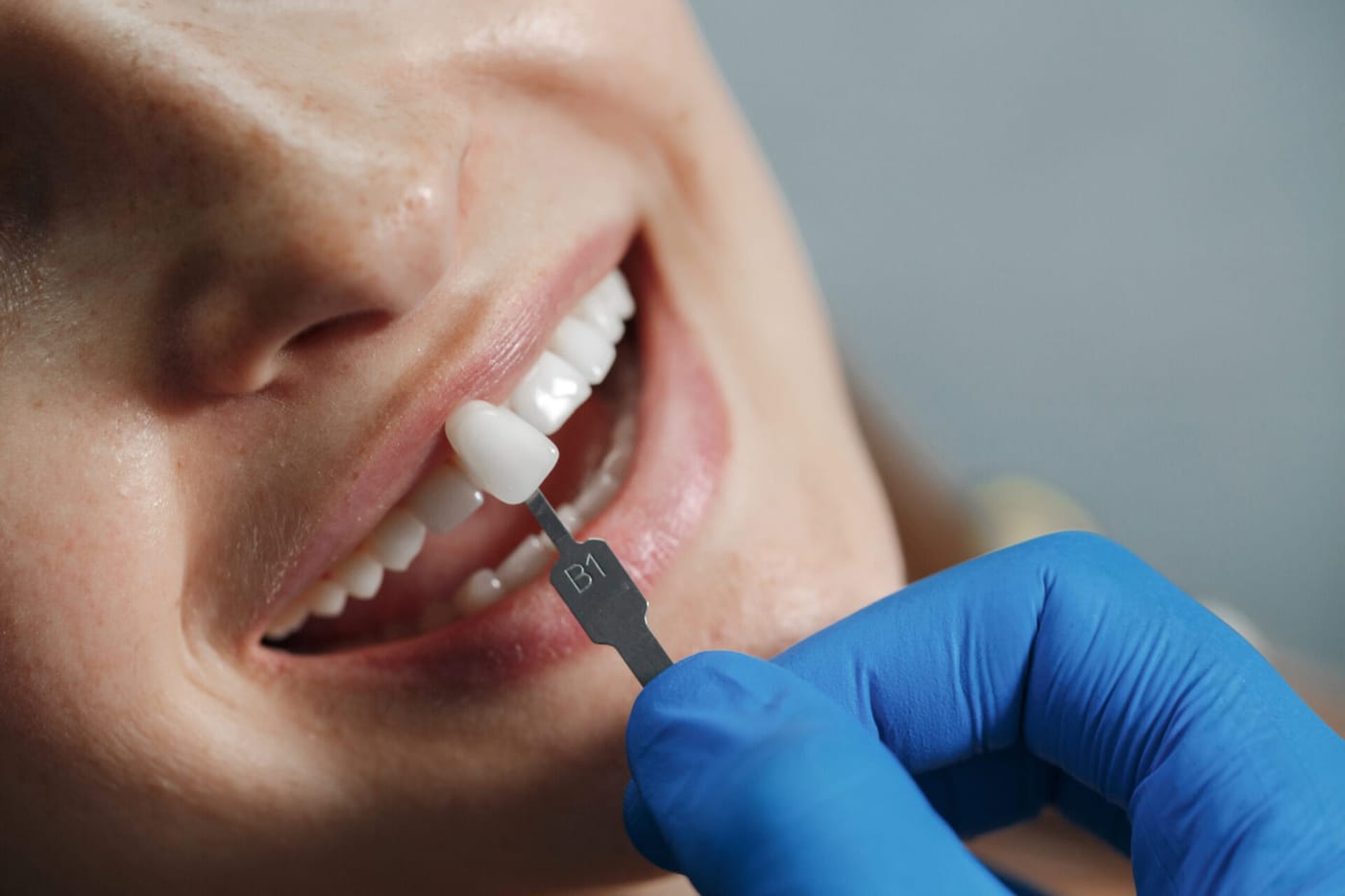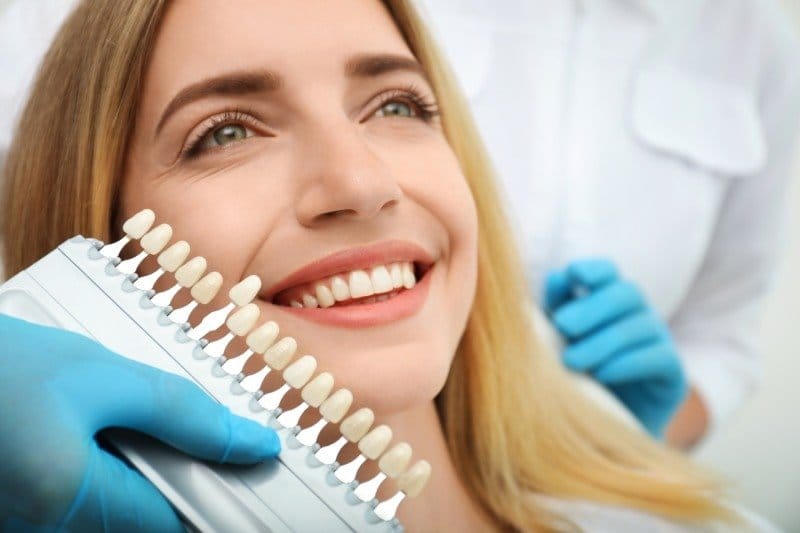
Emax veneers are thin restorations made from lithium disilicate glass-ceramic, bonded to the front surface of a tooth. Emax names the material, not the restoration type, and the same material is also used for full-coverage crowns, which is where the confusion begins: a veneer covers the labial surface with minimal preparation, while a crown encircles the tooth. The manufacturer states a flexural strength of 530 MPa after crystallisation, with a minimum thickness of 0.4 mm for veneers and 1 mm for crowns (ivoclar.com, IPS e.max CAD). Published clinical data reports a pooled survival of 96.81% at 10.4 years for lithium disilicate laminate veneers (PubMed 39523553) and 96.7% at 10 years for lithium disilicate single crowns (PubMed 24674802). Whether a veneer or a crown is appropriate for your tooth depends on how much enamel remains, which is measurable at examination rather than guessable from photographs.
- 01Emax is a material (lithium disilicate glass-ceramic); a laminate veneer is a technique. The same material is used to make veneers, crowns, inlays and onlays.
- 02Manufacturer data: 530 MPa flexural strength for lithium disilicate, 850 to 1,200 MPa for the same manufacturer's zirconia range (ivoclar.com).
- 03Lithium disilicate laminate veneers show a pooled survival of 96.81% at 10.4 years, with a technical complication rate of 6.1% (PubMed 39523553).
- 04In 580 laminate veneers followed for up to 12 years, veneers with preparations kept entirely within enamel survived at 99%, while those bonded to dentine carried roughly a tenfold higher failure risk (PubMed 23342345).
- 05Minimum thickness is 0.4 mm for a veneer and 1 mm for a crown (ivoclar.com). That difference is the reason crown preparation removes substantially more tooth structure than veneer preparation.
Emax veneers are made from lithium disilicate glass-ceramic. The name Emax belongs to a material, not to a type of restoration: IPS e.max is a registered product family from Ivoclar, a company whose trade register entry is in Liechtenstein. The same product is written E-max and E.max in various places, and all three spellings refer to the same lithium disilicate ceramic. That distinction between material and restoration type sounds academic until you read a treatment plan and find that the word veneer has been used for something that is actually a crown. Material and technique carry separate published survival figures and remove different amounts of tooth structure.
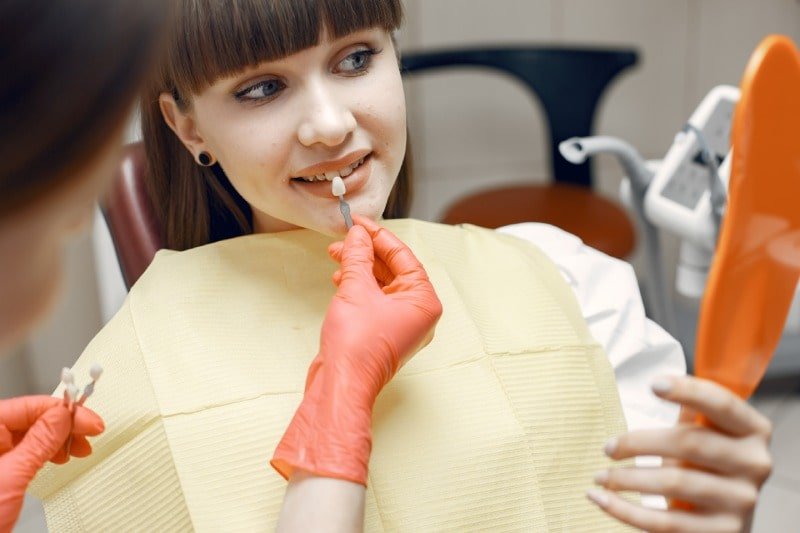
/ Emax is a material, a laminate veneer is a technique
Emax names a material: lithium disilicate reinforced glass-ceramic. A laminate veneer names a technique: a thin, minimally prepared restoration covering the labial surface of a tooth. These two sit on different axes. A laminate veneer can be made from lithium disilicate, from feldspathic porcelain, or from composite. Lithium disilicate, in turn, is used for veneers, full crowns, inlays and onlays alike.
The distinction is not a matter of preference. Emax names a material rather than a single restoration type, so the question that matters at consultation is whether the restoration will cover the front of the tooth or wrap around it entirely. Two treatment plans can both say Emax and describe very different amounts of tooth removal.
A question such as emax laminate veneers versus zirconia crowns carries the category error inside itself, comparing a technique against a material. The comparison that can be answered is either material against material (lithium disilicate against zirconia) or technique against technique (veneer against crown). Both are covered below, and the material side in more depth in our zirconia crowns article.
/ Technique and material are two separate axes, and a table shows both
Treatment plans usually collapse these two axes into one list of options, which is how a patient ends up choosing between a veneer and zirconia as though they were alternatives. The table below separates them: rows are techniques, columns are materials.
| Technique | Lithium disilicate (Emax) | Monolithic zirconia | Feldspathic porcelain | Composite | PMMA (acrylic) |
|---|---|---|---|---|---|
| Laminate veneer | Common | Rare | Common | Common | Not used |
| Full-coverage crown | Common | Common | Rare | Not used | Provisional only |
| Inlay / onlay | Common | Possible | Rare | Common | Not used |
| Multi-unit bridge | Limited | Common | Not used | Not used | Provisional only |
| Provisional restoration | Not used | Not used | Not used | Possible | Standard |
The word limited in that table has a number behind it. Lithium disilicate single crowns show 96.7% survival at 10 years, while multi-unit fixed dental prostheses made from the same material drop to 70.9% over the same period (PubMed 24674802). The material has not changed; the load it carries has. Zirconia is common in multi-unit bridgework because its flexural strength sits between 850 and 1,200 MPa in the manufacturer's own data, against 530 MPa for lithium disilicate (ivoclar.com). Composite as an alternative technique is covered in our composite bonding article, and metal-supported options in our PFM crowns article.
/ Emax veneers and Emax crowns differ in how much tooth is removed
The difference between an Emax crown and an Emax veneer is short to state: both are lithium disilicate, and they differ in preparation depth.
Manufacturer data puts a number on it. For IPS e.max CAD the stated minimum thickness is 0.4 mm for a veneer and 1 mm for a crown (ivoclar.com). Restoration thickness dictates how much tooth has to be removed to accommodate it. A veneer involves the labial surface and usually the incisal edge; a crown is prepared circumferentially, on all surfaces of the tooth.
The clinical consequence has been measured. In a retrospective study of 580 porcelain laminate veneers followed for up to 12 years, preparations that remained entirely within enamel survived at 99%, those with enamel margins only at 94%, and the overall survival was 86%; bonding to dentine carried approximately a tenfold higher risk of failure (PubMed 23342345). A separate clinical study reported the same direction: veneers bonded with severe dentine exposure failed more often than those bonded to enamel (PubMed 25279393).
This is why a treatment plan that says veneers and a treatment plan that says crowns are not interchangeable documents, and why the number of teeth listed on that plan deserves a second look. If a plan proposes full-coverage crowns on healthy, unrestored anterior teeth, the reason for that choice should be stated in clinical terms before anything is prepared. Minimal preparation cases are described on our laminate veneer page, and no-preparation cases on our prepless laminate page.
/ How long Emax veneers last, according to published data
Published survival rates give a narrow, well-supported picture of how long Emax veneers last.
A meta-analysis pooling 29 clinical studies reported a survival rate of 96.81% for lithium disilicate laminate veneers at 10.4 years, with technical complications at 6.1%, aesthetic complications at 1.9% and biological complications at 0.45% (PubMed 39523553). The same analysis found 96.13% for feldspathic and 93.70% for leucite-reinforced glass-ceramic veneers, with no statistically detectable survival difference between materials; the separation appeared in the complication rates rather than in survival.
On the crown side, a systematic review of 12 clinical investigations reported lithium disilicate single crown survival of 97.8% at five years and 96.7% at ten (PubMed 24674802). A more recent review pooling 64 studies and 3,509 metal-ceramic plus 8,051 all-ceramic crowns gave five-year survival by material: monolithic lithium disilicate 98.5%, veneered zirconia 97.3%, metal-ceramic 97.1%, monolithic zirconia 96.8%, feldspathic and silica-based ceramics 90.4% (PubMed 41489982). The figures sit close together, which means the material name alone is a weak predictor; where the restoration goes in the mouth matters more.
/ Emax and zirconia differ measurably in strength and in light transmission
Emax and zirconia are compared on strength and light transmission. The two specifications are set side by side below.
| Criterion | Lithium disilicate (Emax) | Monolithic zirconia |
|---|---|---|
| Flexural strength (manufacturer data) | 530 MPa | 850-1,200 MPa |
| Minimum crown thickness (manufacturer data) | 1 mm | Not stated on the product page |
| Minimum veneer thickness (manufacturer data) | 0.4 mm | Not stated on the product page |
| Single-crown survival at 5 years | 98.5% (monolithic) | 96.8% (monolithic) |
| Laminate veneer long-term data | 96.81% at 10.4 years | None. 100% at 2.6 years, no long-term data available |
| Hydrofluoric acid etching | Etchable | Not etchable |
| Cementation | Adhesive resin bonding | Conventional cementation possible |
Light transmission has been ranked experimentally. In a study comparing the translucency of veneering ceramics, the zirconia-based material sat at the least translucent end of the ranking, with lithium disilicate measuring more translucent (PubMed 24969410). That does not make lithium disilicate the better material; it makes it the more light-permeable one. If the underlying tooth is dark, or a metal post is present, translucency works against the result and a more opaque material is preferred instead. In the anterior region lithium disilicate is frequently chosen because its light behaviour sits closer to that of the adjacent natural teeth.
Zirconia has its own specification sheet, including the distinction between monolithic and veneered forms, set out on our zirconium dental crown page and in more detail in the zirconia article. Using both materials in the same mouth is routine and clinically coherent, with lithium disilicate anteriorly and zirconia in the posterior segments.
/ Emax restorations are bonded, not cemented, and the bond is part of the strength
Lithium disilicate is a glass-ceramic, and its glass phase can be etched with hydrofluoric acid. Etching is followed by silanisation, and the restoration is bonded with resin cement. This is a property of the material rather than a stylistic choice, and the bond forms part of how the restoration behaves mechanically.
The measured evidence runs as follows. In a study comparing IPS e.max specimens across surface treatment and resin bonding conditions, biaxial flexural strength ranged from 258.6 MPa to 416.4 MPa across three groups, with the highest value in the bonded group (PubMed 30072165). Bond durability has also been examined: adding silanisation to hydrofluoric acid etching produced more stable microtensile bond strength after water ageing (PubMed 34269544). Where dentine is exposed, immediate dentin sealing is recommended for thin glass-ceramic restorations (PubMed 28843882).
Zirconia behaves differently. It has no glass phase, so hydrofluoric acid does not etch it, and it can be conventionally cemented. For Emax, isolation during bonding is not optional. Bleeding gingiva, a margin placed deep below the gingival level, or a field where rubber dam cannot be applied all degrade the bond. Gingival health is therefore addressed before restorative work begins, with periodontal treatment completed first where needed.
/ Emax veneers are indicated in some situations and contraindicated in others
Emax suits certain clinical pictures and not others.
Situations where lithium disilicate is commonly chosen include single-tooth anterior restorations, minimal-preparation veneers for shape and shade correction, full crowns on vital teeth with no underlying discolouration, and cases where most of the enamel is still present.
Situations where it is not the material of choice are equally clear. In multi-unit fixed bridgework, lithium disilicate survival falls to 70.9% at ten years (PubMed 24674802), and material selection changes accordingly. Where enamel has largely been lost, a veneer would be bonding to dentine, which carries roughly a tenfold higher failure risk (PubMed 23342345). In heavy bruxism, thin restorations are exposed to forces that need to be managed first, which is why bruxism treatment and, where indicated, a night guard come before restorative planning. On severely discoloured or root-treated teeth, a translucent material will not mask the substrate, and root canal treatment may need to be completed before any restoration is planned.
Where the only complaint is shade and the tooth is otherwise intact, a restoration may not be the first option at all. Teeth whitening or reversible composite bonding can resolve the same complaint without removing tooth structure.
/ Staining and fracture are two different questions with two different answers
Whether Emax restorations stain, and whether they can be whitened afterwards, are two frequent questions about the same property from opposite directions. Glass-ceramic is not porous in the way natural enamel is, so as long as the glazed surface remains intact the material itself does not discolour. Where discolouration appears, the usual source is the cement line at the margin, the natural adjacent teeth changing shade over time, or the tooth beneath the restoration. For the same reason, ceramic does not respond to bleaching agents, which is why shade decisions are made before the restoration is made, not after.
On fracture, the meta-analytic data is specific. Lithium disilicate laminate veneers showed a technical complication rate of 6.1% at 10.4 years, against 41.48% for feldspathic porcelain and 29.87% for leucite-reinforced glass-ceramic in the same analysis (PubMed 39523553). Lithium disilicate veneers do fracture; the reported technical complication rate is markedly lower than for the two other glass-ceramics studied. The recurring contributors to fracture are insufficient thickness, unmanaged occlusal forces and an incomplete bonding protocol.
/ What to establish before travelling for Emax veneers
Treatment abroad works when the plan is specific and the specifics are written down. The questions below are the ones that separate a plan you can evaluate from a quotation you cannot.
Ask whether each tooth is receiving a veneer or a crown, tooth by tooth, and ask for the reason where a crown is proposed on an intact tooth. Ask how much enamel is expected to remain after preparation, since enamel-bonded veneers survived at 99% against 86% overall in a dataset followed for up to 12 years (PubMed 23342345). Ask which material and which processing route is being used, since pressed and milled lithium disilicate are handled differently in the laboratory. Ask how the restoration will be cemented, because lithium disilicate requires adhesive bonding and that requires proper isolation. Ask what happens after you fly home: who reviews the work, over what period, and how a technical complication is handled at distance.
A plan proposing a large number of full-coverage crowns on healthy, unrestored teeth deserves a second opinion before any preparation is carried out, because preparation is irreversible in a way that a quotation is not. Our own sequence, from first records to the final fit and the follow-up afterwards, is set out on the patient journey page, and the clinicians who would carry it out are listed on our team page.
/ What determines the cost of Emax veneers
Quoted prices for Emax veneers vary widely, and most of the variation comes from what is inside the quotation rather than from the ceramic itself.
The material and its processing route form one line: pressed lithium disilicate and CAD/CAM milled lithium disilicate are not the same laboratory process. Laboratory work is a second line, and in anterior cases requiring layering and characterisation it forms a substantial share of the total. Scope is the third and the most common reason two quotations cannot be compared: a per-tooth price and a full-arch package price answer different questions, and the number of teeth in the package decides the real figure. Additional procedures sit on separate lines, including gingival contouring, root canal treatment, removal of existing restorations and the number of provisional restorations required. Warranty terms and the review appointments included within that period belong to the price as well.
For an accurate figure, an examination is required, because the number of teeth, the choice between veneer and crown, and any preparatory treatment can only be determined clinically and radiographically. Our published price ranges are on the prices page, and a treatment plan specific to your case can be requested through the contact page.
/ Warranty and long-term review matter as much as the restoration itself
Some of the problems in international dental treatment arise not from the restoration but from what happens after the patient has flown home. Under the heading of warranty, the questions worth asking are concrete: what is covered, whether fracture and debonding are treated the same way, whether review appointments are included, and whether the material used is recorded and given to the patient.
The measured data explains why review matters. In lithium disilicate laminate veneers the biological complication rate at 10.4 years was 0.45%, while technical complications reached 6.1% (PubMed 39523553). The likelier long-term event is therefore technical rather than biological, and technical events caught early are frequently repairable. An annual review covering occlusal contacts and marginal integrity is generally sufficient.
Recording the restoration together with its material specification means that any dentist you see later can continue with the same material rather than guess at it. The full range of crown and veneer options is collected on our prosthetics and crowns page, and treatment by treatment in the prosthodontics category. Provisional restorations, which carry the tooth between preparation and fit, are covered in our temporary crowns article, and the wider smile planning process on the smile makeover page. For full-arch aesthetic cases the sequence is longer, as described on our Hollywood smile page, and implant-supported restorations follow a different protocol again, set out on the dental implants page. Our Emax treatment page carries its own specification summary, alongside the porcelain veneer page.
Let’s plan the right treatment together.
Free Assessment→- 1.Pieger S, Salman A, Bidra AS. Clinical outcomes of lithium disilicate single crowns and partial fixed dental prostheses: a systematic review. J Prosthet Dent 2014;112:22-30. PubMed 24674802
- 2.Klein P, Spitznagel FA, Zembic A, Prott LS, Pieralli S, Bongaerts B, et al. Survival and Complication Rates of Feldspathic, Leucite-Reinforced, Lithium Disilicate and Zirconia Ceramic Laminate Veneers: A Systematic Review and Meta-Analysis. J Esthet Restor Dent 2025;37:601-619. PubMed 39523553
- 3.Pjetursson BE, Pitta J, Balet A, Bjarnadottir GR, Sailer I, Romandini P. A Systematic Review and Meta-analysis Evaluating the Survival, Failure, and Complication Rates of Metal-Ceramic, Veneered, and Monolithic All-Ceramic Tooth-Supported Single Crowns-Part 1. Int J Prosthodont 2026;39:308-324. PubMed 41489982
- 4.Gurel G, Sesma N, Calamita MA, Coachman C, Morimoto S. Influence of enamel preservation on failure rates of porcelain laminate veneers. Int J Periodontics Restorative Dent 2013;33:31-9. PubMed 23342345
- 5.Oztürk E, Bolay S. Survival of porcelain laminate veneers with different degrees of dentin exposure: 2-year clinical results. J Adhes Dent 2014;16:481-9. PubMed 25279393
- 6.Uwalaka CO, Karpukhina N, Cao X, Bissasu S, Wilson RM, Cattell MJ. Effect of sandblasting, etching and resin bonding on the flexural strength/bonding of novel glass-ceramics. Dent Mater 2018;34:1566-1577. PubMed 30072165
- 7.Südbeck JM, Jacker-Guhr S, Lührs AK. Do Different Pretreatment Methods Influence the Microtensile Bond Strength of Composite Cements to Silicate Ceramic?. J Adhes Dent 2021;23:335-345. PubMed 34269544
- 8.Yazigi C, Kern M, Chaar MS. Influence of various bonding techniques on the fracture strength of thin CAD/CAM-fabricated occlusal glass-ceramic veneers. J Mech Behav Biomed Mater 2017;75:504-511. PubMed 28843882
- 9.Barizon KT, Bergeron C, Vargas MA, Qian F, Cobb DS, Gratton DG, et al. Ceramic materials for porcelain veneers: part II. Effect of material, shade, and thickness on translucency. J Prosthet Dent 2014;112:864-70. PubMed 24969410
- 10.Ivoclar, IPS e.max CAD technical data (530 MPa flexural strength, minimum thicknesses)
- 11.Ivoclar, IPS e.max ZirCAD technical data (850-1,200 MPa flexural strength)
- 12.Palla ES, Kontonasaki E, Kantiranis N, Papadopoulou L, Zorba T, Paraskevopoulos KM, et al. Color stability of lithium disilicate ceramics after aging and immersion in common beverages. J Prosthet Dent 2018;119:632-642. PubMed 28923549