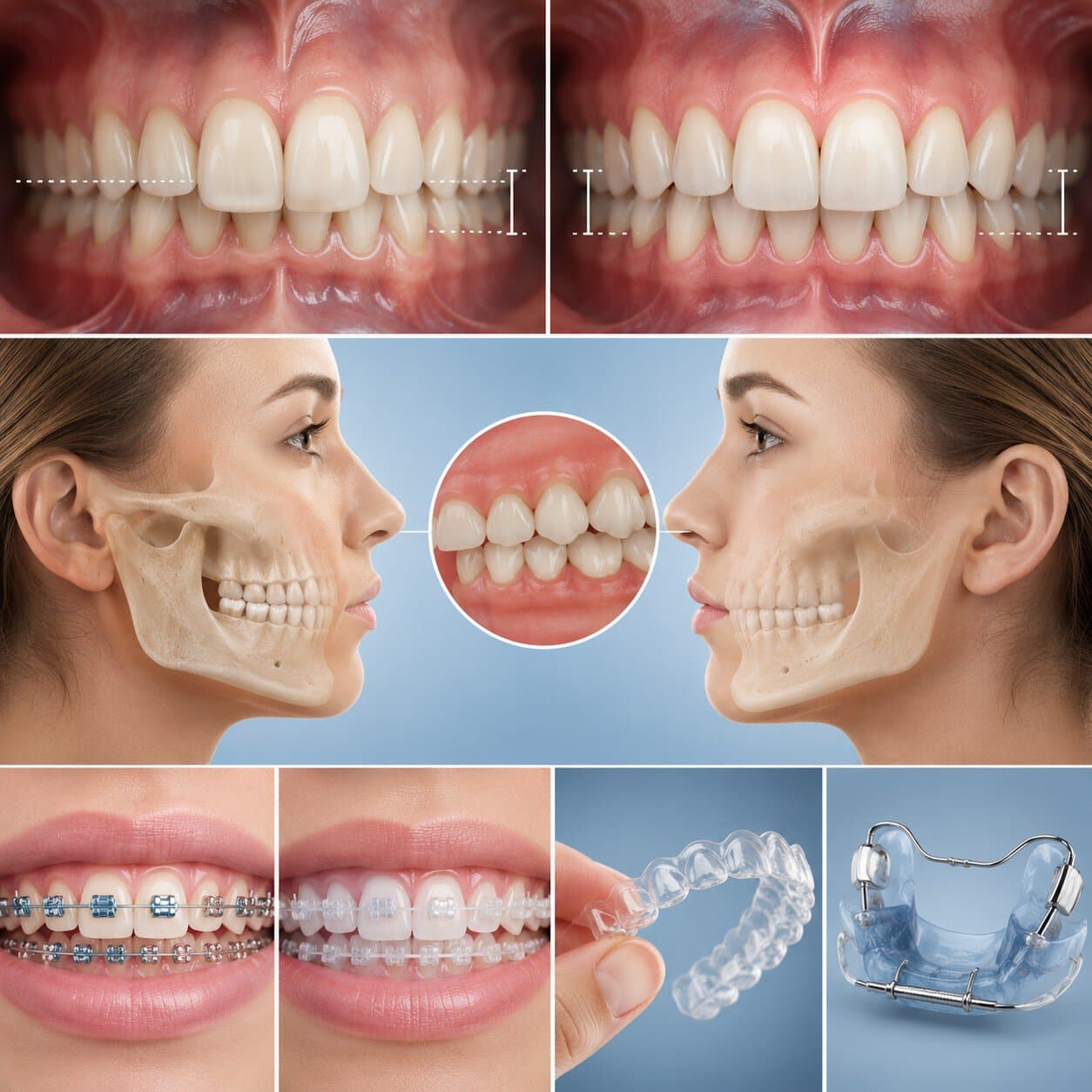
An impacted tooth is a tooth that fails to erupt into its normal position because bone, soft tissue or a neighbouring tooth blocks its path, and it can be partially or fully impacted. Third molars are the usual case: a meta-analysis of 49 studies covering 83,484 radiographed individuals put worldwide third molar impaction prevalence at 24.40 percent (95 percent CI 18.97 to 30.80), with mesioangular the most common angulation at 41.17 percent (PubMed 26561441). Management runs from radiographic monitoring through surgical removal, or surgical exposure with orthodontic traction when the impacted tooth is a canine.
- 01Impaction is defined by failed eruption rather than by pain: a tooth can stay fully impacted and symptom-free for years and be visible only on a radiograph.
- 02Worldwide third molar impaction prevalence is 24.40 percent (95 percent CI 18.97 to 30.80) across 49 studies and 83,484 radiographed individuals (PubMed 26561441).
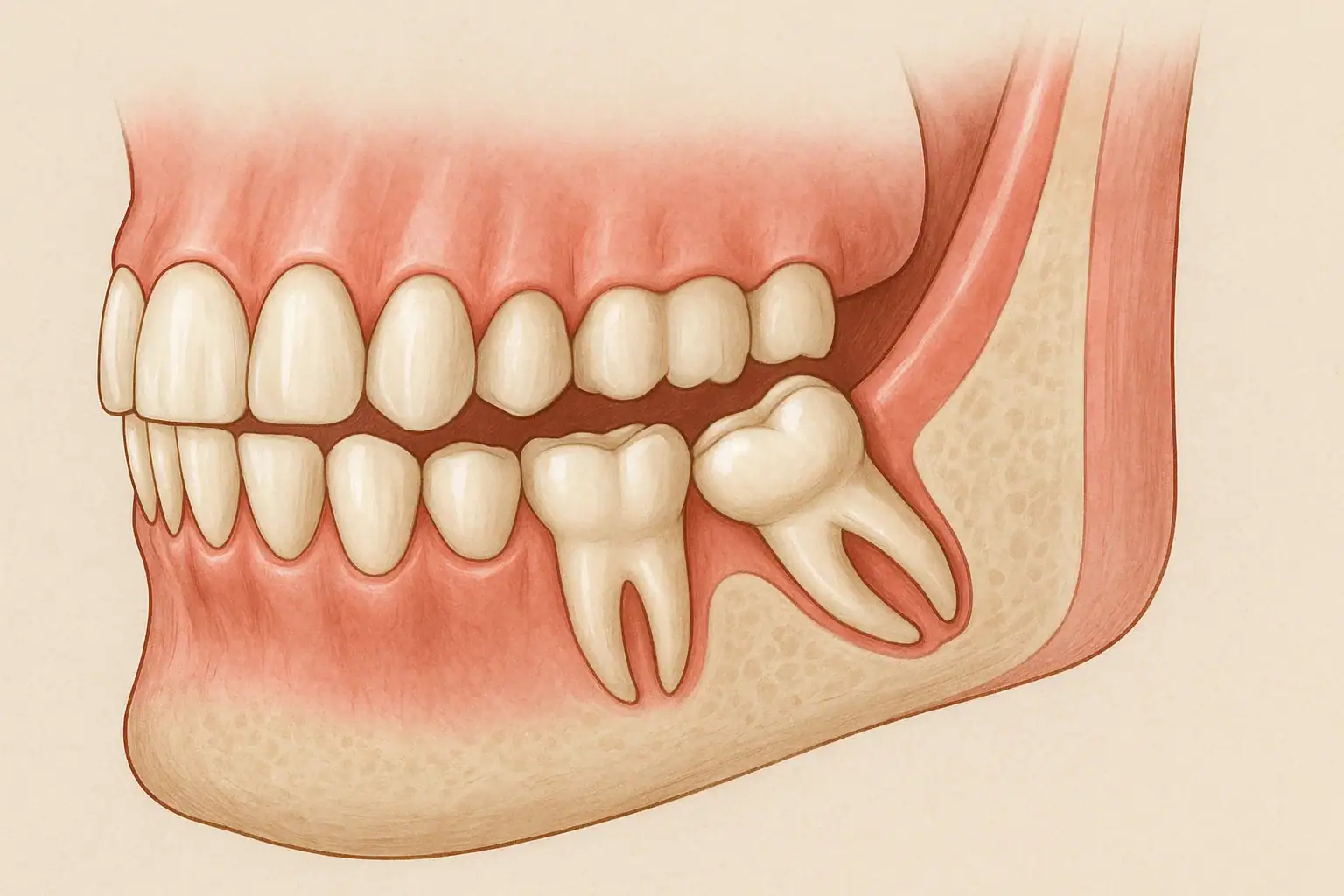
- 03Angulation is unevenly distributed: mesioangular 41.17 percent, vertical 25.55 percent, distoangular 12.17 percent and horizontal 11.06 percent, and the odds of impaction in the mandible are 57.58 percent higher than in the maxilla (PubMed 26561441).
- 04Most affected people carry one or two impacted third molars, 42.71 percent and 29.64 percent respectively, rather than all four at 8.74 percent (PubMed 26561441).
- 05Where inferior alveolar nerve injury risk is high, coronectomy is an alternative to full removal: across 34 studies with 7,115 wisdom teeth in 4,477 patients it lowered nerve injury risk (RR 0.1, 95 percent CI 0.0 to 0.2) but carried a 2.79 percent failure rate and 3.63 percent reintervention (PubMed 39956152).
/ Introduction: What Is an Impacted Tooth?
An impacted tooth is a common dental condition where a tooth fails to fully emerge through the gums into its expected position. This typically occurs due to lack of space, misalignment, or obstruction by other teeth or bone. While any tooth can become impacted, impacted wisdom teeth and impacted canine teeth are the most frequently affected.
Impacted teeth can lead to discomfort, infection, and long-term oral health complications if not properly treated. This comprehensive guide explores everything you need to know about impacted teeth, with a focus on causes, symptoms, treatment options, and frequently asked questions.
/ 1. Understanding Impacted Teeth
1.1 What Is an Impacted Tooth?
An impacted tooth is one that is blocked from breaking through the gum. This can happen partially (partially impacted) or completely (fully impacted). It usually occurs in areas of the mouth where there isn’t enough space for the tooth to erupt properly.
1.2 Common Types of Impacted Teeth
- Impacted Wisdom Tooth : The third molars are the most common teeth to become impacted, usually between the ages of 17–25.
- Impacted Canine Tooth : Often seen in the upper jaw, impacted canines are crucial for dental alignment and aesthetics.
- Impacted Premolars : Less common, but can also occur during orthodontic treatments or due to space constraints.
/ 2. Causes of an Impacted Tooth
- Lack of space in the dental arch
- Genetic factors (e.g., small jaw)
- Over-retained baby teeth
- Unusual tooth angulation
- Cysts or tumors obstructing eruption
- Dense bone or soft tissue overlying the tooth
/ 3. Symptoms of an Impacted Tooth
3.1 Impacted Wisdom Tooth Symptoms
- Persistent pain or throbbing at the back of the jaw
- Swollen or bleeding gums
- Bad breath or unpleasant taste
- Swelling of the jaw or face
- Difficulty opening the mouth
- Headaches or neck pain (yes, impacted wisdom tooth can cause neck pain due to inflammation or infection spreading to surrounding muscles and lymph nodes)
3.2 Signs of an Impacted Canine Tooth
- A noticeable gap where the canine should be
- Swelling or tenderness in the upper gums
- Prolonged retention of baby canine
- Misalignment of surrounding teeth
/ 4. Diagnosis: How Is an Impacted Tooth Detected?
Dentists or oral surgeons diagnose impacted teeth through:
- Clinical Examination : Checking for tenderness, swelling, or missing teeth.
- Dental X-rays or Panoramic Radiographs : Revealing the exact position of the impacted tooth.
- 3D Cone Beam CT Scans : For complex cases, especially near nerve-rich areas like the lower jaw.
/ 5. What Does an Impacted Wisdom Tooth Look Like?
An impacted wisdom tooth may be:
- Mesioangular : Angled forward toward the front of the mouth
- Vertical : Upright but stuck beneath the gum
- Distoangular : Angled backward toward the rear of the mouth
- Horizontal : Completely lying sideways within the jawbone
Intraoral examination and radiographs will show the tooth’s angulation and depth. Sometimes, a small part of the tooth is visible through the gum, but it cannot fully erupt.
/ 6. Complications of Impacted Teeth
6.1 If Left Untreated, Impacted Teeth May Cause:
- Tooth decay or cavities in neighboring teeth
- Gum infections and abscesses
- Cyst or tumor formation
- Crowding or shifting of other teeth
- Damage to adjacent roots or jawbone
- Bad breath and chronic oral discomfort
/ 7. Treatment Options for Impacted Teeth
7.1 Monitoring (Watchful Waiting)
In some cases especially with asymptomatic impacted wisdom teeth dentists may recommend routine observation.
7.2 Surgical Extraction
- Impacted Wisdom Tooth Removal : Performed under local anesthesia, IV sedation, or general anesthesia.
- Recovery : Usually involves mild swelling, soreness, and diet modification for a few days.
7.3 Exposure and Bracketing (For Impacted Canines)
- The tooth is surgically exposed and a small bracket is attached.
- Orthodontic treatment gradually pulls the tooth into place.
/ 8. Preventive Strategies and Oral Care
- Regular Dental Checkups : Early identification through X-rays.
- Orthodontic Monitoring : Especially in children aged 7–10, to guide canine eruption.
- Maintain Oral Hygiene : To reduce risks of infection around partially impacted teeth.
/ 9. Frequently Asked Questions
9.1 What Is an Impacted Tooth?
An impacted tooth is one that fails to emerge fully into its proper position in the mouth due to lack of space or obstruction.
9.2 What Is an Impacted Wisdom Tooth?
An impacted wisdom tooth is a third molar that cannot erupt properly due to being blocked by bone, gum tissue, or adjacent teeth.
9.3 What Does an Impacted Wisdom Tooth Look Like?
It may appear partially visible, tilted, or completely hidden under the gum. Dental X-rays are required to see its full orientation.
9.4 Can an Impacted Wisdom Tooth Cause Neck Pain?
Yes, impacted wisdom teeth can cause radiating pain into the neck, jaw, and head due to inflammation or nerve compression.
9.5 How Painful Is the Extraction of an Impacted Tooth?
With modern anesthesia and post-op care, the procedure is generally safe and well-tolerated, though mild discomfort and swelling are common.
/ 10. Recovery and Aftercare
- Ice packs to reduce swelling
- Soft diet for 2–3 days
- Salt water rinses after 24 hours
- Avoid smoking, straws, and vigorous rinsing
- Pain management with prescribed or OTC medications
Follow-up with your dentist or oral surgeon is critical to ensure proper healing.
/ 11. Impacted Tooth in Children and Teens
Early Warning Signs:
- Delayed eruption of permanent teeth
- Persistent baby teeth
- Misaligned smile
- Crowded or spaced teeth
Early orthodontic assessment can help intercept and prevent impaction-related complications.
/ 12. Impacted Tooth vs. Erupted Tooth: Key Differences
| Criteria | Impacted Tooth | Erupted Tooth |
|---|---|---|
| Visibility | Not fully visible in the mouth | Fully emerged into dental arch |
| Position | Angled, misaligned, or stuck | Properly aligned |
| Pain/Infection Risk | High | Low |
| Treatment Required | Often surgical | Regular hygiene maintenance |
/ Conclusion: Don’t Ignore the Signs of an Impacted Tooth
An impacted tooth, whether a wisdom tooth or an impacted canine tooth, should never be ignored. While some impacted teeth remain painless for years, many eventually cause discomfort, infections, or alignment issues. Regular dental visits, early intervention, and timely treatment are key to maintaining your oral health.
If you’re experiencing symptoms like jaw pain, swelling, or unexplained bad breath, consult a dental professional to assess for impacted teeth and get personalized guidance.
Let’s plan the right treatment together.
Free Assessment→- 1.Carter K, Worthington S. Predictors of Third Molar Impaction: A Systematic Review and Meta-analysis. J Dent Res 2016;95:267-76. PubMed 26561441
- 2.Kang FW, Yuan XR, Li GC, Yang YFZ, Zhang XM, Hou GY. Coronectomy in Lower Third Molar Surgery: A Systematic Review and Meta-Analysis. J Oral Maxillofac Surg 2025;83:601-615. PubMed 39956152