
Oral & Maxillofacial Surgery
Comprehensive surgical treatments in our fully-equipped theatre.
- Fully-equipped operating theatre
- Dedicated anaesthesia team
- Experience with complex cases
First consultation free · same-day reply · no price pressure
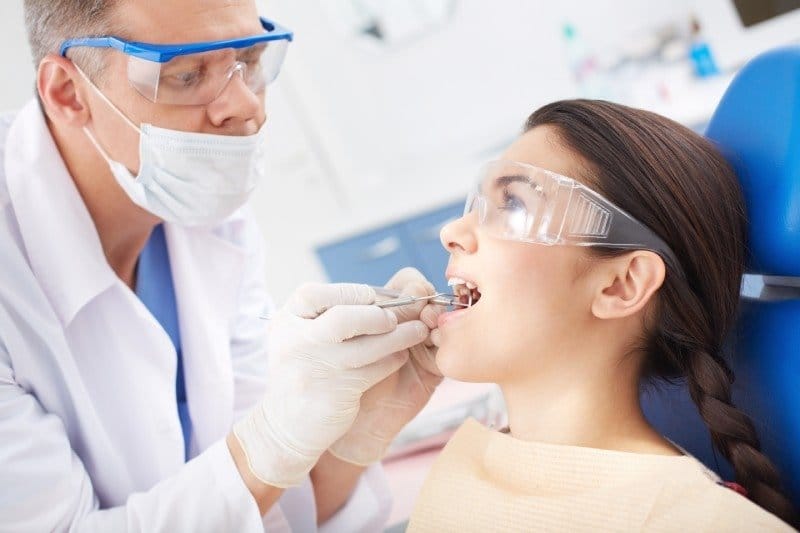
Oral and dental surgery covers the surgical procedures of the mouth and jaws: removal of erupted and impacted teeth, implant placement, root-end resection, pre-prosthetic tissue surgery, cyst management and jaw fracture repair. In Turkey it is a four-year dental specialty, one of the nine listed in Schedule 2 of Law 1219, and it sits in a different register from the five-year medical specialty of oral and maxillofacial surgery in Schedule 1. Its most frequent operation is lower wisdom tooth surgery. Pooling 7,115 teeth from 4,477 patients, coronectomy reduced inferior alveolar nerve injury against full extraction (RR 0.1, 95% CI 0.0-0.2; PubMed 39956152).
- 01Two Turkish specialties share a similar name and confer different scope. Ask which register the named surgeon holds: the dental specialty of oral and dental surgery (four years, Schedule 2 of Law 1219) or the medical specialty of oral and maxillofacial surgery (five years, Schedule 1).
- 02Coronectomy is the deliberate removal of the crown with the roots left in bone. It lowers nerve injury and dry socket (RR 0.4, 95% CI 0.3-0.7) but carries its own cost: 3.63% of cases needed a second operation and 2.79% failed technically (PubMed 39956152). A written plan should state which of the two techniques is intended.
- 03Routine antibiotics for every extraction are not supported by the size of the effect. Cochrane data put the reduction in post-surgical infection at about 66% (RR 0.34, 95% CI 0.19-0.64), yet 19 patients must be treated to prevent one infection, on low-certainty evidence (PubMed 33624847). A network meta-analysis of 2,428 lower third molars gives numbers needed to treat of 25 for dry socket and 18 for surgical site infection (PubMed 37612199).
- 04Claims that a particular surgical technique lowers complications run ahead of the evidence. Across 62 randomised trials and 4,643 participants, flap design, lingual retraction, bone removal method and irrigation showed no decisive difference, and 53% of the trials were at high risk of bias (PubMed 32712962).
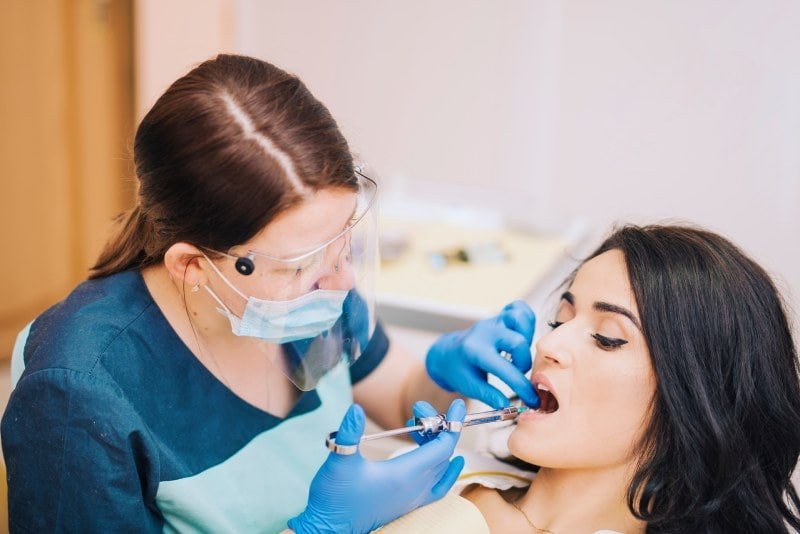
- 05Anaesthesia is quoted and consented separately from the surgery itself. The demand behind it has been measured, with dental fear affecting an estimated 15.3% of adults (95% CI 10.2-21.2) and severe dental fear 3.3%, across 31 studies and 72,577 people (PubMed 33711405).
In our clinic, diagnostic and treatment procedures covering all disorders of the soft tissues in the mouth, teeth, jaws and jaw joint are performed. Depending on the type of procedure and patient compliance, surgical procedures can be performed under local anesthesia, conscious sedation or general anesthesia.
| At a glance | |
|---|---|
| Duration | Case-dependent |
| Warranty | · |
| Materials Used | Fully equipped operating theatre |
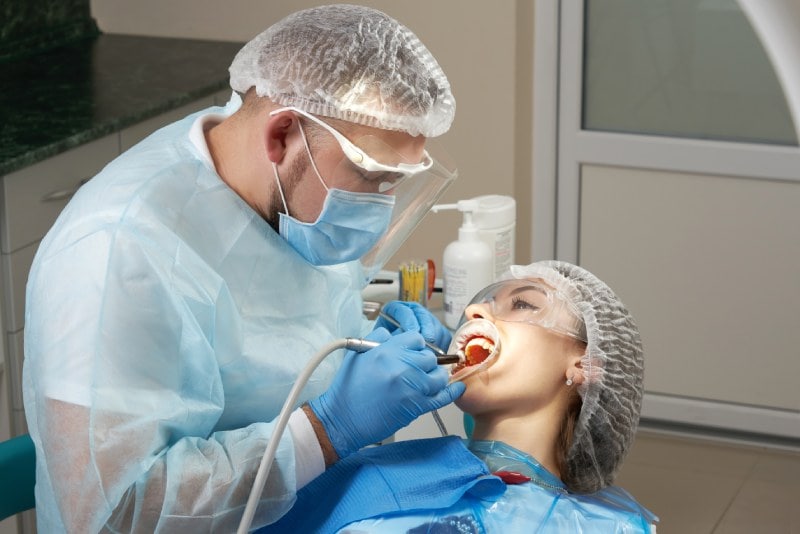
/ Treatments we apply in our Oral, Dental and Maxillofacial Surgery Clinic
- Extraction of erupted or impacted teeth with indication for extraction.
- Dental implant applications and implant surgery.
- Root tip resections.
- Surgical arrangement of soft and hard tissues in the mouth before prosthesis.
- Surgical and non-surgical treatment of temporomandibular joint diseases.
- Treatment of cystic or tumoral formations in soft and hard tissues.
- Treatment of infections in the jaw and facial region.
- Treatment of jaw fractures caused by trauma or other factors.
- Treatment of patients with dentist phobia under general anesthesia and sedation.
/ Implant
Implant Applications
Dental implants are among the most commonly used treatment options for missing teeth today. They are placed in the jawbone and mimic a normal tooth. With regular check-ups and good care, they can be used for a lifetime.
Patients usually return to work the next day and can regain their teeth in about 3 months. Implant treatments can now be applied in many patient groups thanks to sinus elevation procedures and bone grafts applied by our specialist physicians when necessary.
/ What is implant treatment?
- Dental implants are an option that allows us to offer patients the closest solution to nature in some tooth deficiencies.
- Dental implants made of titanium materials with proven biocompatibility, placed in the jawbone, are an effective, long-lasting and aesthetic method.
/ What is the treatment time?
- The surgical operation part of the implant treatment is completed in 10-15 minutes. While no pain is felt in this process, there may be very mild pain and tingling for the following 1-2 days.
- After 2-3 months for the implants to integrate into the jawbone, the prosthesis part can be delivered to the patient within 1 week.
/ Impacted Tooth Extractions
In our clinic, embedded and normal tooth extractions are performed by our specialist physicians under sterile conditions. After the extraction, our patients are informed in terms of pain, swelling and bleeding in line with the information given by our physician and necessary controls are provided after the procedure.
/ Treatment Process
- 01Consultation: Initial examination and needs assessment; imaging where required.
- 02Treatment: Case-specific surgical protocol; typically under sedation or general anaesthesia.
- 03Follow-up: Outcome review and aftercare guidance.
/ Treatment of Temporomandibular Joint Disorders
Diagnosis and treatment of joint disorders, which have increased recently, are carried out in our clinic. Thanks to Botox and arthrocentesis applications for joint disorders, many complaints of patients such as pain and restriction in opening the mouth are eliminated.
/ Cyst and Tumor Treatments
Cysts and tumors occurring in the soft and hard tissues associated with the jaw and facial region are diagnosed and treated. After treatment, appropriate reconstruction methods are applied and regular controls are carried out by our specialist physicians.
/ Treatment of Jaw Fractures
Diagnosis and treatment of jaw fractures due to trauma or pathological factors are carried out with great care in our clinic. When necessary, the operation is planned under general anesthesia and patient maintenance is ensured.
/ Oral & Maxillofacial Surgery Turkey
- 1.Law 1219 on the Practice of Medicine and its Branches, Schedules 1 and 2 (Turkish specialty registers and training durations). Legislation Information System
- 2.Kang FW, Yuan XR, Li GC, Yang YFZ, Zhang XM, Hou GY. Coronectomy in Lower Third Molar Surgery: A Systematic Review and Meta-Analysis. J Oral Maxillofac Surg 2025;83:601-615. PubMed 39956152
- 3.Peixoto AO, Bachesk AB, Leal MOCD, Jodas CRP, Machado RA, Teixeira RG. Benefits of Coronectomy in Lower Third Molar Surgery: A Systematic Review and Meta-analysis. J Oral Maxillofac Surg 2024;82:73-92. PubMed 37925166
- 4.Lodi G, Azzi L, Varoni EM, Pentenero M, Del Fabbro M, Carrassi A, et al. Antibiotics to prevent complications following tooth extractions. Cochrane Database Syst Rev 2021;2:CD003811. PubMed 33624847
- 5.Camps-Font O, Sábado-Bundó H, Toledano-Serrabona J, Valmaseda-de-la-Rosa N, Figueiredo R, Valmaseda-Castellón E. Antibiotic prophylaxis in the prevention of dry socket and surgical site infection after lower third molar extraction: a network meta-analysis. Int J Oral Maxillofac Surg 2024;53:57-67. PubMed 37612199
- 6.Bailey E, Kashbour W, Shah N, Worthington HV, Renton TF, Coulthard P. Surgical techniques for the removal of mandibular wisdom teeth. Cochrane Database Syst Rev 2020;7:CD004345. PubMed 32712962
- 7.Silveira ER, Cademartori MG, Schuch HS, Armfield JA, Demarco FF. Estimated prevalence of dental fear in adults: A systematic review and meta-analysis. J Dent 2021;108:103632. PubMed 33711405
Doctors specialising in this treatment

Frequently asked
01What conditions does oral and maxillofacial surgery cover?+
Impacted teeth, jaw cysts, jaw fractures, salivary gland issues, and oral tissue pathologies are among the primary areas of this specialty. The register matters too: in Turkey this is a four-year dental specialty, one of the nine listed in Schedule 2 of Law 1219.
02Are the procedures painful?+
Procedures are performed under local anaesthesia, sedation, or general anaesthesia. Patients feel no pain during the operation. Adequate post-operative pain management is always provided. Local anaesthesia is a technique that temporarily blocks nerve conduction in the treated area.
Oral Surgery
Implant
A permanent, natural-looking titanium replacement for a single missing tooth.
Explore→02Wisdom Tooth Extraction
Wisdom tooth removal. Under sedation, comfortable.
Explore→03Jaw Correction
Orthognathic surgery. Surgical correction of jaw proportions.
Explore→Speak with your doctor about this treatment.
Not sure which treatment fits? Tell us what’s wrong →