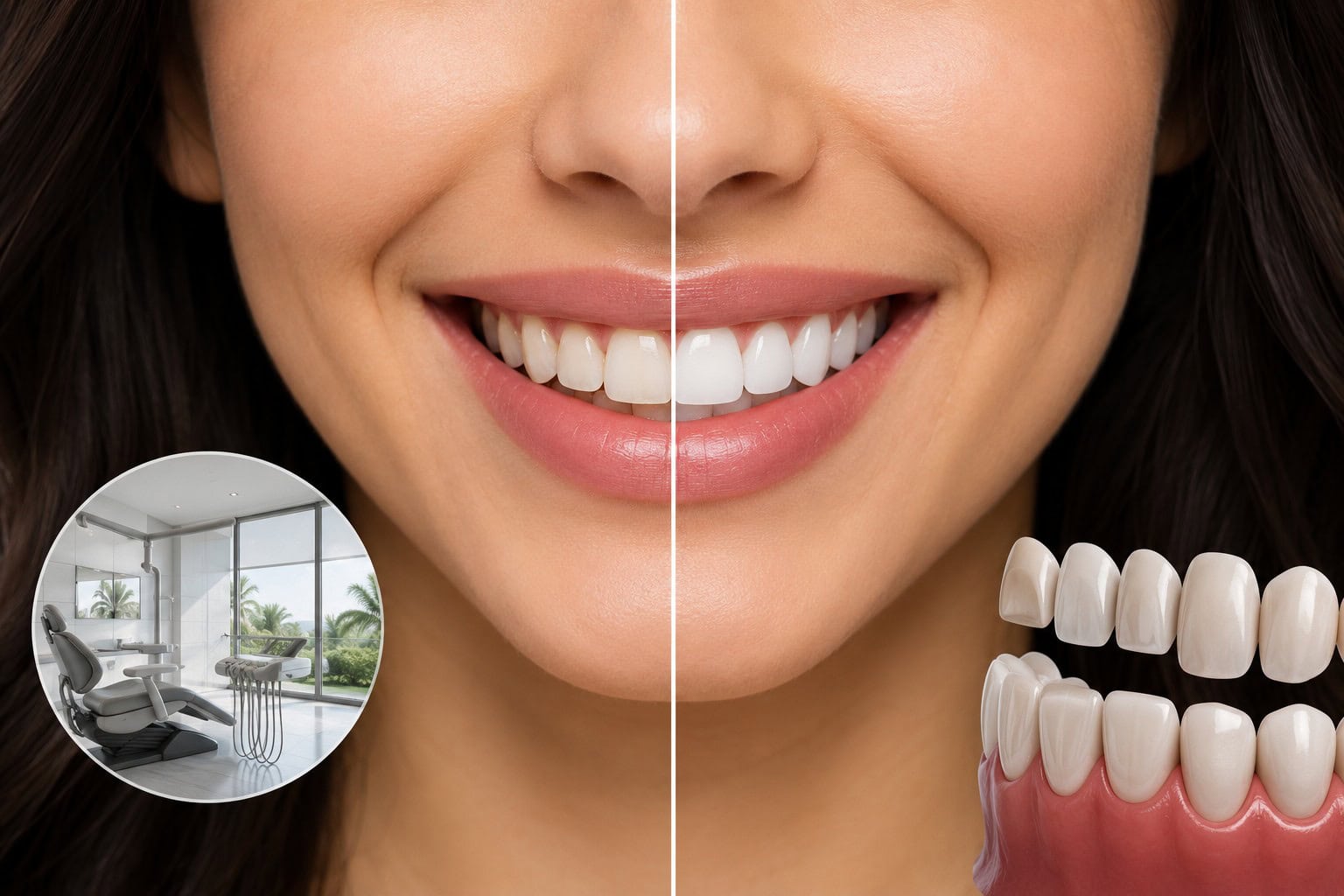
Laminate veneers are thin ceramic shells, averaging 0,3-0,5 mm thick (roughly the thickness of a human fingernail), bonded to the front surface of the tooth as a minimally invasive aesthetic solution in which only a small amount of tooth tissue is removed, or none at all. With regular check-ups and a night guard, they can last fifteen to twenty years.
- 01They average 0,3-0,5 mm in thickness and, unlike a conventional crown, require only a very small amount of tooth tissue to be removed, or none at all.
- 02No-prep veneers are possible in certain cases, but because a ceramic layer is added the teeth may project very slightly forward; the outcome is shown in advance via digital simulation.
- 03They are ideal for discolouration, chipped or worn incisal edges, mild crowding or diastema, and shape asymmetry; they are not recommended alone for significant bruxism, where the bruxism protocol must be addressed first.
- 04With regular check-ups and a night guard, fifteen to twenty years of use is achievable, depending on twice-yearly check-ups, good brushing habits, and avoiding biting hard foods with the veneers.
Laminate veneers are the finest example of minimally invasive aesthetics in dentistry. These thin ceramic shells are bonded to the front surface of the tooth; their average thickness is between 0.3 and 0.5 mm. Roughly the thickness of a human fingernail. The essential difference from a conventional crown: only a very small amount of tooth tissue is removed, or none at all.
Are no-prep laminates possible? Yes, in certain cases. Veneers can be bonded without any preparation in patients who have spacing between their teeth, minor discolouration, or small shape corrections they want made. This approach does have limits: because an additional ceramic layer is added to the existing tooth thickness, teeth may project very slightly further forward after veneers. Is this aesthetically acceptable? A digital simulation shows the outcome in advance.
Who is ideal for this treatment? Teeth with discolouration (including those that do not respond to conventional whitening), chipped or worn incisal edges, mild crowding or diastema, shape asymmetry. Who is it not suitable for? Laminate veneers alone are not recommended for patients with significant bruxism. The bruxism protocol must be addressed first.
The production process at Mosdent runs on a fully digital workflow. Intraoral scanning, digital smile design, CAD/CAM manufacture and the technical team's hand-finishing work together. The finished veneers are trialled temporarily in your mouth before permanent bonding. You will not approve without seeing them first.
What is the lifespan? With regular check-ups and a night guard, fifteen to twenty years of use is achievable. How long that extends depends entirely on care: attending twice-yearly check-ups, maintaining good brushing habits, and avoiding biting hard foods with the veneers.
Let’s plan the right treatment together.
Free Assessment→