
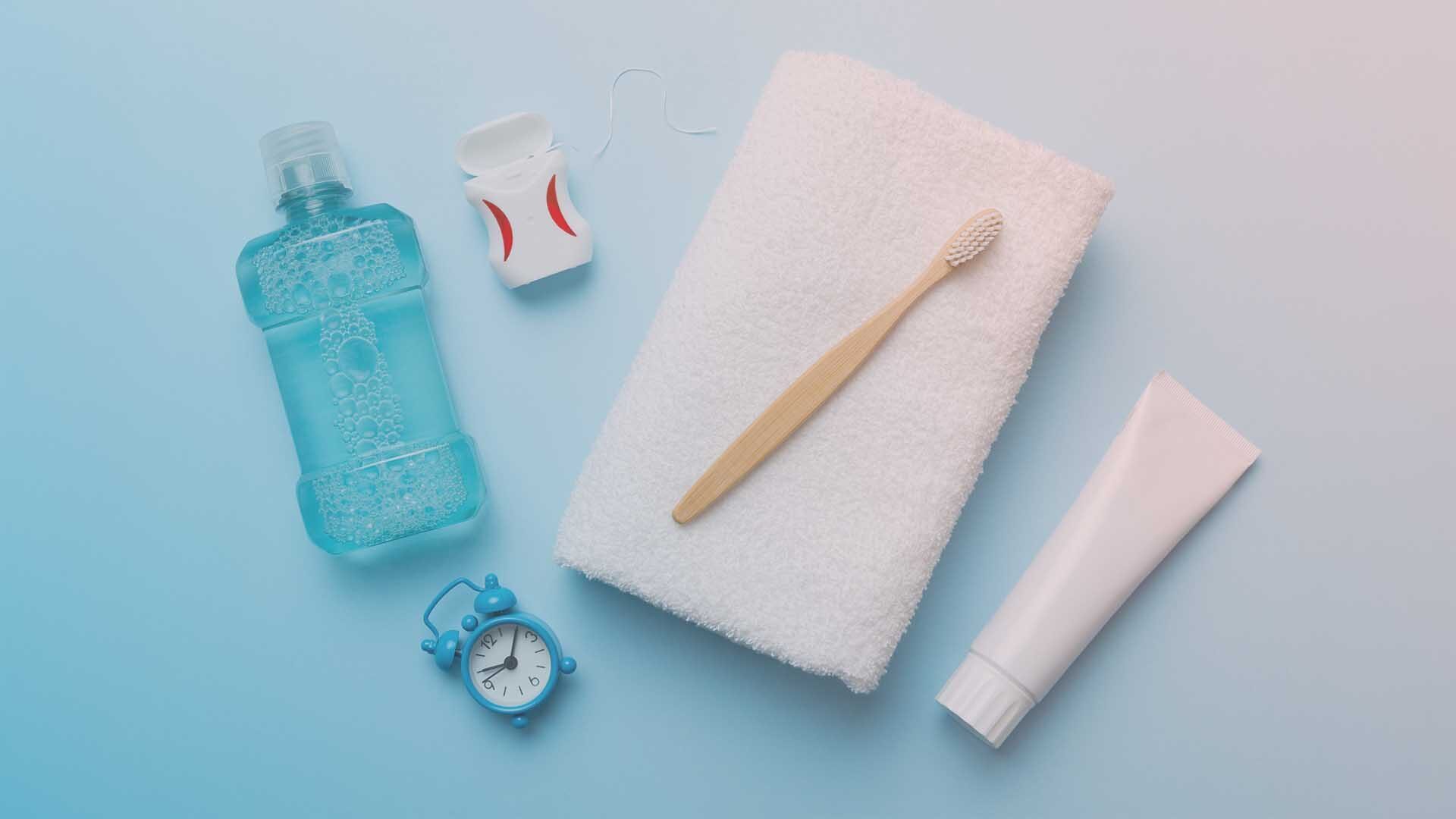
Home dental care is the daily routine that keeps plaque under control between appointments: brushing twice a day for at least two minutes with a fluoride toothpaste, cleaning between the teeth once a day, and limiting sugar. The fluoride part carries the strongest evidence. A Cochrane review of 96 studies found high to moderate certainty that toothpaste at 1,000 to 1,250 ppm and at 1,450 to 1,500 ppm fluoride reduces caries increment compared with non-fluoride toothpaste (PubMed 30829399). Interdental cleaning is supported more weakly: 35 randomised trials in 3,929 adults gave low certainty evidence that flossing added to brushing may reduce gingivitis at one month (PubMed 30968949).
- 01Technique beats effort: a soft-bristled brush with a small head, light pressure, circular motions and roughly 10 to 15 seconds per tooth, for a total of at least 2 minutes, twice a day.
- 02Fluoride concentration is the single best-evidenced choice in the bathroom. Across 96 studies, 1,000 to 1,250 ppm and 1,450 to 1,500 ppm fluoride toothpastes both reduced caries increment against non-fluoride paste, and the higher band was slightly better than the lower (PubMed 30829399).
- 03Flossing helps but the evidence is modest: 35 randomised trials in 3,929 adults produced low certainty evidence that flossing plus brushing may reduce gingivitis at one month (SMD -0.58 across 8 trials, 585 participants), with inconsistent results for bleeding and plaque (PubMed 30968949).
- 04Mouthwash is an addition, not a replacement. Swish for about 30 seconds after brushing, choose an alcohol-free fluoride formula since alcohol-containing rinses can cause dry mouth, and do not swallow it.
- 05Home care does not remove tartar. Replace the toothbrush every 3 months and after illness, and keep professional cleaning and examination at least twice a year, which is where hardened deposits and early lesions are actually dealt with.
Dental health is of great importance for overall health. Regular dental care is essential for a good smile and for a healthy life. By taking proper care of your teeth at home, you can protect yourself from tooth decay, gum disease and bad breath. So, how do you take care of your teeth at home? Here are effective dental care methods that can be applied at home for healthy teeth.
/ Brushing Your Teeth: The Essential Step of Dental Care
The most basic step for home dental care is regular and correct tooth brushing. You should brush your teeth at least twice a day, in the morning after breakfast and at night before going to bed. Brushing is an important step for cleaning your teeth.
- Toothbrush Selection: Remember that the toothbrush should have soft bristles. Hard bristles can damage tooth enamel. The head of the brush should be small so that the back teeth can be easily reached.
- Brushing Techniques: Brush your teeth using circular motions and light pressure. Be sure to gently brush each tooth for 10-15 seconds. Applying too much pressure while brushing can damage the gums.
- Brushing Time: Make sure to brush your teeth for at least 2 minutes. Brushing for a short time may prevent you from cleaning your teeth adequately.
/ Choosing Toothpaste: Use Fluoride Paste
When choosing toothpaste, you should choose those with fluoride. Fluoride strengthens tooth enamel and prevents cavities. In addition, choosing toothpastes with low abrasive properties will help protect your teeth in the long term. Abrasive ingredients can damage tooth enamel and cause sensitivity in your teeth.
- Whitening Toothpastes: You can use whitening toothpastes to preserve the natural whiteness of your teeth and prevent yellowing. However, it is important not to use such products too often to avoid damaging your teeth.
/ Floss: Improve Oral Hygiene
Brushing your teeth alone is not enough to clean your teeth. Flossing cleans the hard-to-reach areas between your teeth and prevents plaque buildup. Flossing is especially effective in keeping gums healthy and preventing cavities.
- How to Use Dental Floss: Gently place the floss between your teeth and move it upwards. Avoid applying too much pressure to avoid damaging your gums. It is important to clean thoroughly between each tooth.
- Benefits of Dental Floss: Dental floss removes bacteria accumulated in the gums , prevents gum inflammation and reduces bad breath.
/ Using Mouthwash: Extra Cleanliness and Protection
Using mouthwash after brushing your teeth is another step to support oral health. Mouthwash helps kill bacteria in the mouth, strengthens gums, and prevents bad breath. A mouthwash with fluoride has the added benefit of protecting tooth enamel.
- Alcohol-Free Mouthwashes: Mouthwashes that contain alcohol can cause dry mouth. Instead, choose mouthwashes that are alcohol-free, contain fluoride, and have antibacterial properties.
- How to Use Mouthwash? Use mouthwash by swishing it around in your mouth for about 30 seconds after brushing your teeth. Be careful not to swallow the mouthwash.
/ Support Your Dental Health with Proper Nutrition
Proper nutrition is very important to maintain dental health. Adequate calcium, vitamins and minerals should be taken for a healthy mouth. Inadequate nutrition can lead to weakening of teeth and the formation of cavities.
- Foods Containing Calcium: Foods rich in calcium such as milk, cheese, and yogurt strengthen your teeth and protect your tooth enamel.
- Foods Containing Calcium: Foods rich in calcium such as milk, cheese, and yogurt strengthen your teeth and protect your tooth enamel.
- Avoid Sugar: Sugary foods create an acidic environment on the teeth, which is one of the biggest causes of tooth decay. Avoid junk foods and sugary drinks.
/ Teeth Whitening: Home Teeth Whitening Methods
There are a few simple whitening methods you can apply at home to preserve the whiteness of your teeth and prevent yellowing.
- Baking Soda and Lemon: Baking soda and lemon juice are natural whiteners. You can whiten your teeth by mixing a teaspoon of baking soda with a few drops of lemon juice. Use this mixture once a week.
- Baking Soda and Lemon: Baking soda and lemon juice are natural whiteners. You can whiten your teeth by mixing a teaspoon of baking soda with a few drops of lemon juice. Use this mixture once a week.
/ Regular Checkups for Dental Health
Home dental care is important to keep your teeth healthy. However, dental check-ups should not be neglected. Visiting the dentist at least twice a year for professional cleaning is the best way to protect your dental health.
- Get Rid of Tartar: Your dentist removes tartar that has built up on your teeth. This helps prevent gum disease and cavities.
- Early Diagnosis: The dentist diagnoses tooth decay and gum problems at an early stage and begins the necessary treatment.
/ Tips for Home Dental Care
In addition to protecting your teeth by taking care of them at home, there are some points you should pay attention to in your daily habits:
- Change Your Toothbrush Regularly: Change your toothbrush every 3 months. Also, replace your toothbrush when you are sick.
- Don't Forget to Drink Water: Water cleans the bacteria in your mouth and protects your teeth. Make sure to drink at least 8 glasses of water a day.
- Limit Smoking and Alcohol: Smoking and alcohol consumption can cause teeth to turn yellow and gums to weaken. Avoid these habits to protect your oral health.
/ Regular Care and Professional Support Are Required for Healthy Teeth
Home dental care is a critical step for a healthy mouth. However, regular dental check-ups are just as important as following basic care methods such as proper nutrition, regular brushing, flossing and mouthwash. By doing regular care to protect your dental health, you can have a beautiful smile and maintain your oral health for many years.
Remember, healthy teeth matter for how you look and for your overall health. Don't neglect the health of your teeth and gums!
Let’s plan the right treatment together.
Free Assessment→- 1.Walsh T, Worthington HV, Glenny AM, Marinho VC, Jeroncic A. Fluoride toothpastes of different concentrations for preventing dental caries. Cochrane Database Syst Rev. 2019;3(3):CD007868. doi:10.1002/14651858.CD007868.pub3
- 2.Worthington HV, MacDonald L, Poklepovic Pericic T, Sambunjak D, Johnson TM, Imai P, Clarkson JE. Home use of interdental cleaning devices, in addition to toothbrushing, for preventing and controlling periodontal diseases and dental caries. Cochrane Database Syst Rev. 2019;4(4):CD012018. doi:10.1002/14651858.CD012018.pub2