Skip to content
MosdentISTANBUL 1992
// Orthodontics

Invisalign: Orthodontics for Adults

Orthodontics past thirty-five. The old reasons for avoiding the word no longer hold. Science and daily practice.

Dr Ahmet Murat Artuç, PhDWritten by
Published
5 minread
Dr Enes Yusuf Gönül, PhDmedical review
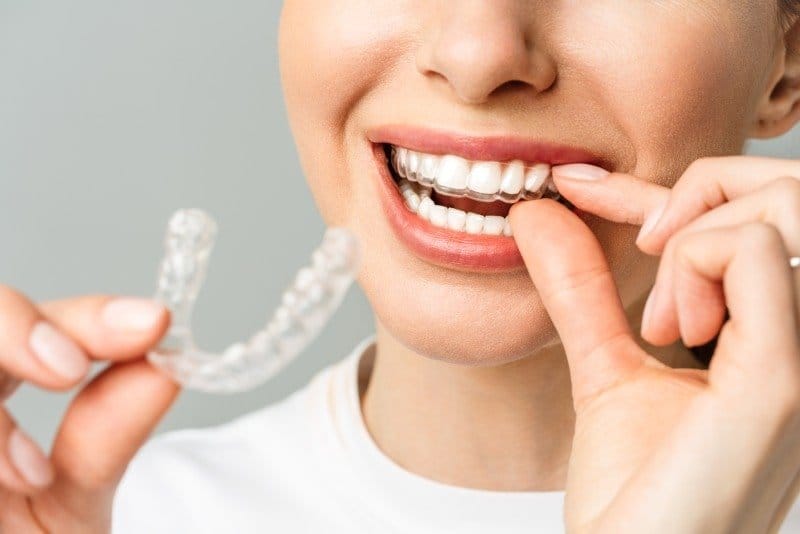
Woman holding a clear aligner beside her smile
Orthodontics·5 min
// Quick answer

Invisalign is a discreet orthodontic option for adults that uses a series of custom-made clear aligners, produced from a digital scan, to gradually align the teeth. Treatment typically takes 6-18 months depending on the case.

// Key takeaways
  • 01Invisalign moves teeth toward their target position using custom clear aligners changed every two weeks, with treatment lasting 6-18 months depending on the case.
  • 02The clear tray is hard to notice in daily life and comes out for eating and brushing; what really governs visibility is the number and position of the attachments bonded to the teeth (in eye-tracking, a smile with anterior attachments held the gaze 0.74 s per visit against 0.61 s for the aligner with minimal attachments).
  • 03It suits mild-to-moderate crowding, bite irregularities, diastema (gaps), and orthodontic relapse cases.
  • 04Planned movement is achieved at a mean accuracy of 50% across all teeth and 46% for rotation (PubMed 32620479); severe malocclusion (Class III), large rotations and cases requiring jaw surgery are planned with classic brackets or an orthognathic approach.

The adult-orthodontics taboo is the largest dental misconception broken over the past two decades. "Won't it show?", "I'm too old", "How will I look in meetings?". Clear-aligner technology answered all of them.
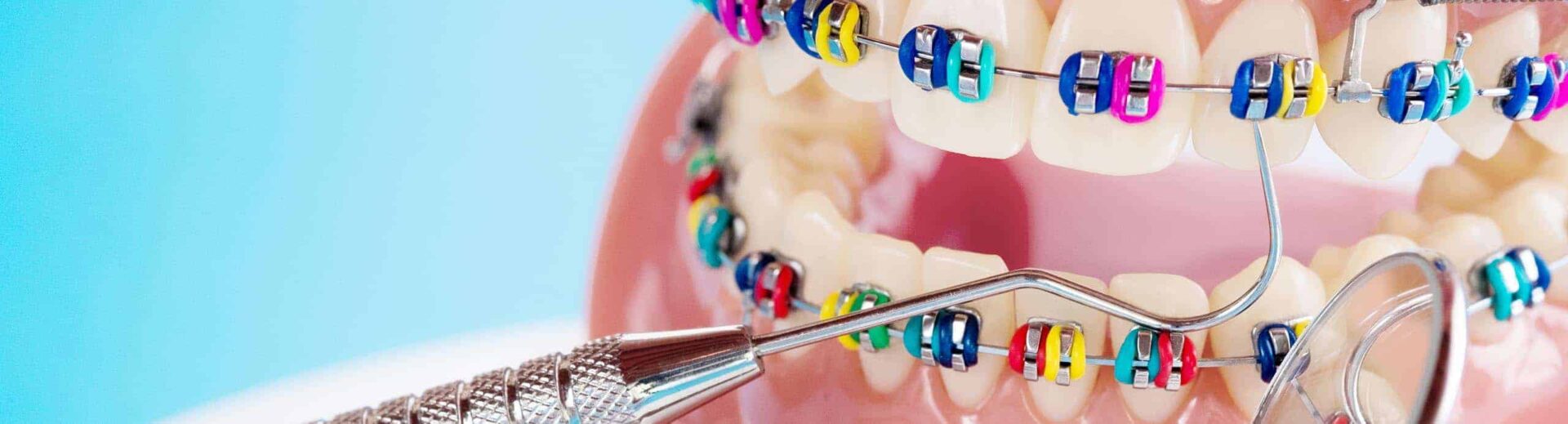
Close-up of brackets with coloured ligatures and an interdental brush under the wire

How Invisalign works: a series of aligners, custom-made from a digital scan of your teeth. Each aligner moves teeth small distances towards a target position. You change to the next aligner every two weeks. Treatment time: 6-18 months, depending on the case.

Is invisibility real? Almost. The aligners are transparent and reflect light like natural teeth. They can be noticed under close inspection but are hard to detect in a business meeting or a photo published on social media. Removed for eating and brushing.

Who is it for? Mild-to-moderate crowding, bite irregularities, diastema (gaps), orthodontic relapse cases. Who is it not for? Severe malocclusion (Class III), large rotations, cases requiring jaw surgery. These require classic brackets or an orthognathic approach.

Over two thousand Invisalign cases have been completed at Mosdent. It is the most-chosen orthodontic option for our adult guests.

Let’s plan the right treatment together.

Free Assessment
OrthodonticsInvisalignAdult Orthodontics
// Written by
Medically reviewed by: Dr Enes Yusuf Gönül, PhD

Let’s plan the right treatment together.

Your personal data is processed as described in our .

Message on WhatsApp
// Frequently Asked

Frequently asked questions

How long does Invisalign treatment take?+

Treatment time depends on the case and is typically between 6 and 18 months.

Are Invisalign aligners really invisible?+

What decides it is not the aligner but the attachments bonded to the teeth. In an eye-tracking study of 250 adults, the image held longest was the smile carrying both anterior and posterior attachments, at 0.74 seconds per visit. Next came posterior attachments only (0.70 s), ceramic brackets (0.65 s) and the aligner with minimal attachments (0.61 s) (PubMed 32620476). So the clear tray on its own goes largely unnoticed, while attachments placed in the anterior region can draw more attention than ceramic brackets do. In the same study 88.4% of participants said they would accept a less discreet appliance during treatment if it produced a better result.

Who is Invisalign not suitable for?+

The question is as much about which movement as about which patient, because aligners do not deliver every movement equally well. In a prospective study measuring every tooth from incisor to second molar in 38 patients, the planned movement was achieved at a mean accuracy of 50%: highest for buccal-lingual crown tip (56%), lowest for rotation (46%). Broken down, mesial rotation of the mandibular first molar reached 28%, distal rotation of the maxillary canine 37% and intrusion of the mandibular incisors 35% (PubMed 32620479). An earlier measurement found extrusion the weakest movement at 29.6%, with canine rotation accuracy dropping markedly beyond 15 degrees (PubMed 19121497). Alignments needing large rotation, extrusion or pronounced intrusion, severe skeletal malocclusion (Class III) and cases requiring jaw surgery are therefore planned with fixed brackets or an orthognathic approach.

Do I have to wear the aligners all day?+

Yes, the threshold is 22 hours a day; the aligner comes out only for eating and brushing. How hard that threshold is to hold has been measured: across a cohort of 2,644 patients only 36% reached 22 hours on most of their aligners, 38.3% managed it partly and 25.7% largely did not (PubMed 34300269). Inadequate wear time is reported as a leading reason outcomes drift from the plan (PubMed 41328132); a few missing hours a day mean a longer treatment and an additional set of aligners.

It begins with a conversation

Discuss the questions with your doctor.

WhatsApp

Not sure which treatment fits? Tell us what’s wrong →