
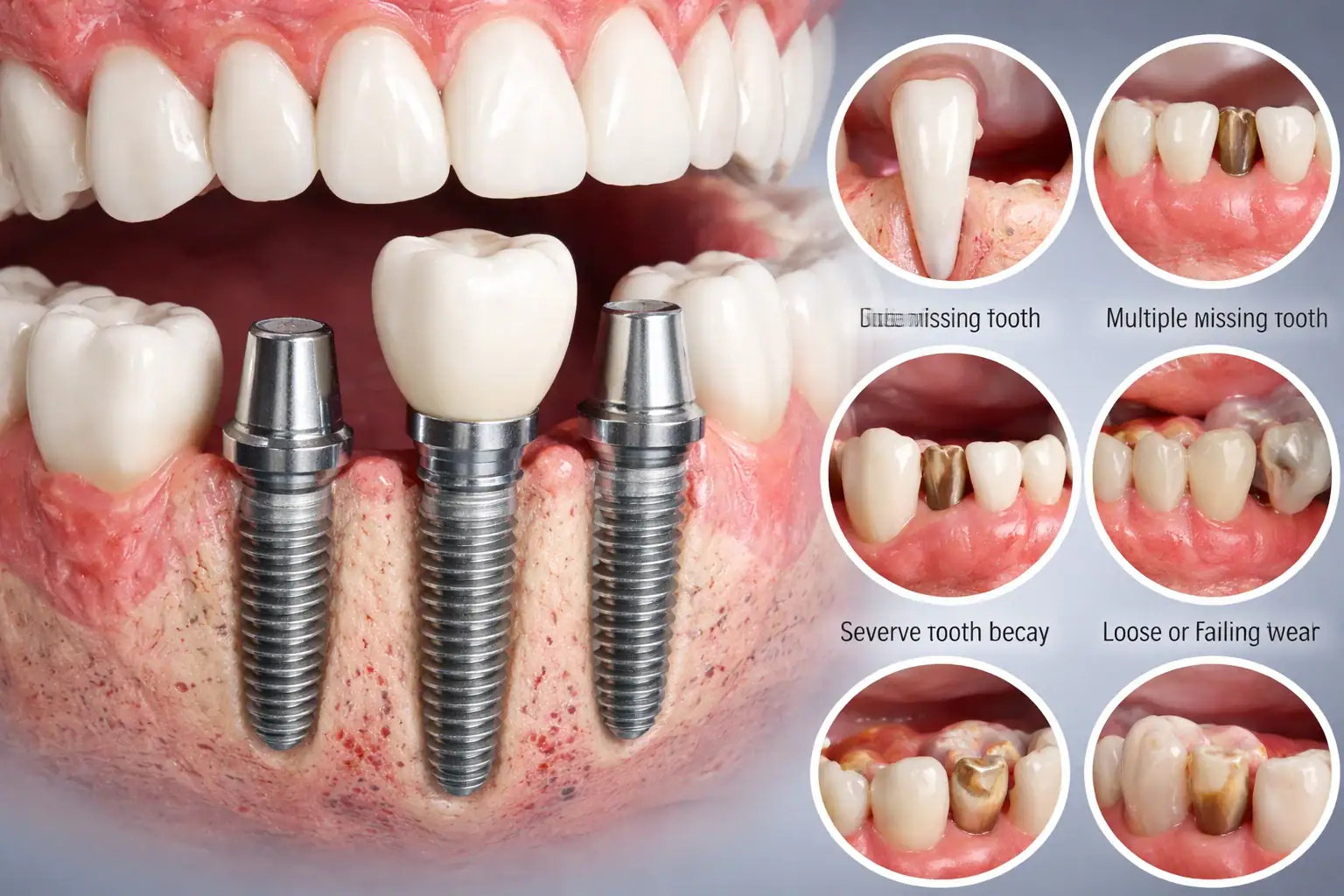
A dental implant is an artificial tooth root, usually medical-grade titanium or zirconia, placed surgically into the jawbone to carry a crown, bridge or full-arch prosthesis; the system has three parts, the fixture in the bone, the abutment connector and the visible restoration. Suitability is decided by bone volume, gum health, general health and skeletal maturity rather than by age. Long-term data are honest about the limits: a 20-year meta-analysis reported survival of 88% across five retrospective studies covering 1,440 implants, and 92% in three prospective studies of 237 implants (PubMed 39305362).
- 01An implant system is three components, not one: the fixture placed in bone, the abutment that connects, and the crown, bridge or prosthesis on top. Maintenance and failure can arise at any of the three.
- 02Twenty-year survival is high but not absolute: 88% (95% CI 78-94%) across five retrospective studies of 1,440 implants, and 92% (95% CI 82-97%) across three prospective studies of 237 implants, falling to 78% (95% CI 74-82%) after imputation on 422 implants (PubMed 39305362).
- 03Bone loss no longer disqualifies a patient by itself: bone grafting, sinus lift, guided bone regeneration, short implants and, in advanced cases, zygomatic implants extend the indication.
- 04Systemic conditions and risk factors change the planning rather than closing the door: well-controlled diabetes, osteoporosis, cardiovascular disease, a history of periodontitis and smoking all require additional assessment, and smoking specifically raises failure risk.
- 05Survival and success are different measures. Success rates run lower than survival because they also account for marginal bone level and soft-tissue health, so an implant still in the mouth is not automatically an implant in good condition.
/ A Comprehensive Guide to Dental Implant Treatment, Candidates, and Long-Term Success
Tooth loss is more than a cosmetic concern. Missing teeth can affect chewing efficiency, speech clarity, facial structure, and self confidence. Over time, untreated tooth loss may also lead to jawbone resorption and shifting of neighboring teeth. Among all modern tooth replacement options, dental implants are widely considered the most advanced, durable, and natural looking solution.
However, many patients wonder:
/ Who is suitable for dental implants?
/ Are dental implants safe for everyone?
/ What conditions must be met before implant treatment ?
This comprehensive guide explains dental implants, the conditions that make implant treatment possible, who is an ideal candidate, and how modern dentistry allows even complex cases to be treated successfully.
/ What Are Dental Implants?
Dental implants are artificial tooth roots, usually made from medical grade titanium or zirconia, that are surgically placed into the jawbone to support a crown, bridge, or full-arch prosthesis.
A dental implant system consists of three main parts:
- Implant fixture: the root-like component placed in the bone
- Abutment: the connector between implant and crown
- Crown or prosthesis: the visible tooth replacement
Dental implants are designed to mimic the function and appearance of natural teeth.
/ Why Dental Implants Are the Gold Standard for Tooth Replacement
Compared to traditional solutions such as removable dentures or fixed bridges, dental implants offer several unique advantages:
- Preserve jawbone density
- Prevent bone loss
- Do not rely on adjacent teeth for support
- Provide superior stability
- Restore natural chewing strength
- Offer long-term durability (often decades)
Because of these benefits, dental implants are widely regarded as the most reliable tooth replacement option available today.
/ Who Is a Good Candidate for Dental Implants?
One of the most common misconceptions is that only “perfect” patients qualify for implant treatment. In reality, modern dental implant treatment is suitable for a wide range of patients.
Ideal Conditions for Dental Implant Candidates
You may be suitable for dental implants if you:
- Have one or more missing teeth
- Have sufficient jawbone volume or are eligible for bone augmentation
- Have healthy gums or treatable gum disease
- Are in generally good health
- Are not actively growing (typically over 18 years old)
Each case requires detailed evaluation, including clinical examination and 3D imaging (CBCT).
/ Dental Implants and Bone Loss: Is Treatment Still Possible?
Bone loss was once a major limitation for implant treatment. Today, advanced techniques allow implant placement even in cases of severe bone deficiency.
Solutions for Bone Loss Include:
- Bone grafting
- Sinus lift procedures
- Guided bone regeneration (GBR)
- Short implants
- Zygomatic implants (in advanced cases)
Thanks to these techniques, bone loss no longer automatically disqualifies patients from dental implants.
/ Dental Implants for Different Clinical Situations
1. Single Tooth Replacement
Dental implants are ideal for replacing a single missing tooth without affecting neighboring teeth.
2. Multiple Missing Teeth
Implant supported bridges can replace several missing teeth using fewer implants.
3. Full Mouth Tooth Loss
Full-arch implant solutions such as All-on-4 or All-on-6 restore an entire smile with fixed teeth.
4. Denture Wearers
Implant-supported dentures provide superior stability compared to removable dentures.
/ Medical Conditions and Dental Implant Suitability
Certain medical conditions require special consideration but do not necessarily prevent implant treatment.
Conditions That May Require Additional Planning:
- Diabetes (well-controlled cases are usually suitable)
- Osteoporosis
- Cardiovascular conditions
- Smoking habits
- History of periodontal disease
With proper medical evaluation and treatment planning, many patients with systemic conditions can safely receive dental implants.
/ Are Dental Implants Safe?
Yes. Published long-term data report implant survival of around 96.4% at 10 years and 94.0% at 15 years, with 20-year figures ranging from 78% to 92% depending on the cohort (J Dent 2019; PMC8359846; PubMed 39305362). Survival and success are different measures: success rates are lower, because they also account for marginal bone level and soft-tissue health.
Key factors influencing implant success include:
- Proper case selection
- High-quality implant materials
- Precise surgical technique
- Good oral hygiene
- Regular follow-up care
/ The Dental Implant Procedure: Step by Step
- Consultation & Diagnostics
Clinical exam, X-rays, CBCT scans, and digital planning.
- Treatment Planning
Personalized implant placement strategy.
- Implant Placement Surgery
Performed under local anesthesia or sedation.
- Healing & Osseointegration
The implant fuses with the bone (3–6 months).
- Final Restoration
Crown, bridge, or prosthesis placement.
/ Dental Implants vs Dentures
| Feature | Dental Implants | Dentures |
|---|---|---|
| Stability | Fixed | Removable |
| Bone Preservation | Yes | No |
| Comfort | High | Moderate |
| Longevity | Long-term | Limited |
| Chewing Efficiency | Near-natural | Reduced |
/ How Long Do Dental Implants Last?
With proper care, dental implants can last 20 years or more, often a lifetime. Factors that affect longevity include:
- Oral hygiene habits
- Smoking
- Regular dental visits
- Quality of restoration
/ Dental Implant Aftercare and Maintenance
- Brush and floss daily
- Use interdental brushes
- Avoid smoking
- Attend regular dental check-ups
- Address gum inflammation early
Proper maintenance is essential for long-term implant success.
/ Frequently Asked Questions (FAQ)
Is dental implant treatment painful?
No. The procedure is performed under anesthesia, and discomfort is usually mild.
How long does dental implant treatment take?
Depending on the case, treatment can range from a few months to a year.
Can smokers get dental implants?
Yes, but smoking increases failure risk. Smoking cessation is strongly recommended.
Are dental implants better than bridges?
In most cases, yes, because implants do not damage adjacent teeth.
Can dental implants fail?
Failures are rare and usually related to infection, smoking, or poor bone quality.
Is age a limitation for dental implants?
No upper age limit exists as long as general health permits.
Can implants replace all teeth?
Yes, full-mouth implant solutions are available.
Are dental implants expensive?
Initial cost may be higher, but long-term value is superior.
/ Dental Implants and Aesthetic Results
Modern implant dentistry focuses not only on function but also on aesthetics. Digital smile design, zirconia crowns, and tissue-level planning ensure:
- Natural gum contours
- Proper tooth proportions
- Harmonious facial appearance
/ Conclusion: Dental Implants Are a Long-Term Solution for the Right Candidates
Dental implants are one of the most predictable and successful treatments in modern dentistry. With advanced diagnostics, digital planning, and surgical techniques, implant treatment is now accessible to a broader range of patients than ever before.
If you are missing teeth or struggling with removable dentures, a personalized implant consultation can determine whether you are a suitable candidate and which treatment option best fits your needs.
A confident smile starts with a strong foundation. And dental implants provide exactly that.
Let’s plan the right treatment together.
Free Assessment→