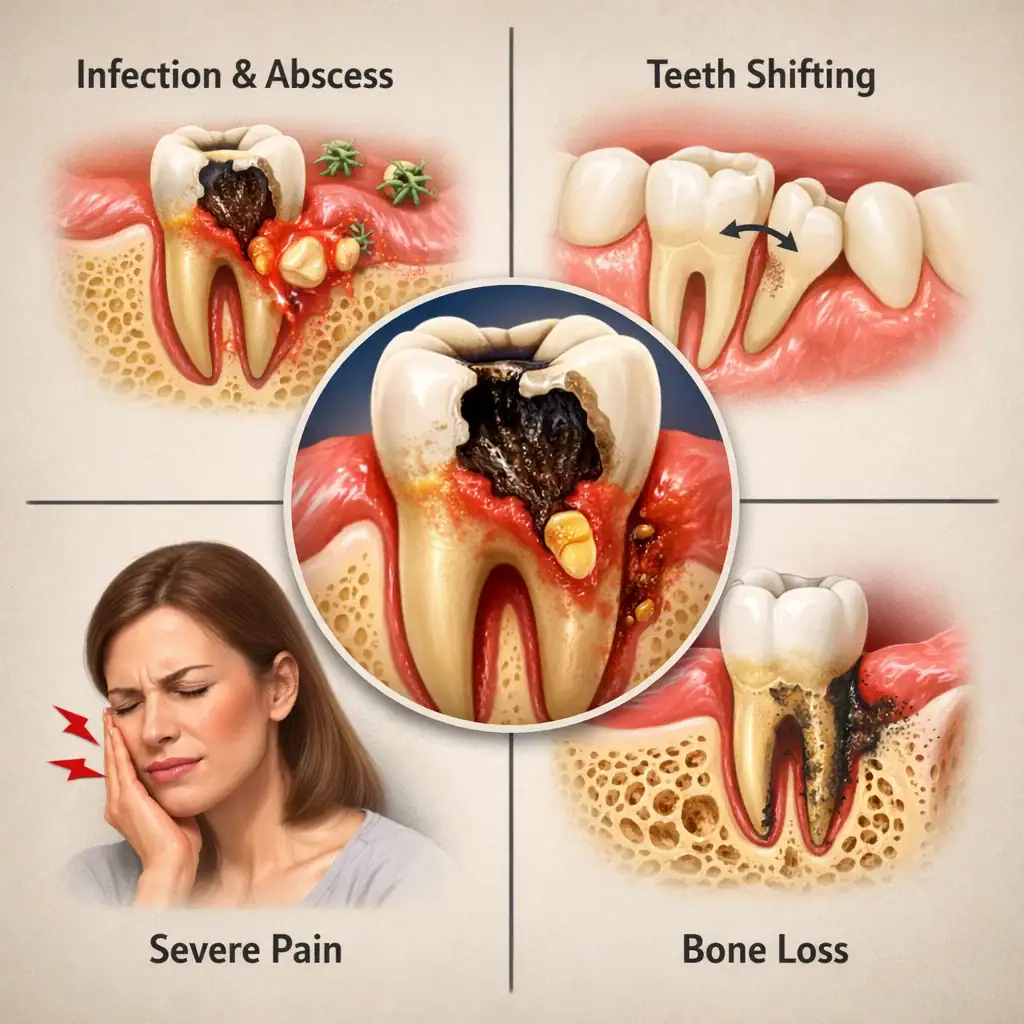
A tooth that needs extraction and is left in place keeps its disease active: infection continues into bone and soft tissue, the supporting alveolar bone keeps resorbing, and neighbouring teeth drift into the compromised space. Odontogenic infection is the leading source of deep neck infection; in a review of 185 cases it accounted for 53.2% of known causes, 16.2% of patients developed major complications during admission and mortality was 1.6% (PubMed 15390207). Pain is not the trigger to act, because a necrotic pulp can stop hurting while the infection continues underneath.
- 01Delay does not pause the disease: odontogenic infection was the most common identified origin of deep neck infection at 53.2% of known causes in a 185-case series, with 16.2% major complications and 1.6% mortality (PubMed 15390207).
- 02The gap between acting early and acting late is measurable: an audit of 462 hospital admissions for deep odontogenic infection averaged AUD 12,228 per patient against AUD 181 for a primary-care extraction (PubMed 31618789).
- 03Bone does not wait for the implant plan: 6 months after extraction, human re-entry studies show horizontal ridge loss of 29% to 63% and vertical loss of 11% to 22%, with a mean horizontal reduction of 3.79 mm (PubMed 22211303).
- 04Absence of pain is not evidence of stability, because a pulp that has become necrotic often stops hurting precisely when the nerve dies while periapical infection continues.
- 05Extraction is recommended in defined situations: unrestorable decay, advanced periodontal bone loss, an abscess not resolved by endodontic treatment, symptomatic impacted wisdom teeth, and space creation for orthodontic treatment.
Most people, when told they need a tooth extracted, feel an instinct to postpone. The idea of an extraction sounds alarming and without pain, it can be easy to convince yourself it isn't urgent.
But here's the thing: a tooth that needs to come out is usually causing damage even when it isn't hurting. Delaying treatment doesn't pause the problem. It allows it to progress, quietly, and often irreversibly.
This article walks through exactly what happens inside your mouth when a necessary extraction is avoided, and why timing matters far more than most patients realise.
/ Why Would a Tooth Need to Be Extracted?
Before understanding the consequences, it helps to understand what brings a dentist to recommend extraction in the first place. The most common reasons include:
Severe decay, when a cavity has destroyed so much of the tooth structure that there is nothing left to restore. At this stage, neither a filling nor a root canal treatment can save the tooth.
Advanced gum disease, gum disease in its later stages destroys the bone and ligaments supporting the tooth. When this support is gone, extraction becomes the only viable option.
Dental abscess, an infection that has reached the root or surrounding bone. If the infection cannot be resolved through endodontic treatment or endodontic surgery, extraction prevents it from spreading further.
Impacted wisdom teeth, wisdom teeth that fail to erupt properly can press against adjacent teeth, cause recurrent infections, or develop cysts that damage the surrounding jawbone.
Orthodontic preparation, in some cases, orthodontic treatment requires the removal of teeth to create space for proper alignment.
In each of these scenarios, the recommendation to extract is not taken lightly. It comes after the treating clinician has determined that saving the tooth is no longer clinically justifiable.
/ What Actually Happens If You Delay?
1. Infection Spreads, and Quickly
A tooth with an active abscess or severe decay is a bacterial reservoir. The longer it remains in the mouth, the greater the risk that the infection spreads beyond the tooth itself, into the jawbone, the surrounding gum tissue, and in serious cases, into the neck and airway.
Dental infections that reach the spaces of the neck can become life-threatening. This is not a rare complication in patients who delay treatment for months. What begins as a sore tooth can, over time, become a genuine medical emergency.
2. The Adjacent Teeth Begin to Suffer
A severely compromised tooth does not deteriorate in isolation. The teeth on either side of it are exposed to higher bacterial loads, altered bite forces, and in abscess cases, direct spread of infection. It is not uncommon for a delayed extraction to eventually require the treatment of adjacent teeth as well, teeth that may have been perfectly healthy at the time of the original recommendation.
3. Bone Loss Accelerates
Infection and untreated periodontal disease both lead to the destruction of the alveolar bone, the bone that holds teeth in place. The longer a non-viable tooth remains, the more bone is lost in that area.
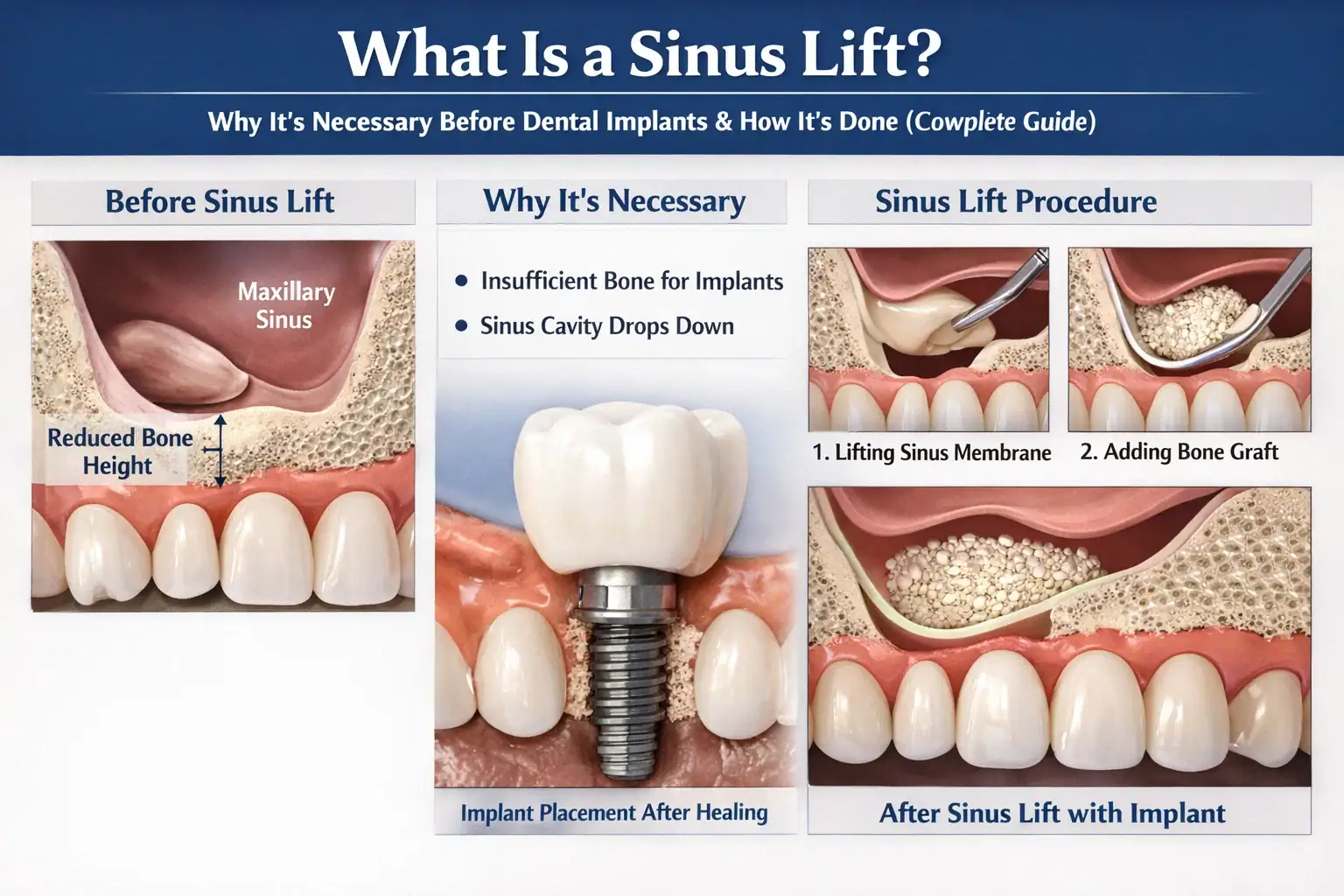
This matters significantly for what comes next. If a dental implant is eventually planned as a replacement, insufficient bone volume may require a bone graft procedure before implant placement can even be considered. What could have been a straightforward implant case becomes a more complex, staged procedure, directly because of the delay.
4. Neighbouring Teeth Shift
Once a tooth is lost or becomes non-functional, the teeth around it begin to drift into the empty space. This happens gradually and is often not noticed until it creates bite problems, crowding, or aesthetic concerns. Addressing this shifting may later require orthodontic treatment or restorative intervention that would not have been necessary had the extraction been carried out in time.
5. Systemic Health Consequences
The relationship between oral health and overall health is well established in the clinical literature. Chronic dental infection and advanced gum disease have been linked to cardiovascular disease, diabetes complications, and adverse pregnancy outcomes. A tooth that requires extraction and is left untreated is a source of ongoing systemic inflammation, one that goes far beyond the mouth.
/ The Special Case of Wisdom Teeth
Impacted wisdom teeth deserve particular attention because they are frequently asymptomatic for long periods, giving patients little incentive to act.
However, impacted wisdom teeth that are not removed can lead to:
- Recurrent pericoronitis (infection of the gum flap over the erupting tooth)
- Damage to the root of the adjacent second molar
- Development of dentigerous cysts, which can silently erode significant amounts of jawbone
- Crowding of the front teeth as pressure is transmitted through the dental arch
The earlier an impacted wisdom tooth is assessed and, if necessary, removed, the less complex the procedure, and the lower the risk of complications. Younger patients also tend to heal more quickly, and the roots are less fully formed, making extraction more straightforward.
/ \"But I'm Not in Pain\"
This is the most common reason patients delay, and one of the most misleading.
Pain is not a reliable indicator of severity in dental disease. Some of the most destructive oral conditions progress silently. A tooth with a necrotic pulp, for example, may stop hurting precisely because the nerve has died, while the infection continues to expand into the bone below. By the time pain returns, significant damage may already have occurred.
Regular dental radiography is the only reliable way to monitor what is happening beneath the gum line and inside the bone, where symptoms often do not reach until disease is advanced.
/ When Extraction Is Recommended, What Comes Next?
Extraction is not the end of the story, it is the beginning of a restoration plan. At Mosdent Dental Hospital, we approach every extraction case with the replacement already in mind.
The most appropriate replacement options following extraction include:
Dental implants, the gold standard for replacing a single missing tooth. An implant replicates both the root and the crown, preserves bone volume, and functions identically to a natural tooth. Options include standard implant treatment, All-on-4, and All-on-6 for cases involving multiple missing teeth.
Fixed prosthetics, zirconium crowns or bridge restorations may be indicated depending on the clinical situation.
Orthodontic space management: in some patients, particularly younger ones, the space can be managed orthodontically as part of a broader smile makeover or alignment plan.
The key point: having a clear restorative plan in place before extraction, not as an afterthought, leads to better outcomes for the patient, less bone loss in the interim, and a smoother overall treatment journey.
/ When to Seek an Evaluation
If you have been told a tooth needs to be extracted and have delayed, or if you are experiencing any of the following, a clinical assessment should not be postponed:
- Persistent or recurring pain around a specific tooth
- Swelling of the gum, cheek or jaw
- A bad taste or smell that doesn't resolve with brushing
- Sensitivity that has suddenly stopped (which can indicate pulp necrosis)
- Visible decay, fracture, or a tooth that feels loose
The earlier a problem tooth is assessed and a plan established, the more treatment options remain available, and the less extensive the intervention required.
/ Conclusion
Delaying the extraction of a tooth that genuinely needs to come out is rarely a neutral decision. It allows infection to spread, accelerates bone loss, affects adjacent teeth, and in some cases, creates systemic health risks that extend well beyond the mouth.
The discomfort of extraction, which, with modern techniques and appropriate sedation options, is far more manageable than most patients expect, is almost always less than the cumulative cost of avoiding it.
If you have concerns about a tooth or have been recommended an extraction and would like a second opinion or a full clinical assessment, we invite you to get in touch with our team . We will walk you through the clinical picture honestly, and outline the options available to you.
Let’s plan the right treatment together.
Free Assessment→- 1.Huang TT, Liu TC, Chen PR, Tseng FY, Yeh TH, Chen YS. Deep neck infection: analysis of 185 cases. Head Neck 2004;26:854-60. PubMed 15390207
- 2.Han J, Liau I, Bayetto K, May B, Goss A, Sambrook P, et al. The financial burden of acute odontogenic infections: the South Australian experience. Aust Dent J 2020;65:39-45. PubMed 31618789
- 3.Tan WL, Wong TL, Wong MC, Lang NP. A systematic review of post-extractional alveolar hard and soft tissue dimensional changes in humans. Clin Oral Implants Res 2012;23 Suppl 5:1-21. PubMed 22211303