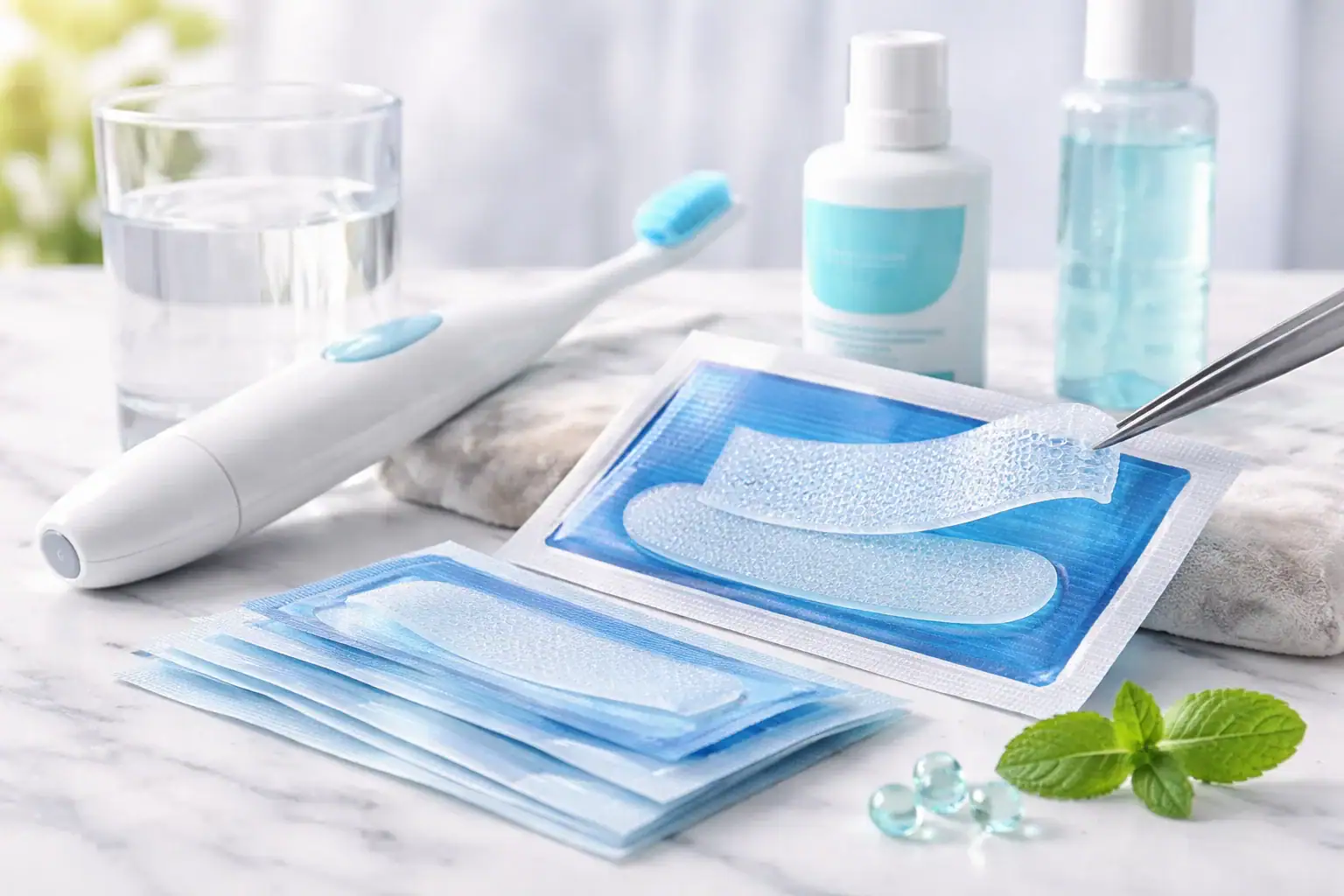
Teeth whitening strips are flexible plastic strips coated with a hydrogen peroxide or carbamide peroxide gel that is held against the enamel for a set contact time, usually 20 to 30 minutes a day over 7 to 14 days, so peroxide can oxidise the stain molecules inside the tooth. They work best on extrinsic stains from coffee, tea, wine and tobacco, give partial improvement on mild intrinsic discolouration and leave crowns, veneers and fillings unchanged. In a double-blind randomised trial with 75 volunteers, strip products were significantly more effective than paint-on products but significantly less effective than dentist-supervised home bleaching (PubMed 29513635).
- 01Strips act by peroxide oxidation on natural enamel only, so crowns, veneers and composite fillings keep their original shade and can end up visibly mismatched.
- 02In a double-blind randomised trial with 75 volunteers, 2.9 percent hydrogen peroxide strips outperformed paint-on products and placebo but stayed below dentist-supervised home bleaching, with gingival irritation and sensitivity described as mild and reversible (PubMed 29513635).
- 03Strips also work as maintenance: in a randomised trial with 60 participants, 6 percent hydrogen peroxide strips used after in-office bleaching preserved the lightness gain at four weeks, which the in-office only group lost (PubMed 39862914).
- 04Contact time is a safety variable, not just the strength: 20 to 30 minutes per application over 7 to 14 days is the labelled range, and exceeding it raises sensitivity and gum irritation rather than results.
- 05Untreated decay, active gum disease, pregnancy and age under 16 are reasons to stop and get assessed before starting rather than contraindications to discover afterwards.
A bright white smile is often associated with confidence, health, and attractiveness. As cosmetic dentistry continues to grow, many people look for convenient and affordable ways to whiten their teeth without visiting a dental clinic. One of the most popular at-home solutions today is teeth whitening strips.
But do teeth whitening strips really work? Are they safe for enamel? How long do the results last? And how do they compare to professional whitening treatments ?
In this in-depth, evidence-based guide, we cover everything you need to know about teeth whitening strips, including how they work, who should use them, their advantages and limitations, safety concerns, and what results you can realistically expect.
/ What Are Teeth Whitening Strips?
Teeth whitening strips are thin, flexible plastic strips coated with a peroxide-based whitening gel. They are designed to adhere to the surface of the teeth and gradually remove stains over a specific treatment period.
Most whitening strips contain:
- Hydrogen peroxide or carbamide peroxide
- Adhesive backing to keep the strip in place
- A flexible shape that molds to teeth
They are considered a form of at-home teeth whitening and are widely available without a prescription.
/ How Do Teeth Whitening Strips Work?
Teeth whitening strips work through a chemical process known as oxidation. When peroxide comes into contact with tooth enamel, it breaks down stain molecules caused by:
- Coffee and tea
- Red wine
- Smoking
- Aging
- Certain foods and beverages
The peroxide penetrates the enamel and lightens discoloration from within.
/ Types of Stains Whitening Strips Can Treat
1. Extrinsic Stains
Surface stains caused by food, drinks, and tobacco.
Whitening strips are highly effective for these.
2. Mild Intrinsic Stains
Stains inside the tooth caused by aging or medication.
Whitening strips may offer moderate improvement.
3. Deep Intrinsic or Genetic Discoloration
Whitening strips are usually not effective.
/ Do Teeth Whitening Strips Really Work?
A common question is:
/ “Do teeth whitening strips work?”
The answer is yes, but with limitations.
Clinical studies and consumer reports show that consistent use of teeth whitening strips can improve tooth shade by 2–6 shades, depending on:
- Peroxide concentration
- Duration of use
- Type of stains
- Oral hygiene habits
Results are gradual and usually visible within 7–14 days.
/ How to Use Teeth Whitening Strips Correctly
Using whitening strips incorrectly can reduce results or cause sensitivity.
Step-by-Step Instructions
- Brush and dry your teeth
- Apply the strip to upper and lower teeth
- Press gently for full contact
- Leave on for the recommended time (usually 20–30 minutes)
- Remove strips and rinse mouth
⚠️ Do not exceed the recommended duration.
/ How Long Do Teeth Whitening Strip Results Last?
Results vary by individual. On average:
- Results last 3–6 months
- Longer with good oral hygiene
- Shorter for smokers or heavy coffee drinkers
Maintenance whitening may be needed.
/ Benefits of Teeth Whitening Strips
1. Convenience
Use at home, no dental visit required.
2. Affordability
Much cheaper than in-office whitening.
3. Ease of Use
No trays, lights, or complicated steps.
4. Proven Effectiveness
Clinically supported for surface stains.
/ Limitations of Teeth Whitening Strips
Despite their popularity, whitening strips are not perfect .
Common Limitations
- Uneven whitening
- Limited effect on deep stains
- Tooth sensitivity
- Gum irritation if misused
They are not a substitute for professional whitening in complex cases.
/ Are Teeth Whitening Strips Safe?
When used as directed, teeth whitening strips are generally safe.
However, misuse can cause:
- Enamel dehydration
- Increased sensitivity
- Gum irritation
Dental professionals recommend:
- Avoiding overuse
- Following instructions carefully
- Consulting a dentist if you have dental restorations
/ Teeth Whitening Strips and Tooth Sensitivity
Sensitivity is the most common side effect.
Why It Happens
- Peroxide temporarily opens enamel pores
- Exposes dentin tubules
How to Reduce Sensitivity
- Use strips every other day
- Use desensitizing toothpaste
- Avoid hot/cold foods
Sensitivity usually resolves within a few days.
/ Can Teeth Whitening Strips Damage Enamel?
When used responsibly:
- No permanent enamel damage occurs
Overuse or combining with other whitening products increases risk.
/ Teeth Whitening Strips vs Professional Whitening
| Feature | Whitening Strips | In-Office Whitening |
|---|---|---|
| Cost | Low | High |
| Speed | Gradual | Immediate |
| Strength | Moderate | Strong |
| Dentist Supervision | No | Yes |
/ Who Should Avoid Teeth Whitening Strips?
Whitening strips are not recommended for:
- Pregnant or breastfeeding women
- Children under 16
- People with gum disease
- People with untreated cavities
- Patients with veneers or crowns on front teeth
/ Best Practices for Better Whitening Results
- Avoid staining foods during treatment
- Maintain good oral hygiene
- Do not smoke
- Use a straw for dark beverages
/ Frequently Asked Questions (FAQ)
Are teeth whitening strips effective?
Yes, especially for surface stains.
How often can I use whitening strips?
Most products recommend once a day for 7–14 days.
Can whitening strips whiten crowns or veneers?
No. They only work on natural enamel.
Are teeth whitening strips bad for gums?
Only if they touch gums excessively or are overused.
Can I sleep with whitening strips on?
No. Extended exposure increases irritation risk.
How soon will I see results?
Usually within 3–7 days.
Are whitening strips better than whitening toothpaste?
Yes. Whitening toothpaste mainly removes surface stains.
Can I drink water while wearing whitening strips?
It is best to avoid drinking during treatment.
Is professional whitening better than strips?
For deep or severe stains, yes.
Are teeth whitening strips worth it?
For mild to moderate staining, absolutely.
/ Final Thoughts: Are Teeth Whitening Strips Right for You?
Teeth whitening strips offer a practical, affordable, and effective way to brighten your smile at home. While they may not replace professional whitening treatments, they are an excellent option for maintaining or enhancing tooth color safely when used correctly.
If you are unsure whether whitening strips are suitable for your teeth, consulting a dental professional ensures optimal results without compromising oral health.
A whiter smile starts with informed choices, and responsible whitening habits.
Let’s plan the right treatment together.
Free Assessment→- 1.Kim YM, Ha AN, Kim JW, Kim SJ. Double-blind randomized study to evaluate the safety and efficacy of over-the-counter tooth-whitening agents containing 2.9% hydrogen peroxide. Oper Dent. 2018;43(3):272-281. PMID 29513635
- 2.Gomez-Polo C, Lobato Carreno M, Martin Casado AM, Gonzalez Jimenez E, Portillo Munoz M. Randomised clinical trial to compare the efficacy of dental whitening with 37.5% hydrogen peroxide gel and 6% hydrogen peroxide whitening strips. J Dent. 2025;154:105589. PMID 39862914