
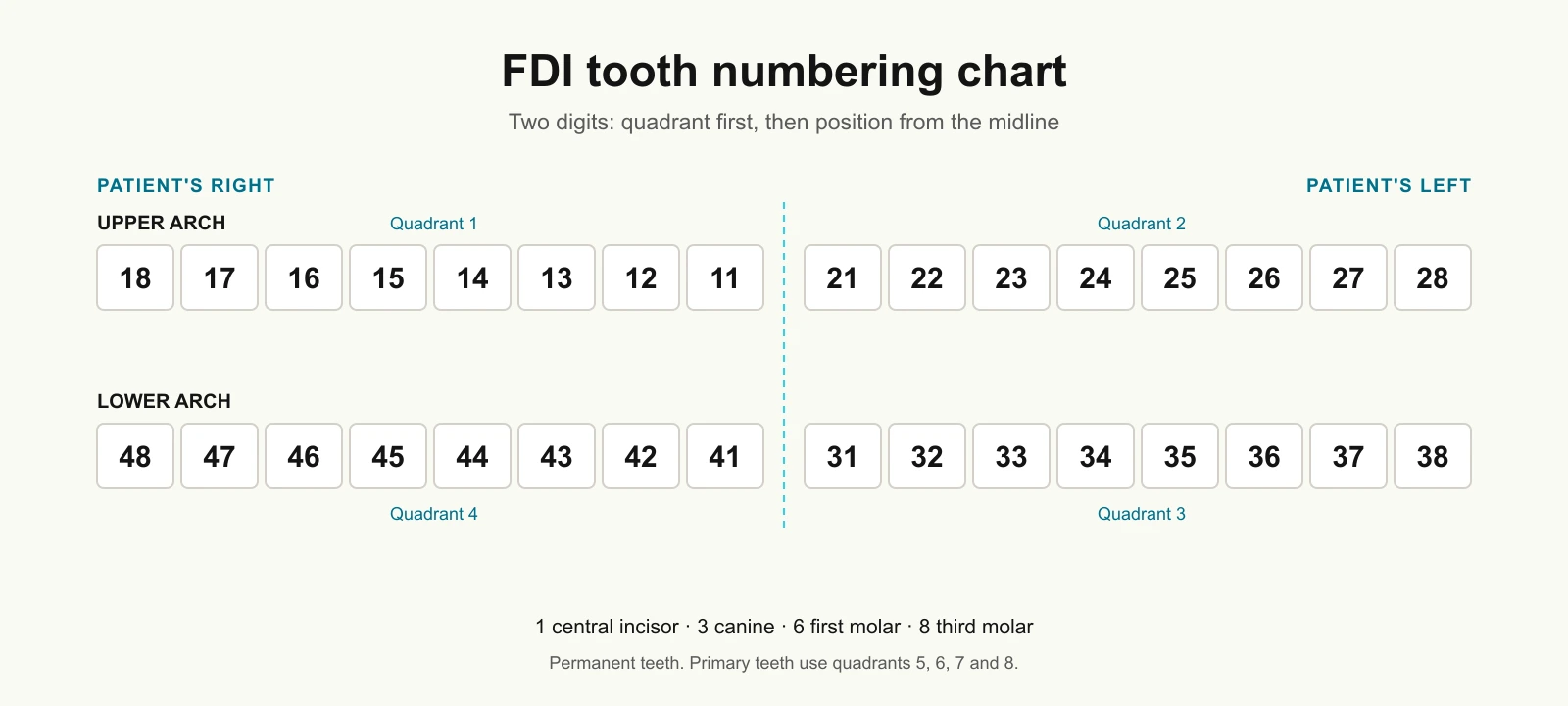
Tooth numbering is a fixed code that lets a dental team name one specific tooth without ambiguity, and three systems are in daily use. The Universal system, used in the United States, runs 1 to 32 from the upper right third molar around to the lower right third molar. The FDI two-digit system, used across Europe and most of the world, gives a quadrant digit, 1 to 4 for permanent and 5 to 8 for primary teeth, plus a position digit 1 to 8, so tooth 16 is the upper right first molar. Palmer notation uses quadrant brackets with the numbers 1 to 8.
- 01The same tooth carries different labels in different systems: the upper right first molar is number 3 in the Universal system and 16 in FDI, which is why the system in use has to be stated before a chart is read.
- 02An adult dentition has 32 permanent teeth, or 28 when the third molars are absent, made up of 8 incisors, 4 canines, 8 premolars and 12 molars; children have 20 primary teeth, lettered A to T in the Universal system and numbered in FDI quadrants 5 to 8.
- 03Wisdom teeth are numbers 1, 16, 17 and 32 in the Universal system and 18, 28, 38 and 48 in FDI, and they usually erupt between ages 17 and 25.
- 04Accurate tooth identification is a patient safety issue: wrong-site tooth extraction is described as the most common serious patient safety incident in dentistry, and a computerised safety checklist reached 67 percent of records by week 10 and raised record-keeping compliance by 50 percent against baseline (PubMed 34658378).
- 05Primary teeth begin erupting at around 6 months and are lost between ages 6 and 12, which is why paediatric charts mix letters and numbers during the mixed dentition period.
Whether you\'re reviewing your dental chart, trying to understand a treatment plan, or simply curious about how dentists refer to specific teeth, understanding teeth numbers is essential. Dental professionals around the world use different teeth numbering systems to identify and record the condition and treatment of each tooth precisely. This comprehensive guide breaks down everything you need to know about dental teeth numbers, including charts, systems, and how to find your wisdom teeth numbers.
1. Introduction to Dental Numbering
Dental numbering is a universal method to identify each tooth in the mouth. With up to 32 permanent teeth (28 if wisdom teeth are missing), it\'s crucial for dentists to communicate clearly using consistent references.
Whether you\'re undergoing a root canal on tooth #14 or a wisdom tooth extraction on tooth #1, accurate teeth numbering ensures precision in diagnosis and treatment .
2. Why Are Teeth Numbered?
Dentists, oral surgeons, and hygienists use dental teeth numbers to:
- Accurately document patient records
- Communicate treatment plans
- Identify teeth during procedures
- Compare x-rays or scans over time
This system minimizes confusion and streamlines patient care.
3. Main Teeth Numbering Systems Explained
There are three primary systems used to number teeth:
#### Universal Numbering System (Used in the U.S.)
- Teeth are numbered 1 to 32.
- Starts from the upper right third molar (#1) to upper left third molar (#16), continues from lower left third molar (#17) to lower right third molar (#32).
- Common in general dentistry in the U.S.
#### FDI World Dental Federation Notation (Two-Digit System)
- Widely used internationally (including Europe, Asia, and many parts of the world).
- Each tooth is identified with two digits:
- First digit: quadrant (1–4 for permanent teeth, 5–8 for primary teeth)
- Second digit: tooth position from the midline (1–8)
- Example: Upper right first molar = 16, lower left central incisor = 31
#### Palmer Notation Method
- Primarily used in orthodontics and oral surgery
- Uses quadrant symbols (┘ └ ┐ ┌) with numbers 1–8 for each quadrant
- Example: Upper left central incisor = ┌1
4. Teeth Numbers Chart: Visual Guide
A teeth numbers chart helps visualize the different systems:
Universal System (Permanent Teeth)
- 1 2 3 4 5 6 7 8 | 9 10 11 12 13 14 15 16
- -------------------------|-------------------------
- 32 31 30 29 28 27 26 25 | 24 23 22 21 20 19 18 17
FDI System (Permanent Teeth)
- 18 17 16 15 14 13 12 11 | 21 22 23 24 25 26 27 28
- ------------------------|-------------------------
- 48 47 46 45 44 43 42 41 | 31 32 33 34 35 36 37 38
These charts are essential tools for understanding and communicating dental information.
5. Primary (Baby) Teeth Numbers
Children have 20 primary teeth. Their numbering differs from adult teeth:
Universal System (Primary Teeth):
- Labeled A–T
- A–J: Upper arch
- K–T: Lower arch
FDI System:
- Quadrants 5–8 used
- Example: Upper right first molar = 54
These teeth typically begin to erupt around 6 months and are lost between ages 6–12.
6. Permanent Teeth Numbers
Adults typically have 32 permanent teeth:
- 8 incisors (front teeth)
- 4 canines (cuspids)
- 8 premolars (bicuspids)
- 12 molars (including 4 wisdom teeth)
They are numbered according to the selected system and are critical for chewing, speaking, and aesthetics.
7. Wisdom Teeth Numbers
Wisdom teeth are the third molars and often erupt between ages 17–25.
In the Universal System:
- Upper right: #1
- Upper left: #16
- Lower left: #17
- Lower right: #32
In the FDI System:
- 18 (UR), 28 (UL), 38 (LL), 48 (LR)
These teeth are often removed due to impaction or lack of space. Understanding their numbering helps with pre-surgical planning.
8. How Dentists Use Teeth Numbering in Practice
Teeth numbering is used in:
- Charting decay or gum issues
- Mapping root canals
- Planning crowns, bridges, or implants
- Monitoring orthodontic movement
- Writing prescriptions and referrals
Every entry in a dental chart includes a tooth number, condition, and treatment notes.
9. Interpreting Your Dental Chart
If you receive a printout of your dental chart, look for:
- Tooth numbers
- Notes like "DO" (distal-occlusal filling), "RCT" ( root canal treatment ), etc.
- X-ray references linked to specific teeth
Ask your dentist which numbering system they use, so you can interpret findings accurately.
10. FAQs About Dental Teeth Numbers
#### How are teeth numbered?
Depends on the system: 1–32 in Universal; two digits like 11–48 in FDI.
#### How are your teeth numbered in the U.S.?
Starting from upper right third molar (#1) moving clockwise to #32.
#### What are wisdom teeth numbers?
- Universal: 1, 16, 17, 32
- FDI: 18, 28, 38, 48
#### What teeth numbers are molars?
- Universal: 1–3, 14–19, 30–32
- FDI: 16–18, 26–28, 36–38, 46–48
#### Is there a universal teeth numbers chart?
Yes, many visual guides exist for both Universal and FDI systems.
11. Conclusion: Why Teeth Numbering Matters
Understanding teeth numbers isn’t just for dental professionals. It empowers patients to be active participants in their oral care. Whether you\'re preparing for a wisdom tooth removal, tracking orthodontic changes, or reviewing a treatment plan, knowing how teeth are numbered helps you understand what’s happening in your mouth.
From the teeth numbering chart to international systems like FDI, this guide equips you with the tools to read your dental chart like a pro.
Next time your dentist mentions tooth #19 or 36, you’ll know exactly what they mean!
Let’s plan the right treatment together.
Free Assessment→