Smile design is a planned cosmetic sequence in which tooth shape, length, colour, midline, gum line and facial proportion are decided together before any tooth is prepared, usually with a digital mock-up the patient approves first. Each treatment inside that plan has its own measured outcomes. In a meta-analysis of 29 clinical studies, ceramic laminate veneer survival at 10.4 years was 96.13 percent for feldspathic, 93.70 percent for leucite-reinforced glass-ceramic and 96.81 percent for lithium disilicate (PubMed 39523553). Whitening, bonding, orthodontics, gum contouring and implants are added only where the analysis calls for them.
- 01Smile design is a planning method whose deliverable is an approved mock-up; the restorations are then selected to reach it.
- 02Ceramic laminate veneer survival at 10.4 years was 96.13 percent for feldspathic, 93.70 percent for leucite-reinforced glass-ceramic and 96.81 percent for lithium disilicate across 29 clinical studies (PubMed 39523553).
- 03Complication load differs sharply by material: technical, aesthetic and biological complications were 41.48, 19.64 and 6.51 percent for feldspathic against 6.1, 1.9 and 0.45 percent for lithium disilicate (PubMed 39523553).
- 04An older meta-analysis of 13 studies put cumulative veneer survival at 89 percent (95 percent CI 84 to 94) over a median nine-year follow-up, with fracture or chipping the most frequent event at 4 percent (PubMed 26757327).
- 05Zirconia laminate veneers showed 100 percent survival with no complications at 2.6 years, but no long-term data for them were available (PubMed 39523553).
What Smile Design Plans Before Any Tooth Is Touched
Smile design is a planning method in aesthetic dentistry in which tooth shape, length, colour, the midline, the gum line and facial proportion are decided together before any tooth is prepared. The deliverable of that planning stage is a design the patient has seen and approved, usually as a digital mock-up. The restorations and treatments that follow are then chosen to reach that design.
The same process goes by several names. It is called a smile makeover, smile design or digital smile design (DSD) when software is used for the planning. What these names share is the order of the work. The plan is built first, the patient reviews it, and only then does irreversible treatment begin.
This order matters because many cosmetic treatments cannot be undone. Once enamel has been reduced for a veneer or a crown, the tooth will need a restoration for life. A plan that has been checked on screen and in the mouth before that step lowers the chance that the final teeth look too long, too wide or out of line with the face.
People seek smile design for a wide range of reasons. Discoloured or stained teeth, crooked or misaligned teeth, worn or chipped edges, an uneven gum line, gaps between teeth, missing teeth and an asymmetric smile are all common starting points. Some patients have a single concern, such as one dark front tooth. Others have several at once, and the value of a plan lies in deciding which treatment addresses which concern, and in what sequence. The rest of the process follows from that analysis, which is why it starts with measurement and photographs.
What the Smile Analysis Measures
The first appointment is a detailed consultation. The dentist reviews dental and medical history, examines the teeth and gums, and assesses the smile line and facial features. High-resolution photographs and intraoral scans are taken, and in some cases a three-dimensional facial scan is added.
The analysis looks at relationships between the teeth and the face. Facial proportions set the frame, and the facial midline is compared with the midline between the upper front teeth. The lip line shows how much tooth and gum are visible at rest and in a full smile. Tooth size and shape are compared with each other and with the face, and the width-to-length ratio of the central incisors carries particular weight because those two teeth dominate the smile. Gum visibility and the height of the gum margins on each side determine whether the gum line needs attention before the teeth are shaped.
Colour enters the plan as well. Skin tone and eye colour influence which shade looks natural, and a very bright shade that suits one face can look artificial on another. Personal preference also shapes the design. Some patients want a bold, uniform smile, while others prefer small irregularities that read as natural.
Face shape, age and sex are often discussed as factors in tooth form, for example softer edges on some faces or slightly more visible upper teeth in a younger smile. These are design conventions and aesthetic guidelines, applied with judgement case by case. The final reference is always the patient's own face and the mock-up they approve.
Digital Mock-Up and Trial Smile
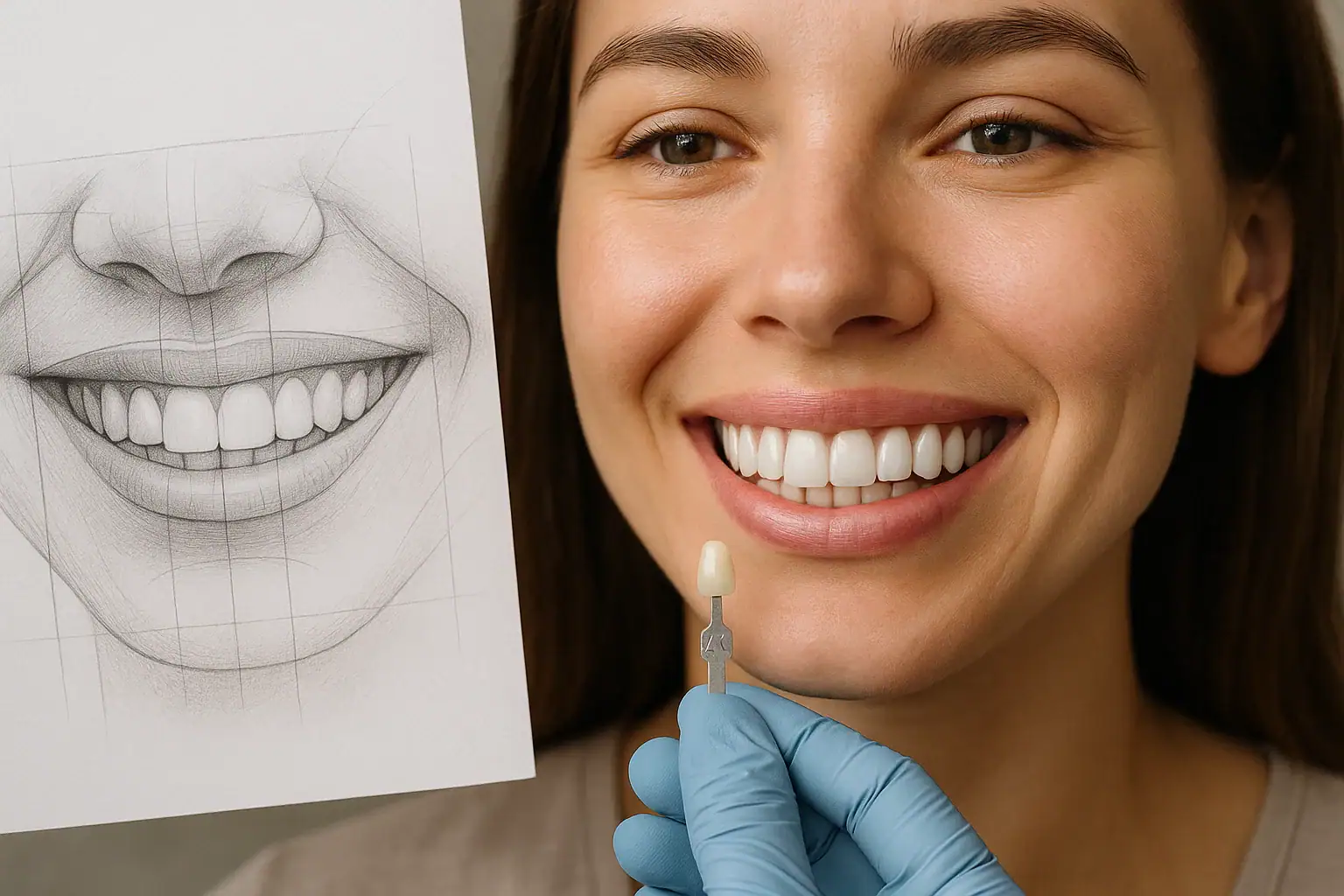
Using the photographs and scans, the dentist builds a digital version of the new smile. The software places the proposed teeth against the patient's face, lip line and midline, so tooth length, width and shape can be judged in context. Changes are made on screen, and nothing irreversible has happened at this point.
The digital mock-up improves communication between patient and dentist. It gives the patient a preview, allows the plan to be adjusted in real time, and makes the treatment steps easier to explain. A systematic review of seven studies on DSD in aesthetic restorative dentistry found that it consistently improved patient satisfaction, treatment acceptance, communication and perceived predictability compared with conventional approaches (PubMed 41473620). The same review notes that the evidence base is limited by differing study designs, varied outcome measures and small samples in some studies (PubMed 41473620).
A screen image has limits, because a smile is a moving thing. For that reason the design is often transferred into the mouth as a trial smile. Temporary material is shaped over the existing teeth to match the approved design, so the patient can see and feel the proportions while speaking and smiling. Tooth length that looked right on screen may feel too long against the lower lip, and a midline correction may need fine adjustment. These changes are easy at the trial stage and difficult once ceramics are made.
Bringing reference photographs of smiles you like helps this stage. They show the dentist what you mean by natural, bright or subtle, and the mock-up can then be tested against your own face.
Preparatory Treatment Comes First
Cosmetic work rests on a healthy mouth. If there are cavities, gum disease or missing teeth, these are addressed before any cosmetic restoration is placed. A veneer or crown bonded to a tooth with untreated decay, or placed next to inflamed gums, starts its life with a problem underneath it.
Gum health has a direct effect on the look of the final result. Inflamed gums are swollen and bleed easily, and their margins sit in a different position from healthy gums. A gum line designed around inflamed tissue will look wrong once the inflammation settles. Periodontal treatment therefore comes first, and the gum line is measured again once the tissue is stable.
Missing teeth are part of the plan from the beginning. A gap may be closed with an implant, a bridge or orthodontic movement, and the choice affects the position and size of every neighbouring tooth in the design. Planning the replacement together with the cosmetic work avoids the situation where a new implant crown does not match the veneers placed beside it.
Orthodontic correction is sometimes the more conservative route. When teeth are crowded or rotated, moving them with aligners or braces can reduce or remove the need to prepare them for veneers. The trade-off is time, since orthodontic movement is measured in months, while a restorative-only plan typically runs 2 to 6 weeks from consultation to the definitive restorations.
Treatments Inside a Smile Design Plan
The treatments used in smile design are familiar ones. What changes is that each is chosen for a specific part of the design, and many plans combine several.
Teeth whitening addresses shade. It removes no tooth structure and is often done first, because veneers and crowns are then matched to the whitened natural teeth. Porcelain veneers are thin ceramic shells bonded to the front of the teeth to change shape, colour and minor alignment. Crowns cover the whole tooth and are used when a tooth is heavily restored, broken or root-treated.
Composite bonding adds tooth-coloured resin directly to the tooth to close small gaps or repair chips. It is additive, often requires little or no preparation, and can be repaired, though composite stains and wears faster than ceramic. Orthodontics, with aligners or braces, corrects genuine misalignment. Gum contouring reshapes an uneven gum line or reduces excess gum display, creating a balanced ratio between gum and tooth. Implants or crowns replace missing or badly damaged teeth.
Once the agreed treatments are complete, the dentist fine-tunes the result. The bite is checked so that the new teeth meet the opposing teeth evenly, tooth length is adjusted in relation to the lips, and shade matching is reviewed in natural light. These final adjustments decide whether the result looks natural in conversation as well as in photographs.
How Long Veneers Last by Material
Veneers are often the centre of a smile design, so their lifespan is a fair question. The answer depends on the ceramic. A meta-analysis of 29 clinical studies of laminate veneers reported pooled survival at 10.4 years of 96.13% for feldspathic porcelain, 93.70% for leucite-reinforced glass-ceramic and 96.81% for lithium disilicate, with no difference in survival between materials (PubMed 39523553).
Complications separated the materials more clearly than survival did. At 10.4 years, technical, aesthetic and biological complication rates were 41.48%, 19.64% and 6.51% for feldspathic veneers and 6.1%, 1.9% and 0.45% for lithium disilicate veneers (PubMed 39523553). A veneer that survives may still need repair or polishing along the way, and these figures show how often that happens with each material. Zirconia veneers showed 100% survival with no complications at 2.6 years, but no long-term data for zirconia were available (PubMed 39523553).
An earlier meta-analysis of 13 studies estimated overall cumulative veneer survival of 89% over a median follow-up of 9 years (PubMed 26757327). Fracture or chipping was the most frequent complication at 4%, followed by debonding, endodontic problems and severe marginal discoloration at 2% each (PubMed 26757327).
These results support veneers as a long-lasting option, and they also show that replacement at some point should be planned for. A veneer placed in early adulthood may well need renewing during the patient's lifetime, and the plan should account for that from the start.
How Much Tooth Structure Is Prepared
Whether smile design harms the natural teeth depends on how much tooth is removed. Whitening and bonding remove none. Veneers remove a thin layer from the front surface of the tooth, and crowns remove considerably more.
For veneers, keeping the preparation within enamel has a measurable effect on how long they last. In a retrospective study of 580 porcelain laminate veneers in 66 patients followed for up to 12 years, 42 veneers (7.2%) failed, and the overall cumulative survival was 86% (PubMed 23342345). Veneers bonded to dentin, or with preparation margins in dentin, were approximately 10 times more likely to fail than veneers bonded to enamel (PubMed 23342345). Survival was 99% for veneers whose preparations stayed within enamel and 94% for veneers with enamel only at the margins (PubMed 23342345).
This is one reason the mock-up and trial smile matter. When the final tooth shape is known before preparation, the dentist can remove only what the design requires, and in some cases prepare very little. A design that adds length or volume often needs less reduction than one that makes teeth smaller.
The same logic applies across the whole plan. Treatments that preserve tooth structure, such as whitening, bonding or orthodontic alignment, are considered before those that remove it, and each irreversible step is justified by the approved design.
Maintenance and Realistic Expectations
A designed smile needs the same care as natural teeth, with a few additions. Brushing twice a day and cleaning between the teeth daily protect both the restorations and the gums around them. Regular dental check-ups allow early detection of chipped edges, worn margins or gum changes. Heavy coffee, tea or red wine can stain composite bonding and the margins of restorations over time, so moderation helps.
Patients who grind or clench their teeth need extra protection. Grinding places large forces on ceramic edges and is a common reason for chipping. A night guard worn during sleep spreads those forces and protects both veneers and natural teeth. Periodic whitening touch-ups can keep natural teeth close to the shade of the restorations, since ceramic does not change colour when natural teeth do.
Some temporary sensitivity after preparation is common and usually settles. Restorations also have a lifespan, as the veneer data show, so a smile design should be seen as a long-term commitment that includes maintenance and, eventually, renewal of some restorations.
Choosing a dentist for this work is worth time. Reviewing the dentist's portfolio of completed cases, asking to see a trial smile before committing, and discussing long-term care before treatment starts all help set realistic expectations. If a wedding or other event is coming up, the schedule should allow for the mock-up, the trial smile and any preparatory treatment.
Let's plan the right treatment together.
Free Assessment→- 1.Klein P, Spitznagel FA, Zembic A, Prott LS, Pieralli S, Bongaerts B, et al. Survival and Complication Rates of Feldspathic, Leucite-Reinforced, Lithium Disilicate and Zirconia Ceramic Laminate Veneers: A Systematic Review and Meta-Analysis. J Esthet Restor Dent 2025;37:601-619. PubMed 39523553
- 2.Morimoto S, Albanesi RB, Sesma N, Agra CM, Braga MM. Main Clinical Outcomes of Feldspathic Porcelain and Glass-Ceramic Laminate Veneers: A Systematic Review and Meta-Analysis of Survival and Complication Rates. Int J Prosthodont 2016;29:38-49. PubMed 26757327
- 3.Alwabel LK, Alabduljabar WM, Alawfi LK, Al Johani NK, Alharbi LE, Kharif MA, et al. Digital Smile Design and Patient-Centered Outcomes in Esthetic Restorative Dentistry: A Systematic Review. Cureus 2025;17:e98084. PubMed 41473620
- 4.Gurel G, Sesma N, Calamita MA, Coachman C, Morimoto S. Influence of enamel preservation on failure rates of porcelain laminate veneers. Int J Periodontics Restorative Dent 2013;33:31-9. PubMed 23342345