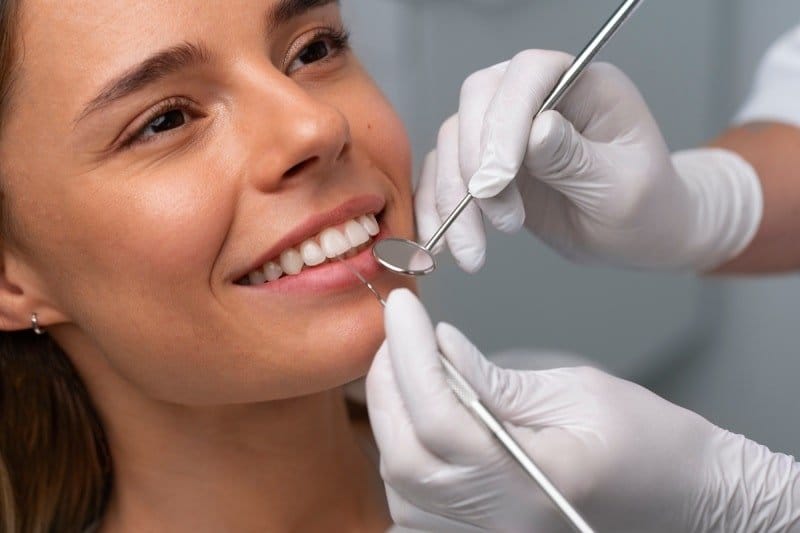

Restorative dentistry is the branch that diagnoses, prevents and treats disease of the teeth and their supporting structures, and rebuilds damaged or missing tooth structure back to normal form and function. What separates it from cosmetic dentistry is intent: restorative work is medically necessary, cosmetic work is usually elective, and modern tooth-coloured materials often deliver both at once. Six treatment groups carry most of the caseload: fillings, inlays and onlays, crowns, root canal treatment, bridges and implant-supported restorations. In the single onlay trial within a systematic review of randomised trials, composite onlays reached 87% five-year survival (95% CI 81-93) (PubMed 27452342).
- 01Restorative and cosmetic dentistry differ in intent rather than always in appearance: restorative work treats decay, fracture and tooth loss and is medically necessary; cosmetic work targets colour, shape and alignment and is usually elective.
- 02Six treatment groups cover most restorative caseloads: fillings, inlays and onlays, crowns, root canal treatment, bridges and implant-supported restorations.
- 03Inlays and onlays occupy the gap between filling and crown: they are used when the damage is too large for a direct filling and the tooth is not damaged enough for full coverage. In the single onlay trial within a systematic review of randomised trials, five-year survival was 87% (95% CI 81-93) (PubMed 27452342).
- 04Full-coverage crowns are well documented at five years: 98.5% survival for monolithic lithium disilicate, 97.1% for metal-ceramic and 96.8% for monolithic densely sintered zirconia across 64 studies (PubMed 41489982).
- 05A restorative plan runs in a fixed order: examination, digital imaging and diagnosis, treatment planning, conservative preparation, placement of the restoration, then bite adjustment and follow-up.
/ A Complete Guide to Restoring Tooth Health, Function, and Aesthetics
Restorative dentistry plays a vital role in modern oral healthcare. While preventive dentistry focuses on avoiding dental problems, restorative dentistry is dedicated to repairing damaged teeth, restoring lost function, and improving both oral health and appearance. For many patients, restorative dental treatments are not just about fixing teeth they are about regaining comfort, confidence, and quality of life.
In this comprehensive guide, you will learn:
- What restorative dentistry is
- Which treatments fall under restorative dentistry
- Who is a suitable candidate for restorative dental care
- The difference between restorative and cosmetic dentistry
- How modern restorative techniques protect natural teeth
- What to expect before, during, and after treatment
What Is Restorative Dentistry?
Restorative dentistry is a branch of dentistry focused on diagnosing, preventing, and treating diseases of the teeth and supporting structures, while restoring damaged or missing tooth structure to its normal form and function.
In simple terms, restorative dentistry aims to:
- Repair teeth affected by decay, trauma, or wear
- Replace missing tooth structure
- Restore proper chewing and bite function
- Prevent further dental damage
- Maintain long-term oral health
Unlike purely cosmetic procedures, restorative dental treatments are medically necessary and often essential for preserving natural teeth.
Why Restorative Dentistry Is Important
Untreated dental problems rarely remain small. A minor cavity can progress into a deep infection, leading to pain, abscess formation, or tooth loss. Restorative dentistry addresses dental issues before they become complex or irreversible.
Key benefits of restorative dentistry include:
- Relief from pain and sensitivity
- Prevention of tooth loss
- Improved chewing efficiency
- Protection of surrounding teeth
- Support for overall oral and systemic health
Modern restorative dentistry combines advanced materials, digital planning, and minimally invasive techniques to achieve predictable, long-lasting results.
/ Common Restorative Dentistry Treatments for Tooth Repair
Restorative dentistry includes a wide range of procedures. The choice of treatment depends on the extent of tooth damage, the patient’s oral health, and functional needs.
Dental Fillings
Dental fillings are the most common restorative dental procedure. They are used to repair teeth damaged by cavities or minor fractures.
Modern restorative dentistry primarily uses composite resin fillings, which:
- Match the natural tooth color
- Bond directly to the tooth structure
- Preserve more healthy tooth tissue
Fillings restore both the function and appearance of the tooth while preventing further decay.
Inlays and Onlays
When a cavity or fracture is too large for a simple filling but does not require a full crown, inlays and onlays are ideal restorative solutions.
- Inlays fit within the grooves of the tooth
- Onlays cover one or more cusps of the tooth
These restorations are often made from ceramic or composite materials and offer excellent durability and aesthetics.
Dental Crowns
A dental crown is a full-coverage restoration placed over a weakened or heavily damaged tooth.
Crowns are commonly used when:
- A tooth has extensive decay
- A tooth has undergone root canal treatment
- A tooth is cracked or severely worn
Crowns restore:
- Tooth strength
- Shape and size
- Chewing ability
- Long-term stability
Materials used in restorative crowns include porcelain , zirconia, and porcelain-fused-to-metal options.
/ Restorative Dentistry Treatments and Cosmetic Dentistry Differences
Root Canal Treatment
Although often associated with endodontics, root canal treatment is a key part of restorative dentistry.
When the dental pulp becomes infected:
- The infected tissue is removed
- The canal is cleaned and sealed
- The tooth is restored with a filling or crown
Root canal treatment allows patients to keep their natural tooth rather than losing it.
Dental Bridges
A dental bridge replaces one or more missing teeth by anchoring an artificial tooth to adjacent natural teeth or dental implants.
Restorative bridges:
- Restore chewing function
- Prevent neighboring teeth from shifting
- Improve bite balance
Bridges are often recommended when implants are not suitable or as part of a comprehensive restorative plan.
Restorative Dental Implants
While implant placement is a surgical procedure, the restorative phase crowns, bridges, or full arch prostheses is a core part of restorative dentistry.
Implant-supported restorations:
- Replace missing teeth permanently
- Prevent bone loss
- Restore natural bite force
Implants are often combined with other restorative treatments in full-mouth rehabilitation cases.
Restorative Dentistry vs Cosmetic Dentistry
Patients often confuse restorative dentistry with cosmetic dentistry. While there is overlap, the primary goals differ.
| Restorative Dentistry | Cosmetic Dentistry |
|---|---|
| Focuses on function and health | Focuses on appearance |
| Treats decay, fractures, tooth loss | Treats color, shape, alignment |
| Medically necessary | Often elective |
| Prevents further damage | Enhances aesthetics |
In many cases, modern restorative dentistry achieves both functional and aesthetic improvements.
/ Restorative Dentistry Patient Suitability
Who Is Restorative Dentistry For?
Restorative dentistry is suitable for a wide range of patients, including those who experience:
Tooth Decay
Patients with cavities or recurrent decay benefit from early restorative treatment to prevent deeper infection.
Cracked or Broken Teeth
Teeth damaged by trauma, grinding ( bruxism ), or biting hard objects often require restorative care.
Worn Teeth
Excessive tooth wear from acid erosion or grinding can compromise bite function and appearance.
Missing Teeth
One or more missing teeth can affect chewing, speech, and jaw stability.
Post-Root Canal Teeth
Teeth that have undergone root canal treatment require restorative protection.
When Restorative Dentistry Becomes Essential
Restorative dentistry is not optional when:
- Pain or infection is present
- Structural integrity of the tooth is compromised
- Chewing function is affected
- Tooth loss threatens adjacent teeth
Delaying restorative treatment can lead to:
- More complex procedures
- Higher costs
- Tooth loss
The Role of Modern Technology in Restorative Dentistry
Advancements in dental technology have transformed restorative dentistry.
Modern tools include:
- Digital impressions
- CAD/CAM restorations
- High-strength ceramic materials
- Adhesive dentistry techniques
These innovations allow for:
- Greater precision
- Faster treatment times
- Improved comfort
- Long-lasting restorations
The Restorative Dentistry Process
Although each case is unique, restorative dental treatment typically follows these steps:
- Comprehensive dental examination
- Digital imaging and diagnostics
- Personalized treatment planning
- Conservative tooth preparation
- Restoration placement
- Bite adjustment and follow-up
Patient comfort and long-term success are prioritized at every stage.
Aftercare and Maintenance
Restorative dentistry outcomes depend on proper aftercare.
Patients are advised to:
- Maintain good oral hygiene
- Attend regular dental check-ups
- Avoid excessive biting forces
- Use night guards if grinding is present
Well-maintained restorations serve for years, depending on material and bite.
Final Thoughts: Why Restorative Dentistry Matters
Restorative dentistry is about more than fixing teeth it is about preserving natural structures, restoring function, and protecting long-term oral health. Whether you need a simple filling or a comprehensive restorative plan, early intervention leads to better outcomes.
If you are experiencing discomfort, damage, or tooth loss, a personalized restorative dentistry evaluation can help determine the most effective treatment options for your needs.
/ Frequently Asked Questions
Is restorative dentistry painful?
Modern techniques and local anesthesia make restorative procedures comfortable for most patients.
How long do restorative treatments last?
With proper care, restorations such as crowns and fillings can last many years.
Is restorative dentistry suitable for older patients?
Yes. Age alone is not a limitation for restorative dental care.
Let’s plan the right treatment together.
Free Assessment→- 1.Angeletaki F, Gkogkos A, Papazoglou E, Kloukos D. Direct versus indirect inlay/onlay composite restorations in posterior teeth. A systematic review and meta-analysis. J Dent 2016;53:12-21. PubMed 27452342
- 2.Pjetursson BE, Pitta J, Balet A, Bjarnadottir GR, Sailer I, Romandini P. A Systematic Review and Meta-analysis Evaluating the Survival, Failure, and Complication Rates of Metal-Ceramic, Veneered, and Monolithic All-Ceramic Tooth-Supported Single Crowns-Part 1. Int J Prosthodont 2026;39:308-324. PubMed 41489982