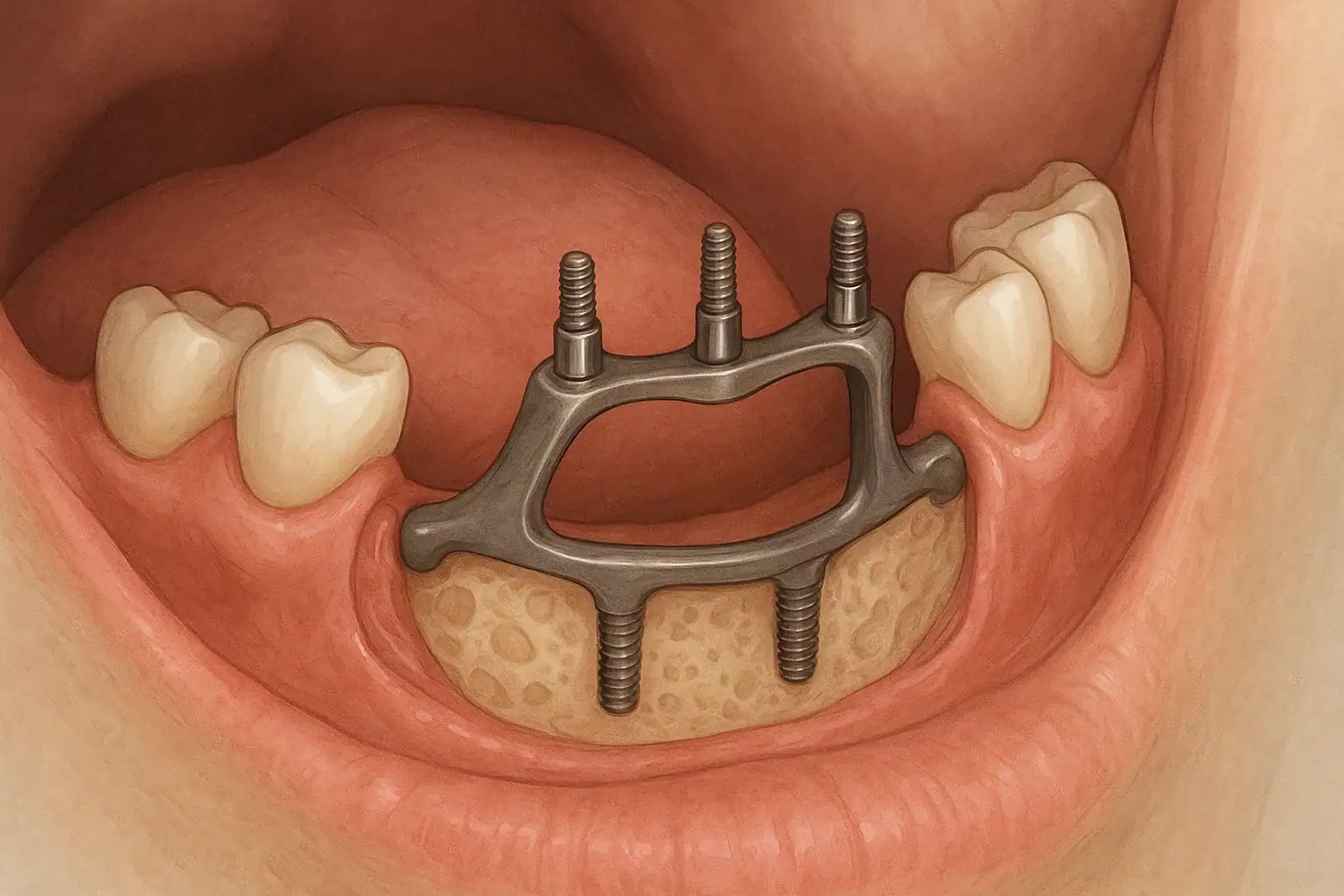
A subperiosteal implant is a patient-specific titanium framework that rests on the jawbone beneath the periosteum, with transmucosal posts carrying a fixed bridge or an overdenture, used when the ridge is too atrophic for conventional in-bone fixtures or when major grafting is unwanted. Modern versions are CAD designed and additively manufactured. In a systematic review of 13 studies covering 227 patients and 227 implants, 97.8 percent were still in function after a weighted mean follow-up of 21.4 months, while 25.6 percent showed partial framework exposure and 5.3 percent had soft tissue or persistent infection (PubMed 38315326). Medium and long-term follow-up is still limited.
- 01A subperiosteal implant rests on the bone under the periosteum, and its stability comes from framework fit and fixation screws; it has no screw-shaped fixture integrating within bone.
- 02Short-term survival is high but follow-up is short: 97.8 percent of 227 implants were in function at a weighted mean of 21.4 months across 13 studies, with 5 failures reported (PubMed 38315326).
- 03A second systematic review of 24 articles and 246 implants reported 97.6 percent functional at a mean of 17 months, survival between 94.1 and 100 percent, and early complications of pain in 25 percent and swelling in 24 percent (PubMed 40263044).
- 04Soft tissue complications dominate the risk profile: partial exposure affected 25.6 percent of implants in one review and 37 percent in the other (PubMed 38315326, PubMed 40263044).
- 05The typical candidate has severe ridge resorption, poor bone quality, a failed or contraindicated graft, or a full-arch case where load must be spread over a wide bone surface; uncontrolled systemic disease, active periodontal disease, heavy smoking and untreated bruxism sit on the other side.
What a Subperiosteal Implant Is
A subperiosteal implant is a custom-made titanium framework that rests on top of the jawbone and underneath the periosteum, the thin, vascular membrane that covers the bone. Posts extend from the framework through the gum and carry a fixed bridge or a removable overdenture. It is used when the jaw is too thin or too short for conventional implants, or when a patient wants to avoid major bone grafting.
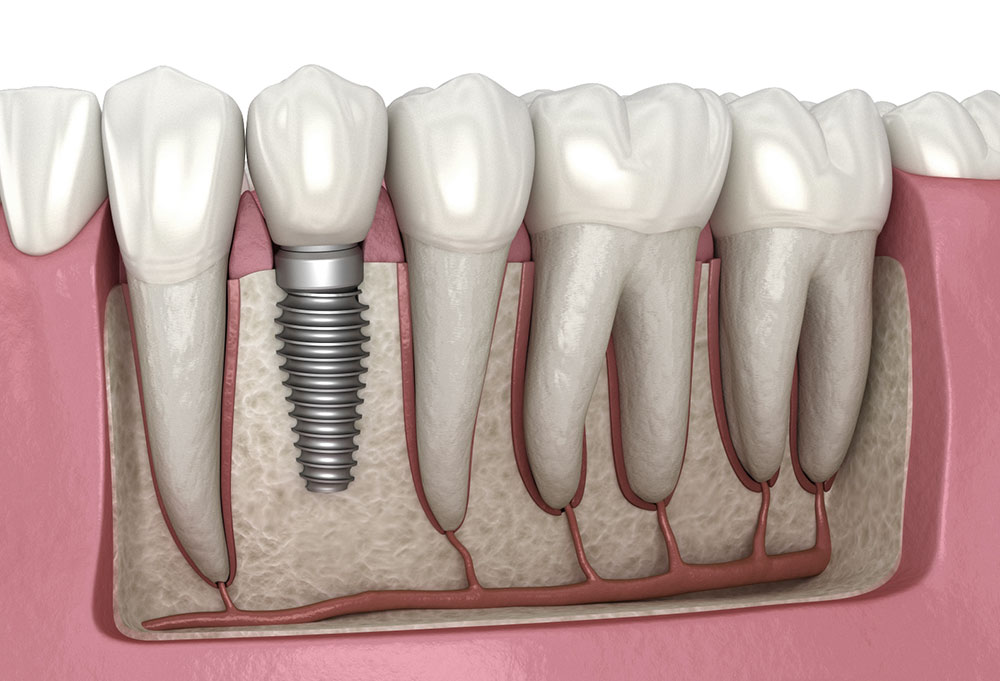
Most dental implants placed today are endosteal, which means screw-shaped fixtures are placed inside the bone and the bone bonds to their surface. A subperiosteal implant works on a different principle. It does not rely on fixtures inside the bone; its stability comes from how closely the framework fits the contour of the bone and, in most modern designs, from small fixation screws that hold it in place.
The idea is decades old, and early frameworks were made from impressions of the exposed bone, which limited their fit. Modern versions are designed on a computer from CBCT data and produced by additive manufacturing, often called 3D printing. A systematic review of these modern implants defined them as CAD designed and additively manufactured, and assessed them separately from frameworks made by traditional methods (PubMed 38315326). This change in manufacturing is the reason the technique has returned to clinical discussion.
The terms subperiosteal implant, subperiosteal dental implant and custom framework implant describe the same device. They all refer to a patient-specific framework that shares chewing forces across a broad area of bone surface. A subperiosteal implant is case-selective. It is considered for particular patients after their bone anatomy, medical history and goals have been assessed, and conventional implants remain the starting point for most people who need teeth replaced.
Who Is a Candidate for a Subperiosteal Implant
The typical candidate has a severely resorbed jaw with too little bone height or width for endosteal implants. After teeth are lost the ridge that held them shrinks over time, and in some patients, especially those who have worn dentures for many years, very little bone remains. In these jaws a conventional implant may have nowhere to anchor without first rebuilding the bone.
Several situations point towards a subperiosteal framework. Poor bone quality can make conventional implants unstable. Some patients cannot have or do not want major bone grafting, such as sinus lifts, onlay grafts or nerve lateralisation, because of medical contraindications or because of the extra surgery and time involved. A history of failed grafting can make a repeat graft undesirable. Full arch rehabilitation with minimal bone is the common scenario, because a custom framework can distribute load across a broad bone surface.
Reviews of the digitally manufactured frameworks describe the same patient group. One review found that these implants were used for full arch dentures in the upper jaw and for bridge prostheses in both jaws (PubMed 40263044). Its authors concluded that digitally manufactured frameworks are a viable option for severely atrophic jaws, especially in elderly or medically compromised patients (PubMed 40263044).
Being a candidate is a matter of degree. Many patients with moderate bone loss can be treated with shorter implants, tilted implants or limited grafting, which have longer published follow-up. The subperiosteal option comes into consideration when bone volume rules out fixtures, or when grafting is refused or medically contraindicated. A CBCT scan and a prosthetic plan are the tools that make this decision.
When a Subperiosteal Implant Is Not Suitable
Some conditions make a subperiosteal framework a poor fit, and they are checked before planning begins. Uncontrolled systemic disease is one of them. Uncontrolled diabetes, for example, slows healing and raises the risk of infection around the posts that pass through the gum.
The condition of the mouth matters as much as general health. Active periodontal disease or poor oral hygiene is a contraindication until it has been treated, because the framework depends on a healthy seal of soft tissue around its posts. The soft tissue is where the complications of these implants concentrate, so a mouth that cannot be kept clean puts the framework at risk from the start.
Habits that load or irritate the tissues count against the treatment. Heavy smoking reduces blood flow and impairs healing of the gum over the framework. Uncontrolled grinding or clenching (bruxism), or an untreated bite imbalance without a plan to manage it, places repeated force on the framework and the prosthesis. Where bruxism is present, it is managed before and after surgery.
Prior high-dose radiation to the head and neck requires careful risk assessment, because irradiated bone heals poorly and is vulnerable to infection. In this group the decision is made together with the patient's medical team.
A patient who is not able to commit to careful daily hygiene and regular professional maintenance is also a weak candidate. The framework sits under the gum for its whole life, and its long-term condition depends on the soft tissue staying healthy. These contraindications are reviewed at the first consultation, and some of them, such as gum disease or an untreated bite problem, can be corrected so that treatment becomes possible later.
How the Framework Is Designed and Made
Modern subperiosteal frameworks are made through a digital workflow that runs from imaging to a printed titanium part. This workflow is what separates today's devices from the analog frameworks of the past.
Diagnostic workup
The process starts with CBCT imaging, a three-dimensional scan that records the contour of the bone and the position of the nerves, the sinus and other structures to avoid. Digital scans or impressions record the soft tissue and the relationship between the jaws. A prosthetic plan then sets the position of the future teeth, the smile line, the vertical dimension and the bite. The framework is designed to serve this plan, so the teeth are planned before the metal.
Virtual design
A 3D model of the jaw is generated from the scan. The surgeon and the laboratory design a titanium framework that follows the bone surface, with posts placed where the prosthetic teeth need support. If fixation screws are used, their positions are planned at this stage to improve primary stability. A systematic review of implants made with virtual surgical planning covered 24 articles and 246 implants, all manufactured through such digital workflows (PubMed 40263044).
Manufacturing
The framework is produced from medical-grade titanium, usually by additive manufacturing, which builds the part layer by layer from the digital design. Some designs are milled. The surfaces that face the bone may be treated to encourage tissue attachment. Methods reported to enhance osseointegration include additively manufactured titanium, acid-etching, grit-blasting and polyether ether ketone, with no clear superiority found among them (PubMed 40263044).
Surgery and Loading the Prosthesis
Subperiosteal implant surgery places the finished framework on the bone in a single operation. For full arch cases it is commonly done under intravenous sedation or general anaesthesia, and the steps follow a set order.
The surgeon first raises a mucoperiosteal flap, which means the gum and periosteum are lifted to expose the bone surface. The custom framework is then test-fitted against the bone. Because it was designed from the patient's own scan, it is meant to seat in a single defined position, and any adjustment is made at this point. Where the plan includes fixation, small titanium screws secure the framework to the bone to prevent micromovement. The posts pass through the gum, and the soft tissue is sutured closely around them to form a seal.
The prosthesis is attached in stages. In selected cases a provisional bridge is fitted immediately or soon after surgery, provided the framework is rigid and the soft tissue is well managed. In other cases loading waits until the soft tissue has matured. A provisional prosthesis often comes first so that the gum can be shaped and the bite refined before the final bridge is made. Across the studies in one review, a provisional prosthesis was used in 155 patients and fractured in 8 of them (PubMed 38315326).
Several prosthetic options can sit on the framework. A screw-retained fixed full arch bridge is the usual aim for function and comfort. An implant-retained overdenture is sometimes chosen for easier hygiene access or for lip support. Segmental frameworks are used in selected partial arch cases. Provisional teeth are often made of PMMA, while final prostheses may be zirconia, a hybrid of titanium and acrylic, or ceramic on metal, depending on the bite, appearance and the patient's plan. Reviews report these implants carrying full arch dentures in the upper jaw and bridges in both jaws (PubMed 40263044).
What the Published Results Show
Published results for modern subperiosteal implants show high short-term survival and a short follow-up. A systematic review of 13 studies included 227 patients and 227 implants (PubMed 38315326). After a weighted mean follow-up of 21.4 months, 97.8% of implants were in function, with 5 failures reported (PubMed 38315326).
A second systematic review covered 24 articles reporting 246 implants (PubMed 40263044). After a mean follow-up of 17 months, 97.6% of implants were functional, and survival across the studies ranged from 94.1% to 100% (PubMed 40263044). Late complications that required removal of the framework were infrequent in this review, which also reported 5 failures (PubMed 40263044).
The limits of this evidence matter as much as the numbers. The first review included 5 cohort studies and 8 case series, found great heterogeneity in study design and could not perform a meta-analysis (PubMed 38315326). The second review drew on 6 cohort studies, 6 case series and 12 case reports, and study heterogeneity again precluded meta-analysis (PubMed 40263044). The first review states that further studies are needed to assess medium and long-term behaviour (PubMed 38315326). The second calls for larger cohorts and longer follow-ups to confirm long-term safety and effectiveness (PubMed 40263044).
One retrospective series reaches further in time. Ten patients with Cawood and Howell Class IV to VI mandibular atrophy received additively manufactured titanium frameworks and were followed for up to 12 years; seven implants (70%) remained functional and stable, three were removed for late complications including bone resorption and granulation tissue formation, and early oedema and pain occurred in all cases and settled with conservative treatment (PubMed 41109674). Ten patients cannot set a survival rate, but the series shows the kind of late problem that follow-ups of 17 to 21 months have not yet had time to record.
In practice, these figures describe the first two years or so after surgery. They do not yet show how the frameworks behave over a decade, which is the timescale on which conventional implants are usually judged. Endosteal fixtures have published follow-up far longer than the 17 to 21 month means currently reported for digitally manufactured frameworks, and this gap shapes how the options are weighed. Success in an individual case depends on the fit of the framework, the thickness of the soft tissue, hygiene, the balance of the bite and the experience of the surgical and prosthetic team.
Risks and Complications
The risk profile of subperiosteal implants is dominated by the soft tissue that covers the framework. The review of 227 implants reported partial exposure of the framework in 58 implants, or 25.6%, and soft tissue or persistent infection in 12 patients, or 5.3% (PubMed 38315326). The review of 246 implants reported partial exposure in 37% of implants (PubMed 40263044).
Exposure happens when the gum over part of the framework breaks down and metal becomes visible. It is more likely when the tissue is thin or hygiene is poor. Early detection allows local soft tissue grafting or changes to the prosthesis, while a larger exposure may need repair or revision of the framework. Infection becomes a risk when plaque control around the posts is poor. Peri-implant mucositis, an inflammation of the soft tissue around the posts, is managed with better hygiene and professional cleaning.
Early complications after surgery are common and usually short-lived. In one review pain was reported in 25% and swelling in 24% as early complications (PubMed 40263044). Fracture of the interim prosthesis was reported in 5.2% of the patients who received a provisional (PubMed 38315326).
Other risks are mechanical. Movement of the framework requires prompt evaluation, since fixation and fit are what hold it still. The prosthesis can fracture or wear over time and is repaired or remade; a balanced bite reduces this risk.
The technique is used less often than endosteal implants and needs a surgical and prosthetic team familiar with digital framework design. Patients should expect close follow-up in the first months, and should understand before surgery that revision is a possibility the plan has to allow for.
Other Options for Severe Bone Loss
A subperiosteal implant is one of three broad routes for a jaw with severe bone loss. The choice depends on where the bone is missing, how much surgery the patient accepts and how much published follow-up each option has.
The first route is endosteal implants with bone grafting. Bone is rebuilt with grafts or a sinus lift, and conventional implants are placed once the graft has healed. This route suits patients who can tolerate augmentation and want in-bone fixtures. It involves more operations and a longer calendar, and it is widely available with a long record of follow-up.
The second route is zygomatic or pterygoid implants. These long implants anchor in the cheekbone or in the dense bone behind the upper jaw, and they are used mainly in severe atrophy of the upper jaw, especially at the back. They avoid sinus grafting in many cases, but the surgery is highly specialised and carries anatomical risks.
The third route is the subperiosteal framework. It suits severe ridge resorption with limited bone in patients who are graft-averse or graft-contraindicated. It avoids large grafts and sinus lifts in many cases, provides custom support for a full arch, can shorten the overall timeline compared with staged grafting and delayed implants in selected cases, and involves less drilling into very thin ridges. Its trade-offs are the soft tissue risk, a shorter record of follow-up than endosteal implants and the need for custom fabrication.
Even so, we assess conventional fixtures first in most atrophic cases, because the published follow-up behind them runs far longer. That assessment is part of our dental implant work, inside the oral surgery service. Fees depend on the arch, the laboratory work, the anaesthesia and the prosthetic materials, so ask for a written plan that sets out surgical, prosthetic, maintenance and possible revision costs.
Recovery and Long-Term Maintenance
Recovery after subperiosteal implant surgery follows the healing of the soft tissue. Swelling, mild discomfort and bruising are expected for a few days. A soft diet is usually recommended for 2 to 6 weeks while the soft tissue matures, and sutures are removed at 7 to 14 days unless resorbable sutures were used. Close review in the first 1 to 3 months checks that the gum around the posts is healing without exposure or infection. Many patients move from a provisional to a definitive bridge after the soft tissue has matured and the bite has been refined.
Daily care at home concentrates on the posts and the underside of the prosthesis. A soft, compact brush cleans around the posts. Interdental brushes or super floss reach under the bridge, and a water flosser on a low to medium setting can flush plaque from areas a brush cannot reach. An alcohol-free antimicrobial rinse may be added if your clinician recommends it. Patients who clench or grind are usually advised to wear a night guard to protect the framework and the prosthesis.
Professional maintenance runs alongside home care. Recall visits are set at short intervals at first and adjusted to how the tissue responds. At these visits the team cleans around the posts and under the prosthesis, checks the bite to prevent overload and micromovement, and takes radiographs or a CBCT scan when needed to confirm stability.
The aim of this maintenance is to protect the soft tissue seal, because that is where the documented risks of subperiosteal implants lie. A framework that stays covered by healthy gum and carries a balanced bite has the conditions it needs to keep working. Any change, such as a sore spot, a visible edge of metal or a loose prosthesis, should be reported early, since small problems at the gum are easier to correct than an established exposure.
Let's plan the right treatment together.
Free Assessment→- 1.Anitua E, Eguia A, Staudigl C, Alkhraisat MH. Clinical performance of additively manufactured subperiosteal implants: a systematic review. Int J Implant Dent 2024;10:4. PubMed 38315326
- 2.Al-Nawas B, Bär AK. Virtual surgical planning and customized subperiosteal implants: a systematic review. Int J Oral Maxillofac Surg 2025;54:979-994. PubMed 40263044
- 3.Łoginoff J, Majos A, Elgalal M. Additively manufactured titanium subperiosteal implants: A long-term retrospective clinical evaluation of 10 patients with severe mandibular atrophy. J Stomatol Oral Maxillofac Surg 2026;127:102621. PubMed 41109674